
 1 / 4
Click image to enlarge
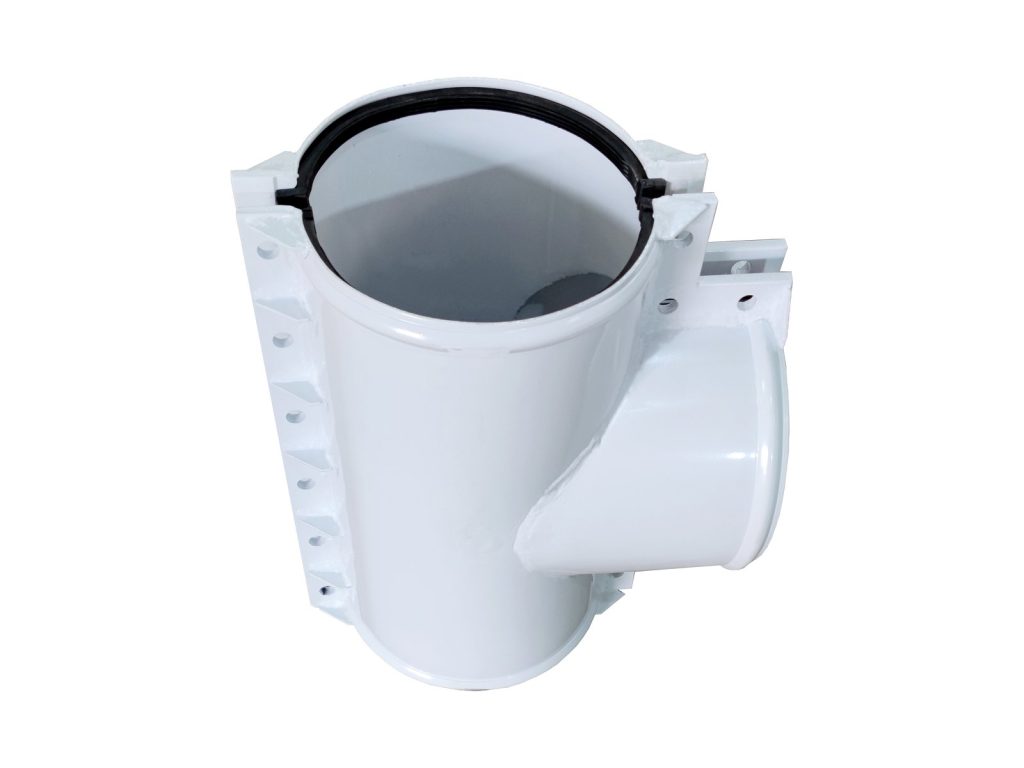
Repair Sleeve for Tee Fittings
A tee repair clamp is a split sleeve formed to follow a tee. A straight sleeve spans a branch rather than wrapping it, so the outlet stays outside the seal; here the four faces of the junction are…
Also known as: Split Repair Tee, Tee Repair Clamp
BS-RCTEUsually replies within 24 hours sales@baoshuopipe.com
Technical Specifications
| Part Number | BS-RCTE |
|---|---|
| Size Range | DN15–DN4000 · Plastic φ20–φ1600 / Ductile Iron DN40–DN2600 / Steel DN40–DN2600 · Custom sizes available beyond the above range |
| Body Material | Q235 Carbon Steel / SS304 / SS316L / Duplex 2205 |
| Seal Material | EPDM |
| Sealing Pressure | ≥1.6MPa (232 PSI) |
| Bolt Specification | M20×100, Grade 8.8 High-Strength Bolts |
| Coating | Epoxy Powder |
| Length Range | 200–800mm (7.9"–31.5") |
| Weight | 0.5–1927 kg (approx) |
| Applicable Pipe Types | Steel, Ductile Iron, Cast Iron |
| Working Conditions | Standard Pressure |
Custom Orders Available
This product can be customized to your specifications. Contact us with your requirements.
Request Custom QuoteCheck the fit before ordering.
- Measure the actual pipe
- Nominal DN alone does not define the outside diameter. Confirm the pipe material, measured OD and condition.
- Confirm the geometry
- Provide dimensions of the connection or damaged area. Product shape, sealing length and end connections must match the job.
- Match the seal to the service
- Confirm medium, temperature and pressure together. A material name alone is not a service approval.
- Plan a safe installation
- Pipe integrity, isolation and installation procedure require a site-specific assessment. Suitability for live service must be confirmed.
Read the full technical guide7 chapters · complete product description
Product Overview
A tee repair clamp is a split sleeve formed to follow a tee. A straight sleeve spans a branch rather than wrapping it, so the outlet stays outside the seal; here the four faces of the junction are pulled down by the bolts at once.
Where it is used
- Equal and reducing tees on steel, iron and plastic mains
- Branch outlets welded, moulded or mechanically fixed into the run
- Leaks at the branch collar or along the junction weld
- Tees that cannot be taken out of service for replacement
Choosing this clamp
What we need first: run and branch outside diameters, and the length over the junction — a tee shell is built to the branch projection, so both diameters matter. Where the junction also needs an open branch, take the branch cross; for a leak on the run itself, the straight sleeve is the simpler part.
Where the load path differs from a straight sleeve
On a straight sleeve the hoop tension has one direction to work in. On a tee the shell has to close on the run and on the branch at the same time, and the two pulls meet at the junction. The branch adds a second centreline, and the gasket has to turn the corner between them without being stretched thin on the outside of that corner.
Two consequences follow. The shell is built to the projection of the branch, so a tee sleeve is specific to both diameters and to the length over the junction — it is not a straight sleeve with a hole in it. And the gasket is laid out as one continuous band around the whole footprint: run, branch, run. A gasket split into separate pieces loses the corner, and the corner is where a tee leaks first.
At the junction the pipe wall is carrying a stress concentration from the collar weld or the moulded branch. The sleeve does not remove that; it gives the leaking face a second, external seal. Where the main has lost significant wall thickness around the branch, that is a different repair problem and a different part.
Installation
- Expose the junction fully, including the branch stub and a short length of both run ends. A tee cannot be fitted to a junction that is only half dug out.
- Clean the run and the branch back to sound pipe. On cast or ductile iron, take off graphitic corrosion until sound metal shows; a gasket cannot seal a friable surface.
- Dry-assemble the two halves around the junction with the gasket in place to confirm the branch projection matches and the gasket reaches the collar on all four faces. If it does not reach, stop — the shell is the wrong shape for the junction, and no amount of bolt load will fix it.
- Seat the gasket into the shell halves, keeping it centred around the branch opening. Check the corner where the band turns from the run onto the branch; this is the first place a gasket twists.
- Bring the halves together and run the bolts in finger-tight, then work from the junction outwards. Tighten in a cross pattern in two or three passes.
- Watch the corner of the branch while tightening. If the gasket is being pushed out at the corner, back the nearest bolts off and re-seat it.
- Test, then backfill with bedding under the branch so the sleeve is not carrying the weight of the branch pipe.
What we need to quote
Four dimensions control the build: the run outside diameter, the branch outside diameter, the distance from the run centreline to the end of the branch that must be covered, and the length of the run the shell has to span. The angle of the branch matters as well — a tee is drawn at 90° by default, and a 45° branch is a different shell.
Alongside those, send the pipe material on run and branch, the medium and its temperature, and whether the branch is welded, moulded or mechanically fixed. Also say whether the branch must stay open or can be temporarily blanked: an open branch changes which split-repair product is correct. Standard sizes are on the table above; junctions outside it are made as drawn.
When not to use a tee sleeve
A tee sleeve seals the outside of a junction. It does not restore a branch that has lost its connection to the run, and it cannot be fitted where the branch is fully restrained — a valve or a spool bolted directly onto the branch leaves no room to open the two halves over it.
Where the problem is a leak at the branch connection but the junction itself is sound and the geometry is a simple take-off, a Threaded Saddle Outlet Tee covers the outlet and leaves the run alone. Where the repair has to add a new branch as well as seal the old one, the part is a Repair Branch Cross, which is a sleeve with an outlet in it. Where two runs cross rather than meet, the shell has four legs and the part is the Split Repair Cross. Where the leak is on the run, a short distance from the junction, the Straight Pipe Repair Clamp is simpler and cheaper.
Materials and standards
The shell is normally Q235 carbon steel to GB/T 700, with SS304, SS316L or Duplex 2205 to ASTM A240 / GB/T 3280 where the soil, the atmosphere or the medium calls for it. A tee sleeve is a fabricated assembly rather than a rolled cylinder, so the material choice is made per face and per weld; stainless is common on branch legs that will stay exposed, with carbon steel on the buried run. Exterior surfaces are epoxy coated to AWWA C210 / GB/T 18593, or zinc plated to ASTM B633 / GB/T 9799.
The gasket is EPDM to BS EN 681-1 / GB/T 21873 for water service. EPDM tolerates being formed around the branch corner better than harder elastomers, which is a real factor on small branches with a tight radius. Where the medium is oily or a fuel, the compound becomes NBR to BS EN 681-2 / GB/T 21873, accepting a stiffer gasket and a slower fit. Bolts are Grade 8.8 to ISO 898-1 / GB/T 3098.1, or SS304 to ASTM A193 / GB/T 3098.6. Tapping sleeves for live mains are covered by AWWA C223; a split repair tee is a repair part rather than a tapping part, but the two are often specified on the same drawing.
Documents
In the field
Photographs from completed installations of this product.
Material standards GB/T 700 · ASTM A240 · GB/T 3280 · BS EN 681-1 · GB/T 21873 · AWWA C210 · GB/T 18593 · ISO 898-1 · GB/T 3098.1
Related Products
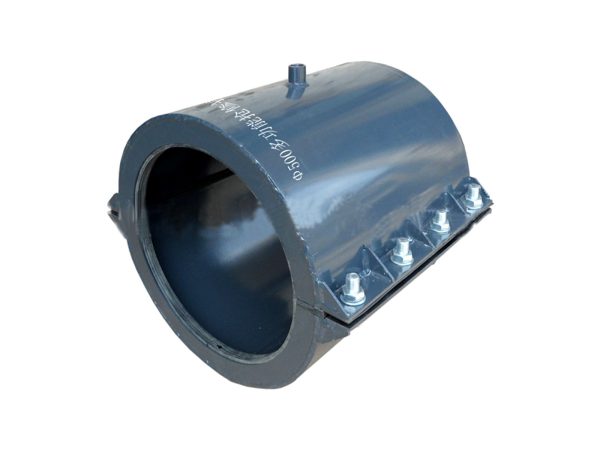
Mechanical Joint Split Repair Sleeve
Select a socket-joint repair sleeve from the actual joint profile, measured pipe and socket diameters, sealing…
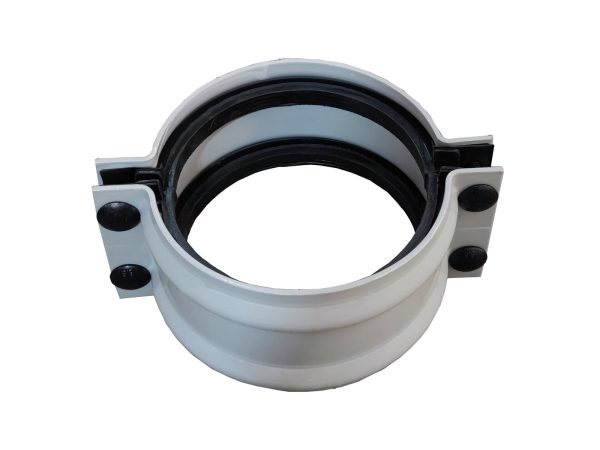
Weld Seam Repair Sleeve
Narrow-profile repair clamp for leaking weld seams on steel pipes. Targets the weld line directly with focused sealing…
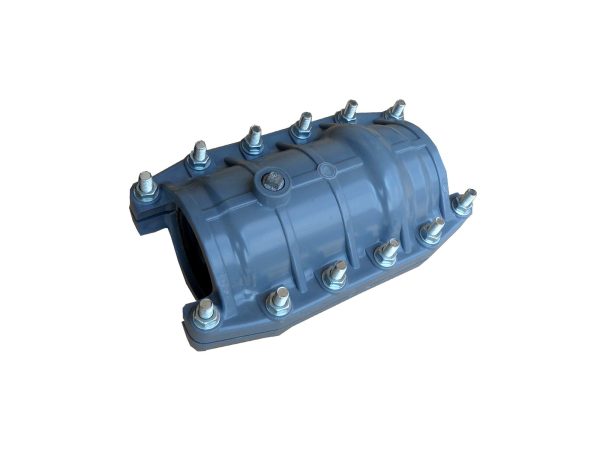
Split Repair Sleeve for PVC-M Pipe
Repair clamp specifically designed for PVC-M pipes. The PVC-M shell and supplied gasket must be checked against actual…