
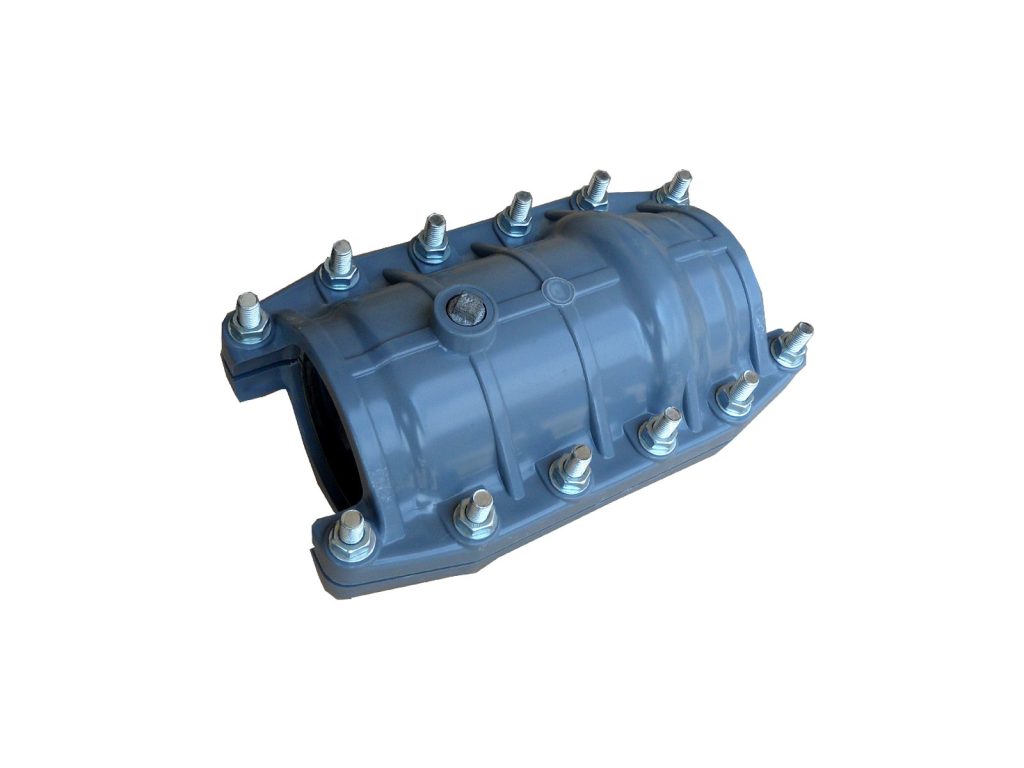
Split Repair Sleeve for PVC-M Pipe
This split repair sleeve is built for a different pipe material. Metal pipe resists a local clamping load; a modified PVC wall does not, and a clamp shaped for steel will deform the pipe it is meant to…
Also known as: PVC-M Pipe Repair Clamp, PVC-M Repair Sleeve
BS-RCSP-PMPLUsually replies within 24 hours sales@baoshuopipe.com
Technical Specifications
| Part Number | BS-RCSP-PMPL |
|---|---|
| Size Range | DN15–DN4000 · Plastic φ20–φ1600 · Custom sizes available beyond the above range |
| Body Material | PVC-M |
| Seal Material | EPDM |
| Sealing Pressure | ≥1.0MPa (145 PSI) |
| Bolt Specification | M12×60, Grade 8.8 High-Strength Bolts |
| Coating | Epoxy Powder |
| Length Range | 120–300mm (4.7"–11.8") |
| Applicable Pipe Types | UPVC, PVC-M, HDPE, PPR |
| Working Conditions | Standard Pressure |
Custom Orders Available
This product can be customized to your specifications. Contact us with your requirements.
Request Custom QuoteCheck the fit before ordering.
- Measure the actual pipe
- Nominal DN alone does not define the outside diameter. Confirm the pipe material, measured OD and condition.
- Confirm the geometry
- Provide dimensions of the connection or damaged area. Product shape, sealing length and end connections must match the job.
- Match the seal to the service
- Confirm medium, temperature and pressure together. A material name alone is not a service approval.
- Plan a safe installation
- Pipe integrity, isolation and installation procedure require a site-specific assessment. Suitability for live service must be confirmed.
Read the full technical guide7 chapters · complete product description
Product Overview
This split repair sleeve is built for a different pipe material. Metal pipe resists a local clamping load; a modified PVC wall does not, and a clamp shaped for steel will deform the pipe it is meant to protect. Confirm the contact load against actual OD and remaining wall thickness; the product does not provide an unconditional guarantee against crushing. Hence a separate part rather than a size option.
Where it is used
- Modified PVC distribution lines
- Pinholes, impact damage and cracks after ground movement
- Plastic pipe in trenches, where a metal-bodied sleeve is too stiff for the wall
- Networks repaired without draining the section
Choosing this clamp
It is not a universal clamp for plastic pipe: each plastic responds to clamping pressure differently, so the same shell should not be assumed to suit all of them. Tell us which plastic your line carries — the geometry is chosen for the material, not adjusted afterwards. See also how to choose the right clamp and repairing leaks by pipe material.
Why clamping load has a ceiling on a plastic wall
Metal pipe reacts a local clamping load with elastic deformation and gives it back. A modified PVC wall does not. Under a sustained load it creeps: the wall indents slowly, the gasket loses compression, and a joint that sealed on the day of the repair begins to weep months later. That is the mechanism this product is built around, and it is the reason the shell and the gasket are not shared with the metal range.
There are two failure directions and they pull against each other. Too little bolt load and the gasket never seals. Too much and the wall is over-stressed at the point of contact, which shortens the pipe’s service life at that location rather than the clamp’s. The useful working window is narrower than on steel, so the shell spreads load over a wider contact patch and the gasket is chosen to seal at lower unit pressure.
Temperature moves the window. A PVC wall is stiffer when cold and softer when warm, and the same bolt setting does not represent the same load in both conditions.
Installation
- Expose the pipe and clean it with a cloth or a solvent wipe. Do not scrape or wire-brush plastic as you would steel: a scraper leaves a notch, and a notch in a plastic wall is a crack starter.
- Measure the outside diameter and check it against the size ordered. Plastic pipe sizes are quoted by outside diameter and wall thickness together, and a different pressure class of the same nominal size has a different outside diameter in some systems.
- Inspect the defect area for crazing or stress whitening around the damage. A sleeve seals a hole; it does not stop a crack from running, and a crack that has already whitened has started.
- Seat the gasket in the shell and keep it clean. Grit trapped between gasket and plastic is a pressure point and a future leak path.
- Close the shell and tighten in a cross pattern by hand first, then in small increments. Bring the two split lines down evenly and stop when the gasket is compressed across its full width.
- Follow the supplied closure and torque limits for the PVC-M shell rather than using contact between the shell edges as a tightening target. On plastic, closing the shell fully is a sign the gasket is over-compressed or the shell is the wrong size, not a sign of a good fit.
- Backfill with bedding and compact it. A plastic pipe relies on its bedding for support; a sleeve that becomes a hard point in the trench creates a shear plane at its edge.
What we need to quote
Which plastic the pipe is. Modified PVC, unplasticised PVC, PE and PPR all respond differently to a clamped load, and the shell geometry is chosen for the material rather than adjusted to it later. This is why the same clamp should not be assumed to suit every plastic line in a network.
Then the pipe outside diameter and wall thickness, the length of defect to be covered, the medium and its temperature, and the working pressure of the line. Where the pipe is in a trench, say whether the sleeve will be under traffic loading and how deep the cover is. Where the pipe is exposed on a rack or a bridge, say so — a plastic line moving with temperature needs the sleeve positioned where it does not become a restraint. Sizes outside the standard range are quoted on the dimensions you send.
Limits and common mistakes
The most common failure is over-tightening, usually by a crew used to steel pipe. The clamp looks right, the leak stops, and the pipe fails at the sleeve edge later. The second most common is re-using a metal-bodied sleeve from a steel job on a plastic line, which is the mistake this part exists to prevent.
A plastic repair clamp is also not the right part for a pipe that has flattened or ovalised, or for a joint that has lost its solvent weld or its fusion. Those are joint repairs, and the pipe ends have to be re-made. Where the line is old PVC that has gone brittle, a clamp may not be the best answer at all: the wall may not take the load in a way that can be predicted, and a replacement length is more honest than a sleeve. Where the line is PE and the failure is at a fitting, the geometry usually points to a straight repair sleeve in the metal range sized for that outside diameter, or to a purpose-made plastic fitting.
Materials and standards
The shell material for this product is PVC-M; confirm the supplied shell geometry, gasket and tightening procedure for the actual plastic pipe. Material and load-path claims for the metal-shell range do not describe this PVC-M shell.
Gaskets are EPDM to BS EN 681-1 / GB/T 21873 for potable and raw water, which is the compound that seals reliably at the lower unit pressures plastic pipe allows. NBR to BS EN 681-2 / GB/T 21873 is used for oily media and FKM or silicone to ASTM D2000 / ISO 1629 where temperature or chemical service requires it. Bolts are Grade 8.8 to ISO 898-1 / GB/T 3098.1, or SS304 to ASTM A193 / GB/T 3098.6. Coatings are epoxy to AWWA C210 / GB/T 18593 or zinc plating to ASTM B633 / GB/T 9799. Where the network is specified to AS/NZS practice, the pipe and fitting standards of that system apply to the pipe; the clamp is a mechanical repair device. Background on matching the clamp to the pipe is in repairing leaks on different pipe materials.
Material standards BS EN 681-1 · GB/T 21873 · AWWA C210 · GB/T 18593 · ISO 898-1 · GB/T 3098.1
Related Products
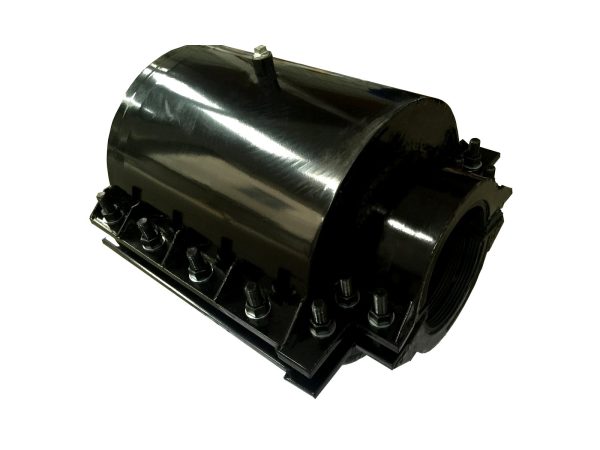
Repair Sleeve for Reducer Fittings
A split repair sleeve for a reducer fitting covers a local defect across an existing change in diameter. Both measured…
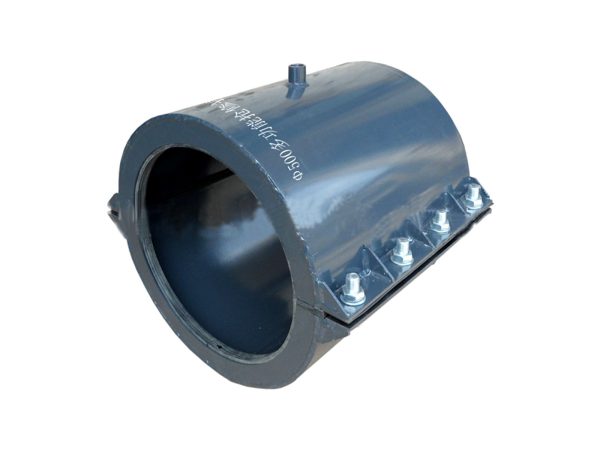
Mechanical Joint Split Repair Sleeve
Select a socket-joint repair sleeve from the actual joint profile, measured pipe and socket diameters, sealing…
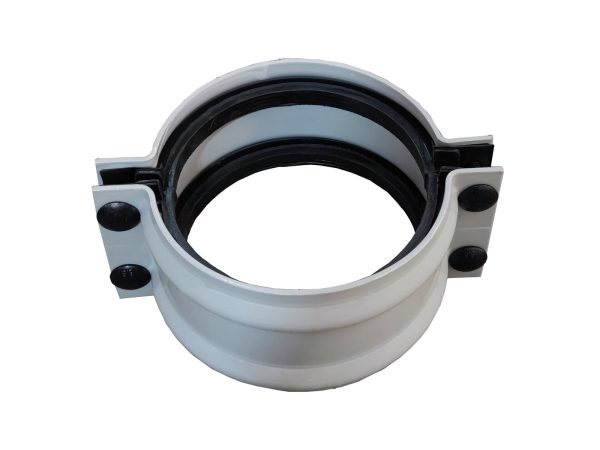
Weld Seam Repair Sleeve
Narrow-profile repair clamp for leaking weld seams on steel pipes. Targets the weld line directly with focused sealing…