
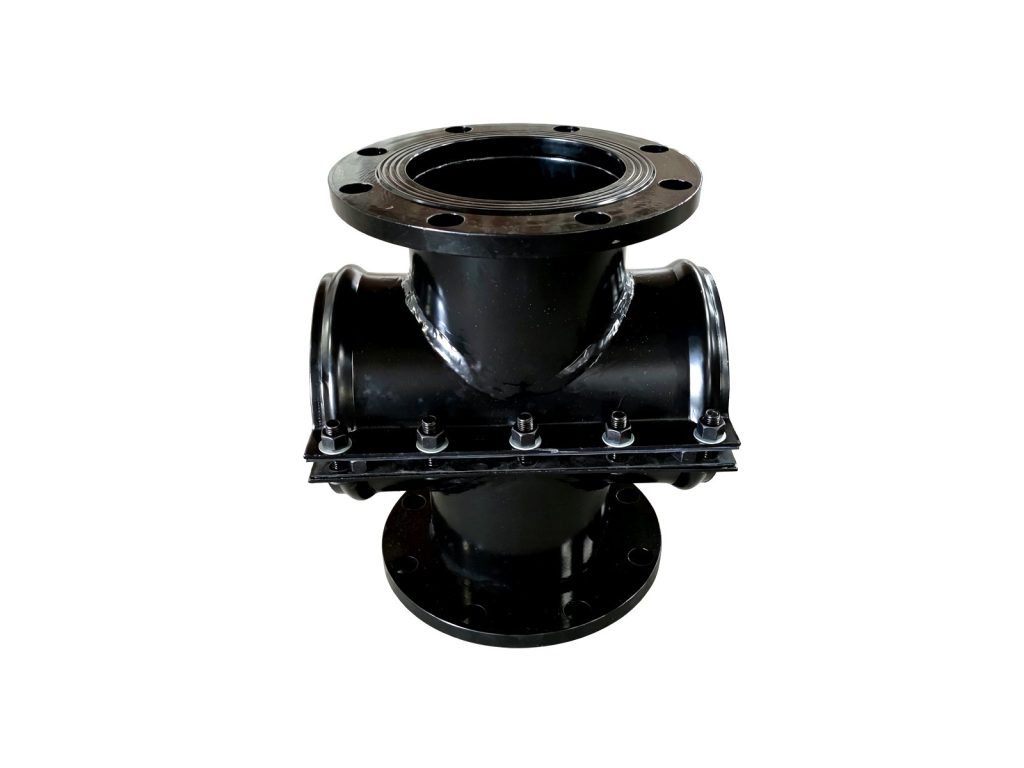
Repair Sleeve with Cross Outlets
A split branch clamp in cross form seals a four-way junction and adds two opposing branches in the same bolt-up. The shell covers all four faces of the crossing and carries two outlets, so a junction that is…
Also known as: Repair Branch Cross, Four-Way Repair Clamp
BS-RBRXUsually replies within 24 hours sales@baoshuopipe.com
Technical Specifications
| Part Number | BS-RBRX |
|---|---|
| Size Range | DN15–DN4000 · Ductile Iron DN100–DN600 / Steel DN100–DN600 · Custom sizes available beyond the above range |
| Body Material | Q235 Carbon Steel / SS304 / SS316L / Duplex 2205 |
| Seal Material | EPDM |
| Sealing Pressure | ≥1.6MPa (232 PSI) |
| Bolt Specification | M16×80, Grade 8.8 High-Strength Bolts |
| Coating | Epoxy Powder |
| Applicable Pipe Types | Steel, Ductile Iron, Cast Iron |
| Working Conditions | Standard Pressure |
Custom Orders Available
This product can be customized to your specifications. Contact us with your requirements.
Request Custom QuoteCheck the fit before ordering.
- Measure the actual pipe
- Nominal DN alone does not define the outside diameter. Confirm the pipe material, measured OD and condition.
- Confirm the geometry
- Provide dimensions of the connection or damaged area. Product shape, sealing length and end connections must match the job.
- Match the seal to the service
- Confirm medium, temperature and pressure together. A material name alone is not a service approval.
- Plan a safe installation
- Pipe integrity, isolation and installation procedure require a site-specific assessment. Suitability for live service must be confirmed.
Read the full technical guide7 chapters · complete product description
Product Overview
A split branch clamp in cross form seals a four-way junction and adds two opposing branches in the same bolt-up. The shell covers all four faces of the crossing and carries two outlets, so a junction that is both leaking and has to supply two directions is dealt with once. It seals what is there and leaves connections that can be used afterwards.
Where it is used
- Crossings leaking at more than one face
- Junctions that also need two opposing take-offs
- Distribution points in steel and iron networks
- Manifold positions where the branch pair must stay in line
Choosing this clamp
Give us the diameters of all four legs, the branch sizes and their end connections, and the distance across the junction. Where only the junction needs sealing, the cross repair clamp has no outlets; where only one branch is added, see the threaded repair branch tee.
How the shell closes on four faces
A cross junction has two axes, so the shell has to close on four faces rather than two. The bolt load is divided differently as a result: where a tee sleeve concentrates its bolts along one branch projection, a cross spreads them around both, and the four corners of the band carry most of the work. The gasket is a continuous band around the whole footprint, so a leak at any one face is sealed by the same compression that holds the fitting on the junction.
The two outlets also behave better than two separate branch clamps would. Carried on one shell, their thrusts act along a common axis and largely cancel at the fitting. Two independent branch clamps at the same point would each put their full thrust into the main, and the two shells would compete for the same length of pipe. On one shell the outlets are additionally guaranteed to be exactly in line, which matters when both branch pipes have to meet fixed downstream points.
What the shell does not do is restore the junction. It seals the outside of a four-way that is still structurally there.
Installation
- Measure all four leg outside diameters and the distance across the junction. Crossings are often built up leg by leg in different materials, so record each one separately.
- Confirm the two outlet sizes and their axes. They need not match. State both, and state the angle of each relative to the legs.
- Inspect the junction for distortion. A crossing pushed out of shape by ground movement may not be closable by a rigid shell at all, and that is better established in the pit than after delivery.
- Clean all four faces back to sound metal. On cast and ductile iron, take off graphitic corrosion until sound metal shows; a gasket cannot seal a friable surface.
- Dry-assemble both halves to confirm the outlets land where the branch pipes need them and that the gasket reaches all four corners.
- Seat the gasket as one band, fit both halves, and bring every bolt up finger-tight first.
- Torque in stages, bringing the four corners up together. Tightening around one outlet first closes that face and springs the other open, and that mistake shows up as a weep on the opposite branch.
What we need to quote
The four leg outside diameters with the material of each, and the distance the shell must span across the junction including the run it needs on every leg.
Then the two branch outlets: size, end connection and the angle of each. If they are directly opposed, say so. If they leave at an angle, give the angle, because it is part of the build and cannot be set on site.
Then the service data: working pressure and test pressure, medium and temperature, and whether the crossing is leaking on one face or on more than one. State whether the main stays in service, and how the two coupons will be retained while drilling.
Finally the practical inputs. The pit dimensions and the lifting arrangements, because this is a heavy shell to place, and the support arrangement at both branches. The built range for steel and ductile iron mains is in the table on this page and it is narrower than the general production range; crossings outside it are made to the dimensions you send.
When a four-way shell is too much part
Where the junction needs sealing and no branch is required, the outlets are dead weight and two extra places to leak. The part is the Split Repair Cross — the same shell with no holes in it.
Where only one branch is needed, a single-outlet body does the job with less to go wrong: the Repair Clamp with Threaded Outlet for a threaded return, or the flanged version where the branch ends at equipment.
Where the junction is sound and both branches are new, there is nothing to seal. That is the Saddle Outlet Cross.
Where the junction is a bell-and-spigot or mechanical joint rather than a welded or moulded cross, the geometry is different and a rigid four-face shell will not close on it. That family starts with the Mechanical Joint Split Repair Sleeve.
Two limits are worth stating plainly. The outlets are carried in the shell, so a large branch on a small junction puts bending into the band, and the build range reflects that. The second limit is access: two opposing branches need clearance on both sides of the crossing, and on a congested rack that clearance is usually the thing that decides against this part.
Materials and standards
The shell is Q235 carbon steel to GB/T 700, epoxy coated to AWWA C210 / GB/T 18593 for buried work, or SS304, SS316L or Duplex 2205 to ASTM A240 / GB/T 3280. A four-face shell is a fabricated assembly with more gasket length and more weld than a tee sleeve, so the material is chosen per face: stainless on the branch faces that stay exposed and carbon steel on the buried legs is a normal specification on one drawing.
The gasket band is EPDM to BS EN 681-1 / GB/T 21873 for water service, NBR to BS EN 681-2 / GB/T 21873 for oil and fuel, and FKM or silicone to ASTM D2000 / ISO 1629 for higher temperature and chemical duty. Because the band runs around four faces, the grade has to resist compression set along its whole length — that property matters here rather than hardness.
Bolts are Grade 8.8 to ISO 898-1 / GB/T 3098.1, or SS304 to ASTM A193 / GB/T 3098.6.
Material standards GB/T 700 · ASTM A240 · GB/T 3280 · BS EN 681-1 · GB/T 21873 · AWWA C210 · GB/T 18593 · ISO 898-1 · GB/T 3098.1
Related Products
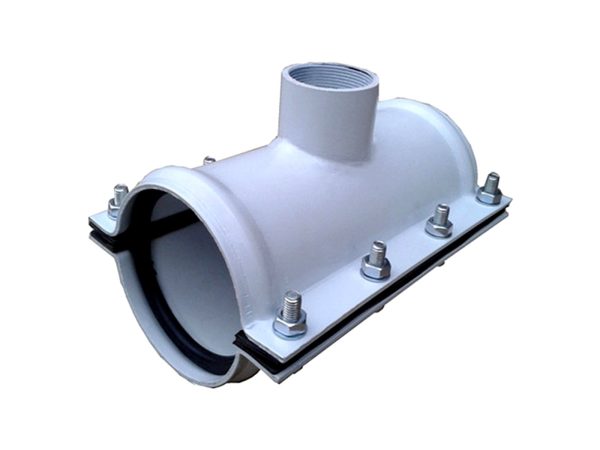
Repair Sleeve with Threaded Outlet
Split-type repair branch clamp with threaded outlet. For adding or repairing threaded branch connections on live…
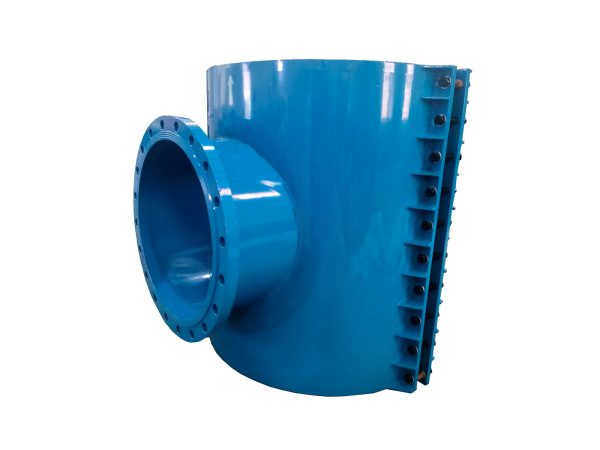
Repair Sleeve with Flanged Outlet
Split-type repair branch clamp with flanged outlet. For high-pressure branch connection repairs on industrial pipelines…
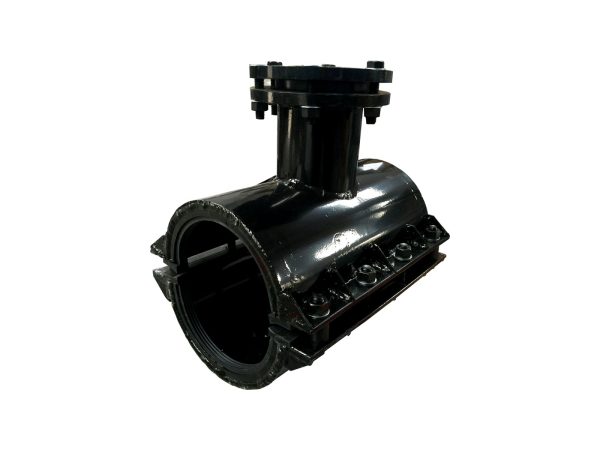
Repair Sleeve with Quick-Connect Outlet
Split-type repair branch clamp with quick-connect coupling. Rapid installation for emergency branch additions on…