
 1 / 4
Click image to enlarge
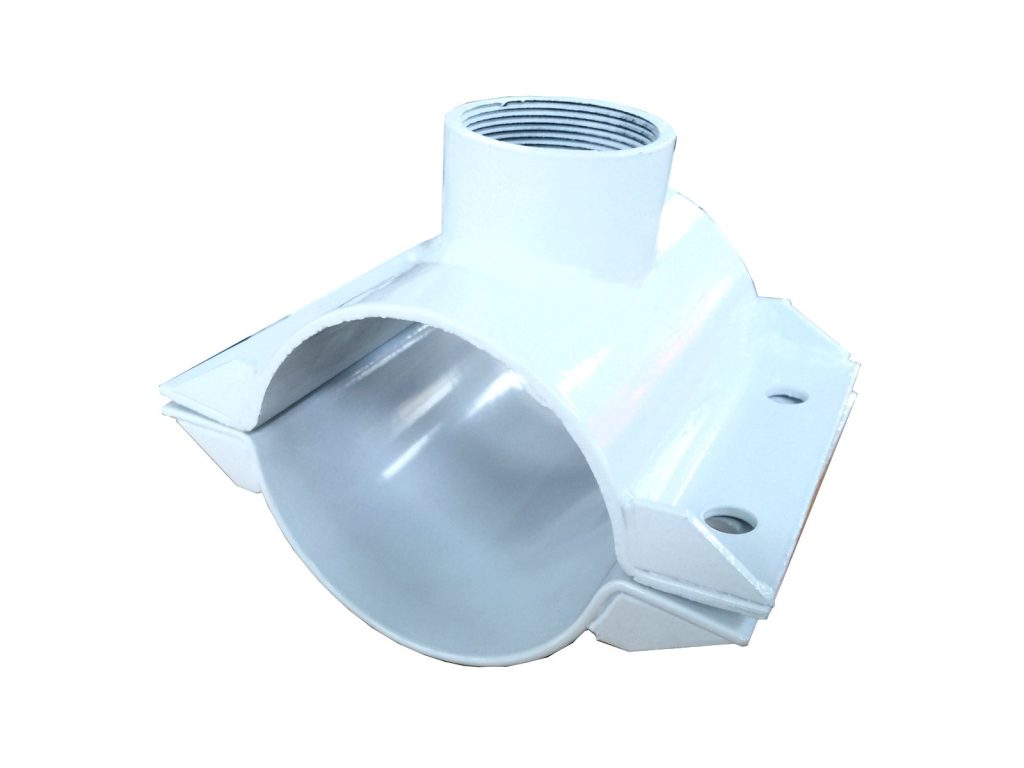
Threaded Saddle Outlet
A saddle with a threaded outlet adds a branch to a main; match the main OD, outlet thread and branch load before ordering.
Also known as: Saddle Outlet, Threaded Branch Saddle
BS-SLTTUsually replies within 24 hours sales@baoshuopipe.com
Technical Specifications
| Part Number | BS-SLTT |
|---|---|
| Size Range | DN15–DN4000 · Plastic φ32–φ1600 / Ductile Iron DN40–DN2600 / Steel DN40–DN2600 · Custom sizes available beyond the above range |
| Body Material | Q235 Carbon Steel / SS304 / SS316L / Duplex 2205 |
| Seal Material | EPDM |
| Sealing Pressure | ≥1.0MPa (145 PSI) |
| Bolt Specification | M16×80, Grade 8.8 High-Strength Bolts |
| Coating | Epoxy Powder |
| Weight | 1.3–85.6 kg (approx) |
| Applicable Pipe Types | UPVC, PVC-M, HDPE, PPR, Steel |
| Working Conditions | Standard Pressure |
Custom Orders Available
This product can be customized to your specifications. Contact us with your requirements.
Request Custom QuoteCheck the fit before ordering.
- Measure the actual pipe
- Nominal DN alone does not define the outside diameter. Confirm the pipe material, measured OD and condition.
- Confirm the geometry
- Provide dimensions of the connection or damaged area. Product shape, sealing length and end connections must match the job.
- Match the seal to the service
- Confirm medium, temperature and pressure together. A material name alone is not a service approval.
- Plan a safe installation
- Pipe integrity, isolation and installation procedure require a site-specific assessment. Suitability for live service must be confirmed.
Read the full technical guide7 chapters · complete product description
Product Overview
A threaded tapping saddle adds a branch to a line that is already in service, without cutting the main. The body is a split saddle that wraps the pipe and the branch leaves it through a threaded outlet. Cutting a main to insert a tee means isolating a section and making two joints where there was one pipe; the saddle makes one joint instead.
Where it fits
- Water distribution and irrigation networks
- Adding a service connection, washout or air valve to an existing main
- Plastic and steel mains, up to the range in the table above
- Branches that end in a threaded valve, meter or fitting
Choosing the right outlet
Send us the main outside diameter, the branch size and its thread standard, plus the medium and temperature. If the branch ends at a valve or pump with a flange face, take the flanged outlet saddle; if the take-off is temporary, the quick-joint saddle is faster to fit and to remove.
A branch load carried by the pipe wall
A saddle carries its branch load into the pipe wall under the saddle pad, spread over a contact patch, and reacted by the split wrap that holds the pad down. That makes two things critical: how well the pad curvature matches the pipe, and how much contact area there is between pad and pipe.
Where the curvature matches, the load spreads over the whole pad. Where it does not, the saddle touches on two lines and the rest of the pad is decoration. This is why the outside diameter has to be measured rather than inferred from the nominal size — a saddle made for the wrong curvature will not hold its branch load, and the leak appears at the pad edge rather than at the outlet.
The outlet is also a moment. A branch pipe hanging off the run pulls sideways on the saddle, and the longer or heavier the branch, the more that pull has to be resisted by the band and by the pipe wall at the pad. Support the branch where the run is plastic or thin-wall.
Installation
- Confirm the main can be tapped under the conditions the network allows, and whether the branch will be made live or after a shutdown. The saddle is the same part either way; the procedure is not.
- Measure the main outside diameter and check it against the saddle ordered. Clean a band of pipe wider than the pad and free of scale, coating and grit.
- Mark the drilling point and centre the outlet on it. Fit the saddle and check the pad sits down on the pipe all round, with no rock and no visible gap at the edges.
- Fit the band or straps and tighten them evenly, in small increments, alternating sides so the saddle stays centred. Do not tighten one side fully before starting the other.
- Mount the tapping machine or drill through the outlet, using the outlet thread as the guide. The drill must be supported by the saddle, not by hand.
- Cut the hole, withdraw the cutter and fit the branch valve or fitting. With a live main, the sequence has to keep the outlet closed between the cut and the branch connection.
- Check the joint at working pressure. A weep at the pad edge means the curvature or the seating is wrong, and tightening further will not correct it.
What we need to quote
The main outside diameter comes first, because the pad is formed to it. Then the branch size and its thread standard — the outlet is threaded, and thread type is not interchangeable between systems. Say whether the branch ends at a valve, a meter, a hose or a plain pipe.
Add the main material and, on plastic mains, the wall thickness, because the pad has to spread load into a plastic wall differently than into steel. Send the medium and its temperature for gasket selection, and the working pressure of the main. If the branch will be drilled live, say so: it changes the fitting supplied at the outlet. If the take-off is temporary and will be removed later, also say that, since a removable arrangement is a different outlet. Where the main is larger than the standard range in the table above, the saddle is fabricated to the dimensions you send.
Limits and alternatives
The branch size a saddle can carry is limited by the pipe it sits on. A large outlet on a small main concentrates the branch load into a small area of wall, and on a plastic main that is where the saddle will fail first. Where the ratio is unfavourable, the answer is a flanged outlet saddle built for the load, or a proper tee inserted into the main.
A saddle is also the wrong part where the pipe is already leaking at that location. It adds a branch; it does not seal an existing defect. That is a repair first and a branch second, and the two operations use different parts — a Straight Pipe Repair Clamp or a Repair Branch Cross where the branch and the repair have to be done together. Where the pipe wall at the tapping point is thin or pitted, the hole may not leave enough sound wall for the outlet to seal. Where the main carries a medium that attacks the gasket compound, the saddle body is not the issue — the seal is — and the compound has to be changed before the part is ordered.
Materials and standards
The saddle body and band are made in Q235 carbon steel to GB/T 700, or SS304, SS316L or Duplex 2205 to ASTM A240 / GB/T 3280. Stainless is commonly specified on potable water mains and on plastic mains, where the saddle stays exposed in a chamber and a coated carbon steel body would need maintenance. The bolts are Grade 8.8 to ISO 898-1 / GB/T 3098.1, or SS304 to ASTM A193 / GB/T 3098.6. Exterior finishes are epoxy to AWWA C210 / GB/T 18593, or zinc plating to ASTM B633 / GB/T 9799.
The gasket is EPDM to BS EN 681-1 / GB/T 21873 for water and most municipal service, which suits the pad geometry because it conforms to the pipe under a modest band load. NBR to BS EN 681-2 / GB/T 21873 covers oily media, and FKM or silicone to ASTM D2000 / ISO 1629 is used where temperature or chemical attack governs. Tapping sleeves and branch connections of this class are described by AWWA C223; full-encirclement service connection clamps are covered by AWWA C230. Background on matching a clamp or saddle to the pipe it sits on is in how to choose the right pipe repair clamp.
Documents
Material standards GB/T 700 · ASTM A240 · GB/T 3280 · BS EN 681-1 · GB/T 21873 · AWWA C210 · GB/T 18593 · ISO 898-1 · GB/T 3098.1
Related Products
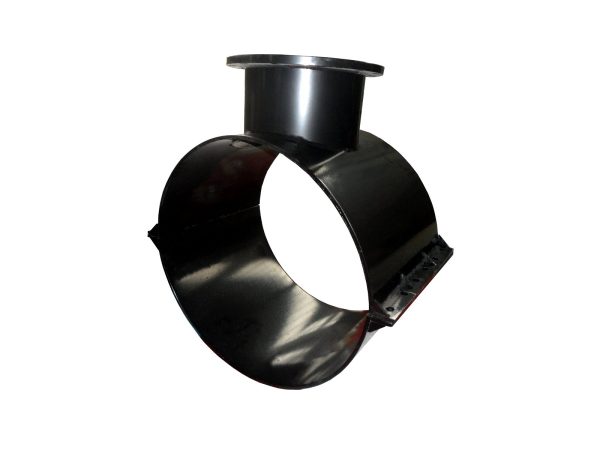
Flanged Saddle Outlet
Saddle-type tapping tee with flanged branch connection. For high-flow branch takeoffs on main pipelines — suitable for…
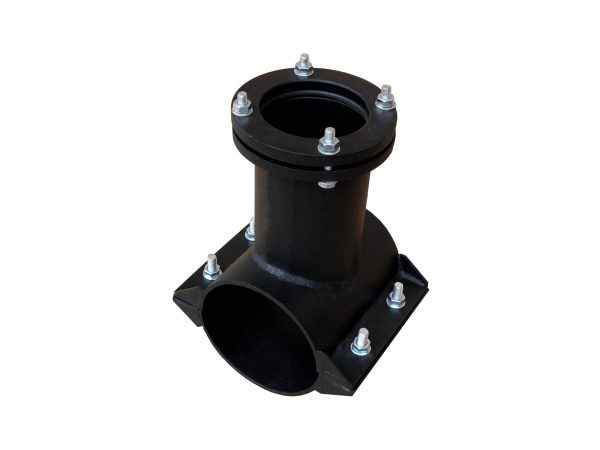
Saddle Outlet with Quick-Connect Branch
Saddle outlet tee with quick-connect coupling on the branch. Tool-free installation for temporary or emergency branch…
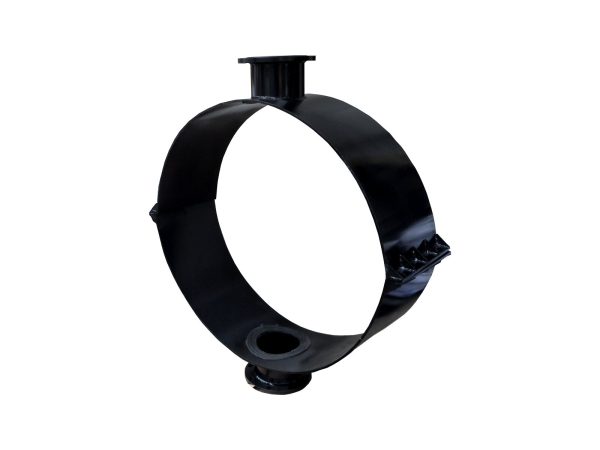
Saddle Outlet for Cross Connections
Four-way saddle clamp for creating cross-intersections on existing pipelines. Two opposing branch outlets with…