
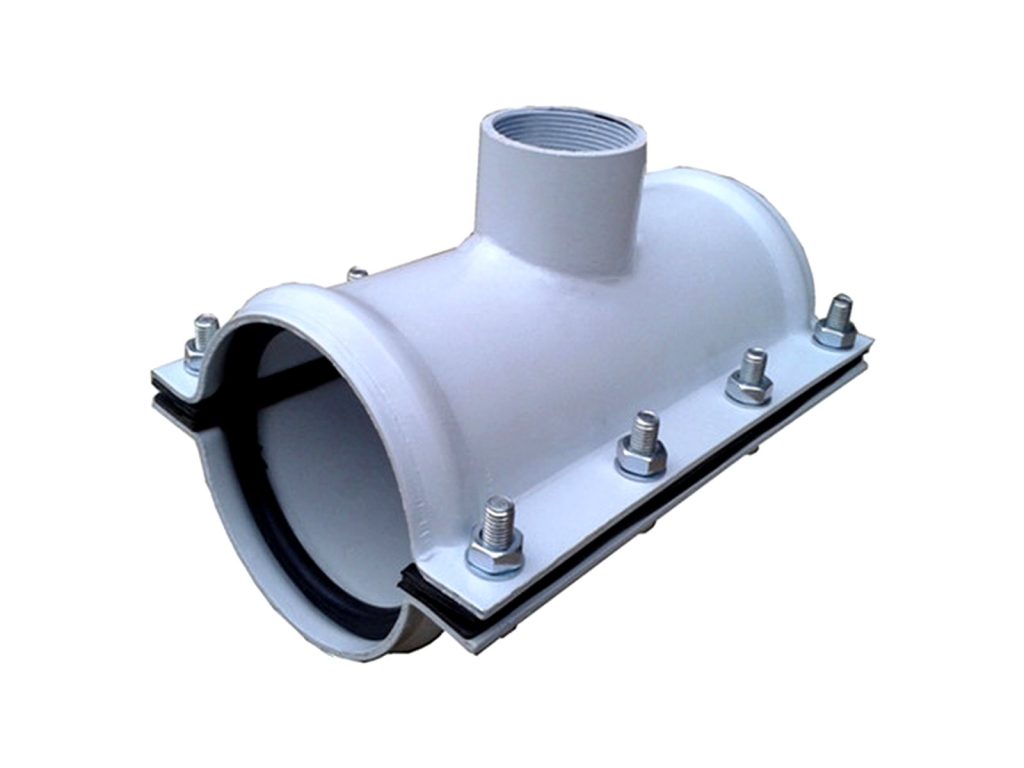
Repair Sleeve with Threaded Outlet
A split branch clamp does two jobs in one fitting: it seals a leak at a branch connection and leaves a threaded outlet that can be used again. That separates it from a saddle, which only adds a…
Also known as: Repair Clamp with Threaded Outlet, Threaded Branch Repair Sleeve
BS-RBRTUsually replies within 24 hours sales@baoshuopipe.com
Technical Specifications
| Part Number | BS-RBRT |
|---|---|
| Size Range | DN15–DN4000 · Plastic φ20–φ400 · Custom sizes available beyond the above range |
| Body Material | Q235 Carbon Steel / SS304 / SS316L / Duplex 2205 |
| Seal Material | EPDM |
| Sealing Pressure | ≥1.6MPa (232 PSI) |
| Bolt Specification | M16×80, Grade 8.8 High-Strength Bolts |
| Coating | Epoxy Powder |
| Length Range | 120–500mm (4.7"–19.7") |
| Weight | 0.5–14.2 kg (approx) |
| Applicable Pipe Types | Steel, Ductile Iron, Cast Iron |
| Working Conditions | Standard Pressure |
Custom Orders Available
This product can be customized to your specifications. Contact us with your requirements.
Request Custom QuoteCheck the fit before ordering.
- Measure the actual pipe
- Nominal DN alone does not define the outside diameter. Confirm the pipe material, measured OD and condition.
- Confirm the geometry
- Provide dimensions of the connection or damaged area. Product shape, sealing length and end connections must match the job.
- Match the seal to the service
- Confirm medium, temperature and pressure together. A material name alone is not a service approval.
- Plan a safe installation
- Pipe integrity, isolation and installation procedure require a site-specific assessment. Suitability for live service must be confirmed.
Read the full technical guide7 chapters · complete product description
Product Overview
A split branch clamp does two jobs in one fitting: it seals a leak at a branch connection and leaves a threaded outlet that can be used again. That separates it from a saddle, which only adds a branch. Specify it when the branch itself is the problem — a weeping thread, a cracked collar or a corroded stub — and the connection has to stay usable.
Where it fits
- Branch connections leaking at the collar or the thread
- Replacing a corroded or broken threaded stub without cutting the main
- Service connections that have to be restored rather than abandoned
- Steel and iron mains with welded or screwed branches
Choosing the right outlet
Send us the main outside diameter, the branch size and thread, and where the leak is — at the collar, in the branch pipe or at the thread. Where the branch is sound and needs extending, the threaded saddle is the lighter part; where the branch ends in a flange, see the flanged repair branch tee.
Seal and outlet from the same bolt-up
A threaded tapping saddle adds a branch and does nothing else. A threaded repair branch tee does two jobs with the same bolts: it closes a leak at the branch connection and it leaves a usable thread where that connection was. That is the whole reason to buy it, and it only pays off when both jobs are genuinely present.
The shell spans the whole junction rather than ringing a single hole. The gasket land therefore covers the branch penetration, the collar and a length of run either side of it, so a leak at the collar weld, at the thread root or along the fillet sits inside the footprint and is sealed by the same compression that holds the fitting on the main. The outlet thread is machined into the shell after forming, so its axis is square to the run. A port welded on at an angle makes the connected fitting cross-thread on assembly, which is a recurring complaint about field-modified parts.
The trade-off against two fittings is real. A separate saddle plus a repair sleeve does the same two jobs, but it needs two bolt-ups on the same short length of pipe and roughly twice the room along the run. Where the excavation is tight, or the pipe between joints is short, doing both jobs in one fitting is what makes the repair possible at all.
Installation
- Measure the main outside diameter and find the leak precisely: at the collar, in the thread, or in the branch stub. If the leak is in the branch pipe beyond the outlet, this fitting will not reach it.
- Decide whether the old stub stays or is cut off flush. A stub left standing proud lifts the shell off the main on one side and the gasket never loads there.
- Clean the junction back to sound metal. Old sealant, tape and scale must come off — the gasket seals against pipe, not against the last repair.
- Check the outlet thread form and size against the fitting that will go back in. Repair work is where mismatched threads are discovered far too late.
- Seat the gasket in the lower half, bring the upper half over the branch, and run every bolt finger-tight before any load goes on.
- Torque in a cross pattern in two or three passes, working outward from the branch. The shell has a hole in it, so it is less stiff around the outlet than a plain sleeve.
What we need to quote
Start with the main outside diameter and material, including how much wall is left. Then the branch: size, thread form and thread size, and whether the old stub will be cut off or left in place. Then the distance across the junction that has to be covered, because the shell must span the whole leaking footprint with sound pipe at both ends.
Then the service data: working pressure and test pressure, medium and temperature, and whether the line is isolated or kept running during the work.
Two inputs are often left out and both change the answer. The first is the load the branch will carry — an unsupported branch pipe running several metres puts bending into the shell that the gasket was never sized for. The second is whether the branch will be taken apart again. A thread that is made and broken repeatedly wears, and above a certain frequency the flanged or push-fit version is the honest recommendation rather than a replacement thread.
Built sizes, the working length range and the pressure rating are in the table on this page.
When this is the wrong purchase
Where the main and the branch are both sound and a new branch is simply needed, there is no leak for the shell to seal. The lighter part is the Threaded Saddle Outlet Tee, and it will normally take a larger branch for the same main size.
Where the leak is in the branch pipe itself, past the point the shell covers, the fitting seals the wrong thing. Use a Straight Pipe Repair Clamp on the branch, or replace the branch.
Where the main is perforated all round the junction rather than just at the collar, the shell cannot close it, because there is no sound pipe left for the gasket to land on. That is the Split Repair Tee, or a Repair Collar where a longer length of run is affected.
And where the branch is large, the thread is limited by how thick the outlet can be formed. Above that the connection has to be a flange, and the part is the Repair Clamp with Flanged Outlet.
Materials and standards
Shells are Q235 carbon steel to GB/T 700 with an epoxy coating to AWWA C210 / GB/T 18593, which covers buried water mains and most plant pipework. SS304 or SS316L to ASTM A240 / GB/T 3280 is specified where the fitting stays exposed, where the water carries residual chlorine or chloride, or where a corrosion product would enter the process. Duplex 2205 is used where high chloride and higher pressure arrive together.
The gasket is chosen from the medium, not from the pipe. EPDM to BS EN 681-1 / GB/T 21873 is the default for water and steam condensate. NBR to BS EN 681-2 / GB/T 21873 covers oil, fuel and hydrocarbon-bearing condensate. FKM or silicone to ASTM D2000 / ISO 1629 covers higher temperatures and aggressive chemical duty. Because this fitting seals a joint that has already failed once, the gasket grade is worth stating explicitly on the order rather than leaving as a default.
Bolts are Grade 8.8 to ISO 898-1 / GB/T 3098.1, or SS304 to ASTM A193 / GB/T 3098.6 where the shell is stainless and the fasteners stay exposed.
Documents
Material standards GB/T 700 · ASTM A240 · GB/T 3280 · BS EN 681-1 · GB/T 21873 · AWWA C210 · GB/T 18593 · ISO 898-1 · GB/T 3098.1
Related Products
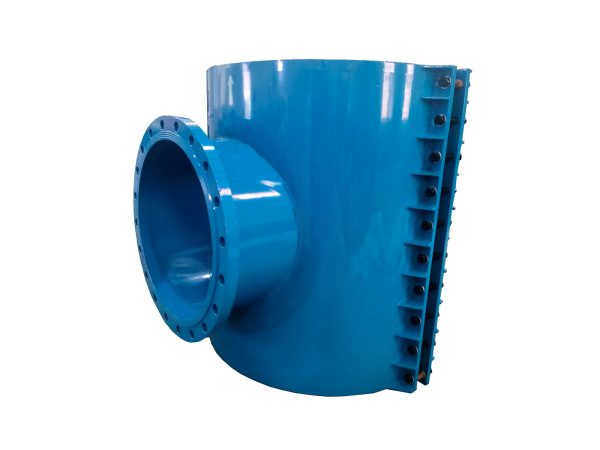
Repair Sleeve with Flanged Outlet
Split-type repair branch clamp with flanged outlet. For high-pressure branch connection repairs on industrial pipelines…
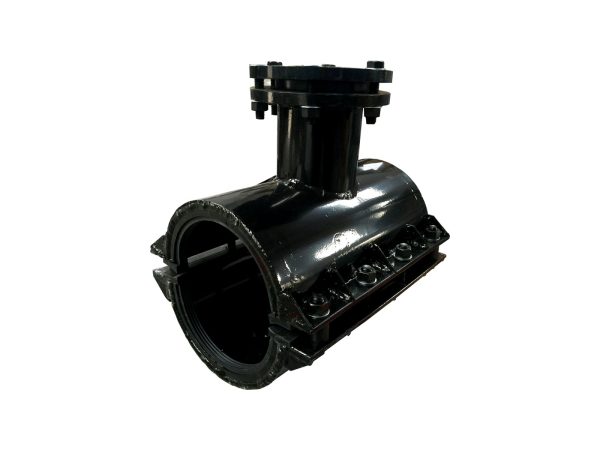
Repair Sleeve with Quick-Connect Outlet
Split-type repair branch clamp with quick-connect coupling. Rapid installation for emergency branch additions on…
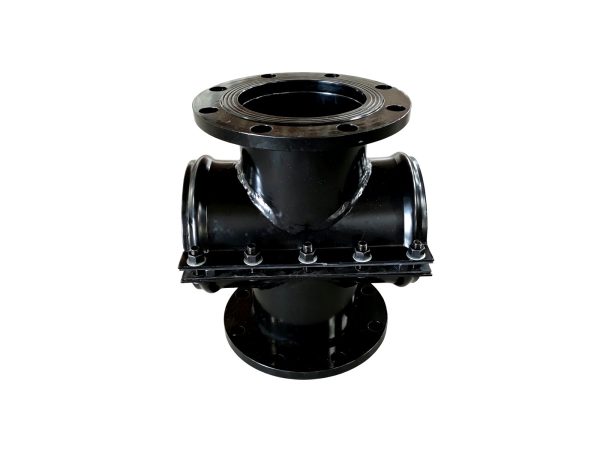
Repair Sleeve with Cross Outlets
Split-type four-way repair clamp for cross-intersection repairs. Dual opposing branch outlets — seals leaks at all four…