
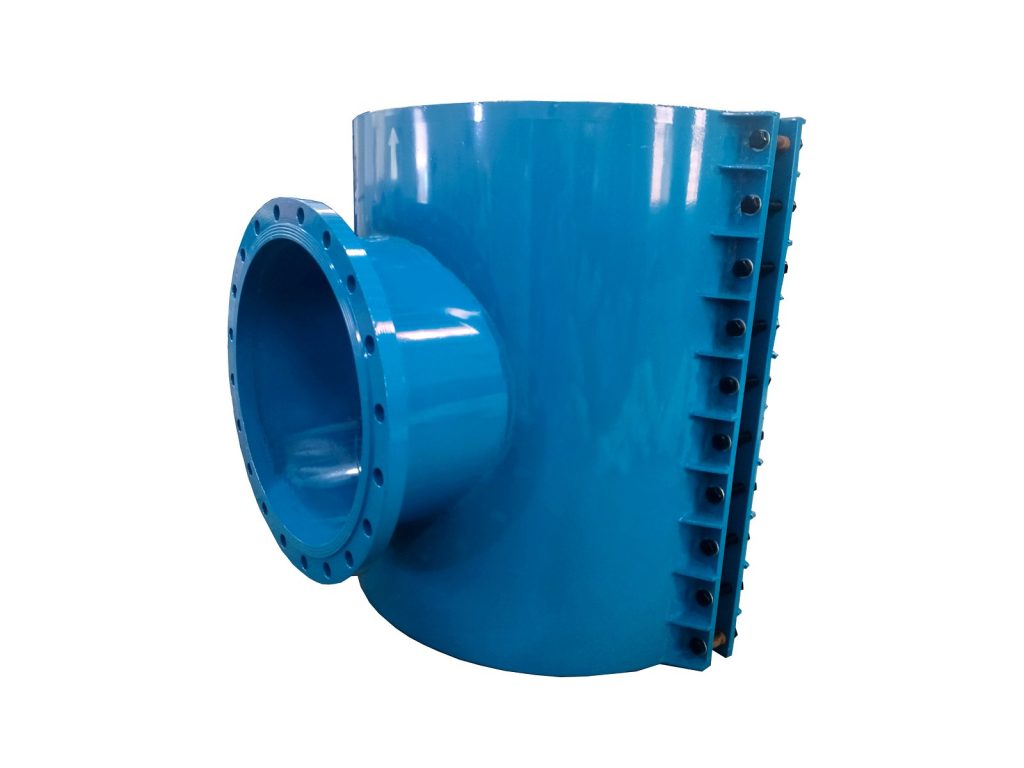
Repair Sleeve with Flanged Outlet
This is the flanged version of the split branch clamp: one shell that seals a leaking branch connection and leaves a flanged outlet behind it. On industrial lines a branch rarely ends in a thread — it ends…
Also known as: Repair Clamp with Flanged Outlet, Flanged Branch Repair Sleeve
BS-RBRFUsually replies within 24 hours sales@baoshuopipe.com
Technical Specifications
| Part Number | BS-RBRF |
|---|---|
| Size Range | DN15–DN4000 · Plastic φ160–φ1600 · Custom sizes available beyond the above range |
| Body Material | Q235 Carbon Steel / SS304 / SS316L / Duplex 2205 |
| Seal Material | EPDM |
| Sealing Pressure | ≥1.6MPa (232 PSI) |
| Bolt Specification | M16×80, Grade 8.8 High-Strength Bolts |
| Coating | Epoxy Powder |
| Length Range | 300–2000mm (11.8"–78.7") |
| Weight | 4.8–506 kg (approx) |
| Applicable Pipe Types | Steel, Ductile Iron, Cast Iron, Stainless Steel |
| Working Conditions | Standard Pressure, Oil Resistant |
Custom Orders Available
This product can be customized to your specifications. Contact us with your requirements.
Request Custom QuoteCheck the fit before ordering.
- Measure the actual pipe
- Nominal DN alone does not define the outside diameter. Confirm the pipe material, measured OD and condition.
- Confirm the geometry
- Provide dimensions of the connection or damaged area. Product shape, sealing length and end connections must match the job.
- Match the seal to the service
- Confirm medium, temperature and pressure together. A material name alone is not a service approval.
- Plan a safe installation
- Pipe integrity, isolation and installation procedure require a site-specific assessment. Suitability for live service must be confirmed.
Read the full technical guide7 chapters · complete product description
Product Overview
This is the flanged version of the split branch clamp: one shell that seals a leaking branch connection and leaves a flanged outlet behind it. On industrial lines a branch rarely ends in a thread — it ends at a valve, a pump, an instrument or a spool — so restoring the connection means restoring the flange face.
Where it fits
- Oil, gas and process-water branches on industrial pipework
- Branch connections where the flange face itself is the leak
- Lines that cannot be cut to insert a new branch fitting
- Branches that must return to their original connection standard
Choosing the right outlet
The main outside diameter, branch size, flange standard and length over the junction settle this one. For a threaded branch, use the threaded repair branch tee; where the branch is new rather than existing, see the flanged saddle outlet tee.
Why a flanged outlet loads the shell harder
On industrial pipework a branch rarely ends in a thread. It ends at a valve, a pump, an instrument or a spool, so restoring the connection means restoring a flange face. The shell covers the leaking junction and carries a machined, drilled flange on its outlet neck.
The load path is what separates this from the threaded version. A flange joint only seals when its bolts pull the two faces together hard, and every one of those bolts reacts into the shell underneath. So a flanged outlet puts a bending moment into the shell at a discrete point instead of spreading it along a thread. The body is built longer and stiffer for that reason, and the neck is reinforced where the outlet leaves the band. It is also why the outlet bolting must never be used to drag two misaligned faces together: the force needed to close a wedge gap goes straight into the shell and into the main seal underneath it.
There is a second payoff that is easy to miss. The outlet is a standard flange, so the branch can be isolated later with a blind or a spade without disturbing the main seal. Maintenance on the branch never has to re-open the joint that is holding the line.
Installation
- Measure the main outside diameter, then measure the flange the branch will mate to: bolt count, bolt size, pitch circle diameter and face outside diameter. Do not assume the two ends of the job share a standard.
- Identify the leak location and confirm the shell length covers it with sound pipe at each end. The built working length range is on this page.
- Clean the main under the gasket land back to sound metal and check for pitting. The gasket follows the pipe surface, not the drawing.
- Assemble both halves with the gasket and run the bolts up evenly, closing both side gaps at the same rate. On a long shell, uneven tension is what breaks the seal at one end.
- Pressure-test the main seal before the branch is bolted on. Finding a weeping gasket now costs nothing.
- Support the branch spool before final tightening, so the weight of the spool and its fittings is not carried by the outlet neck.
- Offer the spool up with a new gasket and bring the flange bolts up in a star pattern in stages.
What we need to quote
Main outside diameter and main material, including the wall condition. Branch size. The flange standard and drilling at the outlet, taken off the item being mated — if the branch returns to an existing valve or vessel nozzle, send that item’s flange dimensions rather than naming a standard and hoping. The length over the junction that has to be covered, and, where the branch must line up with a fixed spool, the distance from the main centreline to the flange face.
Then working pressure and test pressure, medium and temperature, and whether the fitting is buried or exposed.
Say so if the line carries oil or a hydrocarbon. An oil-resistant gasket compound is available and it has to be selected when the order is placed, because the gasket is compressed against the main for the life of the fitting and cannot be swapped afterwards.
Two practical inputs matter on a large body. The first is the flange standard and rating the branch has to mate with, because the outlet is machined to suit it. The second is bolt-hole orientation: on an existing line the flange has to land where the connecting spool can actually reach it, and a few degrees of rotation can be the difference between a buildable branch and one that is not.
Where the flange outlet does not fit
Where the existing branch ends in a thread, a flanged outlet adds a flange, a gasket and a second set of bolts to a connection that never had them. The simpler answer is the Repair Clamp with Threaded Outlet.
Where the main and the branch are both sound and only a new take-off is needed, there is no leak for this shell to seal. That is a saddle job — the Flanged Saddle Outlet Tee, or the threaded version for a smaller branch.
A flanged outlet must not be used to carry the weight of a valve, a pump or a spool. It is a sealing element. If the branch needs a support, fit a support.
Where the main surface under the gasket is deeply pitted, or the main is perforated over a length longer than the shell, the gasket has nowhere to land. That is the Split Repair Tee or a Repair Collar, depending on how much pipe is affected.
And where the branch spool is rigid and cycles in temperature, that movement arrives at the outlet neck as a bending load. A flanged outlet is stiffer than a threaded one, so it passes more of that load into the shell. Where the branch is long and unsupported, a support on the spool is part of the installation rather than an optional extra.
Materials and standards
Shells are Q235 carbon steel to GB/T 700, epoxy coated to AWWA C210 / GB/T 18593 — the usual choice for buried mains and for plant water. SS304 and SS316L to ASTM A240 / GB/T 3280 are specified for exposed service, for chlorinated or chloride-bearing water, and for fittings that may have to come off and be refitted. Duplex 2205 covers higher pressure and chloride together. The outlet flange is machined and drilled to the standard stated on the order, which is exactly why that standard has to be named rather than assumed.
Gaskets are EPDM to BS EN 681-1 / GB/T 21873 for water, steam condensate and general municipal service. Where the line carries oil, fuel or a hydrocarbon condensate, the compound is NBR to BS EN 681-2 / GB/T 21873 — this is what the oil-resistant working condition refers to, and it is selected at order. FKM or silicone to ASTM D2000 / ISO 1629 covers higher temperature and chemical duty.
Bolts are Grade 8.8 to ISO 898-1 / GB/T 3098.1, or SS304 to ASTM A193 / GB/T 3098.6 on stainless shells and flange bolting.
Documents
Material standards GB/T 700 · ASTM A240 · GB/T 3280 · BS EN 681-1 · GB/T 21873 · AWWA C210 · GB/T 18593 · ISO 898-1 · GB/T 3098.1
Related Products
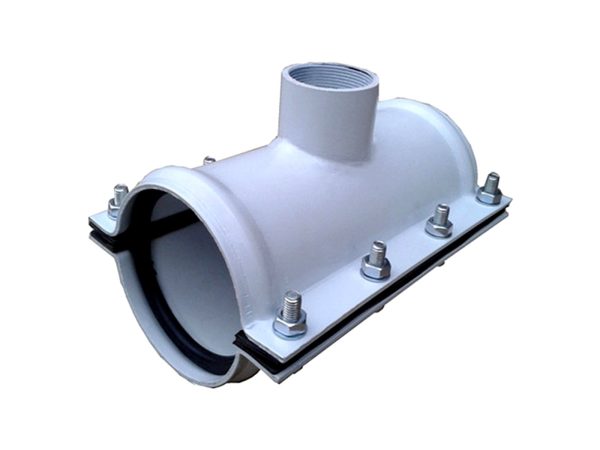
Repair Sleeve with Threaded Outlet
Split-type repair branch clamp with threaded outlet. For adding or repairing threaded branch connections on live…
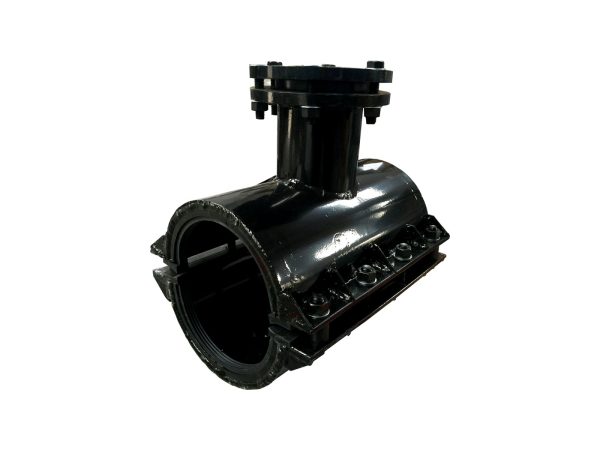
Repair Sleeve with Quick-Connect Outlet
Split-type repair branch clamp with quick-connect coupling. Rapid installation for emergency branch additions on…
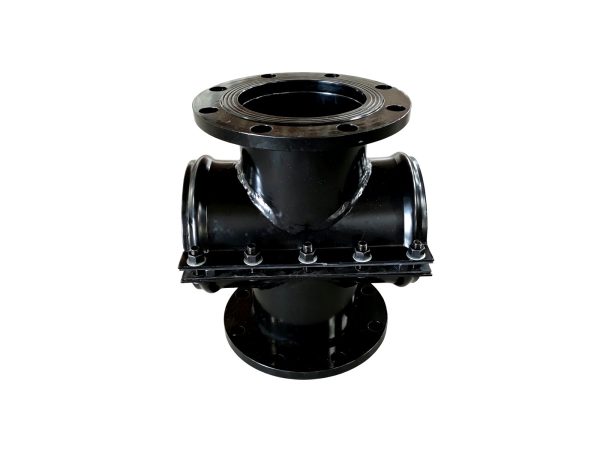
Repair Sleeve with Cross Outlets
Split-type four-way repair clamp for cross-intersection repairs. Dual opposing branch outlets — seals leaks at all four…