
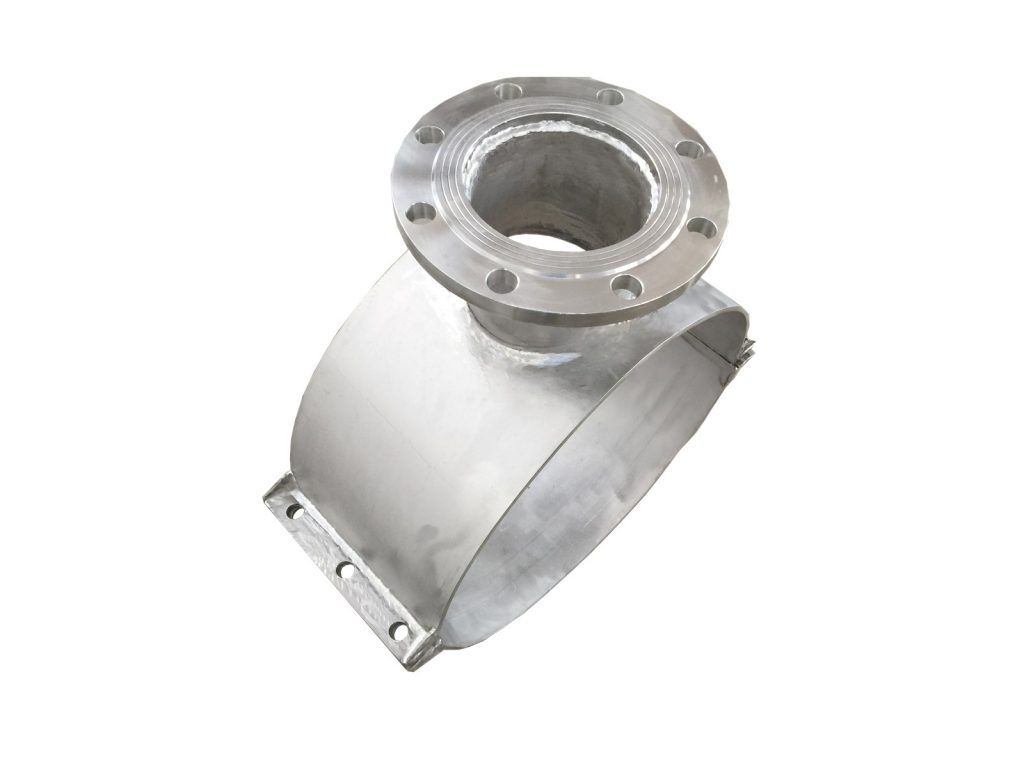
Stainless Steel Repair Sleeve for Flange Joints
A stainless flange wrap sleeve seals a weeping flange without breaking the joint — the flange pair stays bolted and the line stays whole. Breaking it would mean draining the line, renewing the gasket and re-torquing a flange…
Also known as: Stainless Steel Flange Wrap Repair Clamp
BS-RCFL-SSUsually replies within 24 hours sales@baoshuopipe.com
Technical Specifications
| Part Number | BS-RCFL-SS |
|---|---|
| Size Range | DN15–DN4000 · Stainless Steel DN15–DN4000 · Custom sizes available beyond the above range |
| Body Material | SS304 / SS316L / Duplex 2205 |
| Seal Material | EPDM / NBR / FKM |
| Sealing Pressure | ≥1.6MPa (232 PSI) |
| Bolt Specification | M16×80, Grade 8.8 High-Strength Bolts |
| Coating | None (Stainless Steel Body) |
| Length Range | 200–600mm (7.9"–23.6") |
| Weight | 2–48.0 kg (approx) |
| Applicable Pipe Types | Steel, Stainless Steel, Ductile Iron, PVC |
| Working Conditions | Standard Pressure, Corrosion Resistant |
Custom Orders Available
This product can be customized to your specifications. Contact us with your requirements.
Request Custom QuoteCheck the fit before ordering.
- Measure the actual pipe
- Nominal DN alone does not define the outside diameter. Confirm the pipe material, measured OD and condition.
- Confirm the geometry
- Provide dimensions of the connection or damaged area. Product shape, sealing length and end connections must match the job.
- Match the seal to the service
- Confirm medium, temperature and pressure together. A material name alone is not a service approval.
- Plan a safe installation
- Pipe integrity, isolation and installation procedure require a site-specific assessment. Suitability for live service must be confirmed.
Read the full technical guide7 chapters · complete product description
Product Overview
A stainless flange wrap sleeve seals a weeping flange without breaking the joint — the flange pair stays bolted and the line stays whole. Breaking it would mean draining the line, renewing the gasket and re-torquing a flange pair that may have been together for years. The sleeve presses a gasket band across the gap and lands on sound pipe either side.
Where it is used
- Bolted flanges on stainless and hygienic process lines
- Flange pairs where breaking the joint means losing product or a clean state
- Coastal and washdown areas where a coated shell would corrode
- Equipment connections with little room for spanners
Choosing the right build
Give us the pipe outside diameter either side, the flange outside diameter and thickness, and the bolt circle. The carbon steel equivalent is the flange wrap repair clamp, and the whole stainless range is on the stainless steel series page.
Why the seal has to bridge a gap, not press on pipe
Every other sleeve in this range seals by pressing a gasket against a continuous pipe surface. A flange wrap does the opposite: the gasket has to span a gap between two flange faces and then land on sound pipe on both sides of the joint. That inverts the design problem. The shell is not there to grip the pipe; it is there to hold a gasket band in tension across an opening while the bolts hold the whole assembly closed.
The gap itself is the difficulty. If the gasket is soft enough to squeeze into the gap under line pressure, it extrudes into the joint and thins until it no longer seals. If it is hard enough to resist extrusion, it needs more bolt load to compress. The sleeve resolves this by positioning the gasket relative to the gap so that the flange outside diameter backs the gasket on both sides, which limits how far it can deform. That is why the flange outside diameter is a required dimension and not an optional one.
The other design point is access. A flange pair buried in a pipe rack may have no room to swing a spanner on the joint bolts, but the wrap bolts run along the pipe axis, where there is usually more space.
Installation
- Do not break the joint. The whole purpose of this repair is to leave the flange pair bolted and the line whole, so work around the existing bolts rather than releasing them.
- Clean both flange faces, the joint gap, and the pipe either side back to bare metal. Old gasket material, paint and corrosion product in the gap will hold the sleeve off the landing area.
- Measure the pipe outside diameter on both sides of the joint, the flange outside diameter and thickness, and the bolt circle on the flanges. Also count the flange bolts and note how far the nuts and stud ends stand proud — they can foul the shell.
- Judge the gap. Look at how wide the joint has opened, whether it is even all the way round, and whether the flange faces are still parallel. A gap that is wider on one side means the flanges have been pulled out of parallel and the sleeve will land unevenly.
- Dry-fit the shell over the flanges and check that both gasket bands land on sound pipe, not on the weld neck or on a corroded band beside the flange.
- Fit and set the gasket band centred on the gap, then mark both pipes so the shell cannot walk as it is closed.
- Tighten in stages, alternating along the shell and across the joint, bringing the two halves together evenly. Watch the joint gap as you tighten — if it narrows, you are crushing the old gasket further and the leak will return.
- Pressure-test with the joint exposed and check both landing bands and the gap itself. Backfill only when dry.
The usual error is to tighten hard on one side to stop an active weep. That tips the shell, opens the opposite landing band and turns a single leak into two.
What we need to quote a flange wrap
The flange, not the pipe, sets the geometry:
- Pipe outside diameter each side of the joint, which may differ
- Flange outside diameter — essential, because it backs the gasket against extrusion
- Flange thickness and the width of the joint gap as it stands now
- Bolt circle and flange bolt count, plus how far studs and nuts project
Then the service: medium, normal and maximum temperature, line pressure, and whether the joint is insulated. Insulation changes both the room available and the working temperature of the gasket, since a lagged flange runs hotter than the pipe it sits in.
Access is worth describing in words or a photograph. If the flange sits tight against a wall, another flange or a support, the shell may have to be made in a shape that clears it, and that is decided before forming rather than on site. Where there is no room at all for a wrap, a repair collar on the pipe beside the joint, or a proper joint remake, is the alternative. Where the flange is on a carbon steel line, the coated version is the flange wrap repair clamp.
Where a flange wrap is the wrong part
A wrap closes a weeping joint. It does not remake the joint, and there are conditions where trying to make it do so is a mistake.
- A gap too wide to bridge. A wrap spans a joint that is still essentially closed. Once the gap is wide enough that the gasket cannot cross it without extruding, no shell will hold it. Remake the joint.
- Flange faces no longer parallel. If the pair has been pulled out of parallel by pipe stress, one side of the wrap will seat and the other will not. Fix the pipe stress first, or the repair will fail in the same place.
- Corroded or pitted pipe beside the flange. The gasket lands on the pipe, not the flange. If the landing area is pitted, there is nothing for the gasket to seal against, and this is common right beside a flange where a leak has been weeping for a while. Cut back to sound pipe.
- A cracked or distorted flange. If the flange itself has cracked through a bolt hole or the face has been deformed, a wrap covers the crack without arresting it. Replace the flange.
- A joint that has to come apart. If the line is due to be opened for a planned shutdown, or the joint is part of a piece of equipment that has to be removed, a wrap only postpones the work and hides the condition of the gasket. Plan the remake instead.
Where the defect is a leak in the pipe wall rather than at the joint, a straight sleeve is the simpler part — see the stainless straight pipe repair clamp.
Alloy and gasket selection at a joint
The shell is supplied in SS304, SS316L or Duplex 2205 to ASTM A240 / GB/T 3280. A flange joint is already a crevice: the gap between the faces is a place where medium sits, evaporates and concentrates. Adding a stainless shell of the same alloy as the pipe keeps that crevice at a single potential, which is why the flange wrap is normally specified in the same grade as the flange it covers.
- SS304 for 304 flanges and low-chloride service.
- SS316L for chloride-bearing streams, coastal and washdown areas, and wherever the flange is 316L.
- Duplex 2205 where chloride stress corrosion cracking is the concern; a flanged joint is a common origin for that cracking because it traps chlorides and holds the two faces at slightly different condition.
The gasket is EPDM to BS EN 681-1 / GB/T 21873, NBR to BS EN 681-2 / GB/T 21873, or FKM to ASTM D2000 / ISO 1629. Because a flange joint is usually where the line is hottest and where a lagged joint holds heat, temperature often decides the compound before the medium does. EPDM suits potable and waste water but not mineral oil; NBR suits hydrocarbons but not ketones or ozone; FKM covers higher temperatures and a broader chemical range. Compounds are compared in EPDM, NBR, FKM and silicone compared.
Fasteners are SS304 to ASTM A193 / GB/T 3098.6, so the wrap introduces no dissimilar metal at the joint. Design working pressure is 1.6 MPa, the size range is DN15–DN4000, and grades are set out on the stainless steel series page. AWWA C219 and AWWA C227 cover bolted sleeve-type couplings and split-sleeve couplings and are named here as the industry reference for this family of part.
Documents
Material standards ASTM A240 · GB/T 3280 · BS EN 681-1 · GB/T 21873 · BS EN 681-2 · ASTM D2000 · ISO 1629 · ISO 898-1 · GB/T 3098.1
Warning: Undefined array key "rcfl-ss" in /www/wwwroot/baoshuopipe.com/wp-content/themes/astra-child/inc/helpers.php on line 1806
Also available in carbon steel: Repair Sleeve for Flange Joints
Related Products
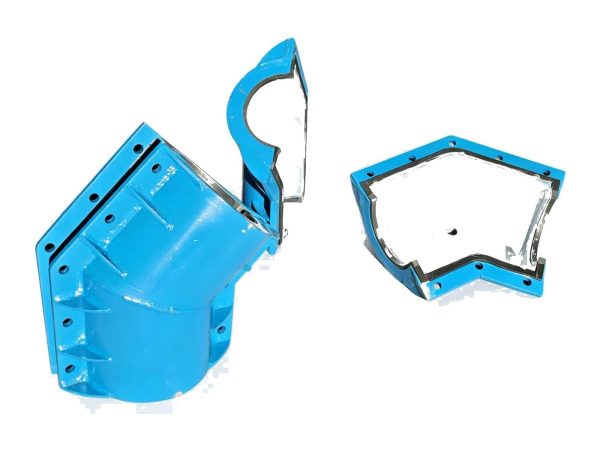
Corrosion-Resistant Repair Sleeve
The interior fluoroplastic barrier protects its covered shell surfaces, while FKM provides the seal; confirm both for…
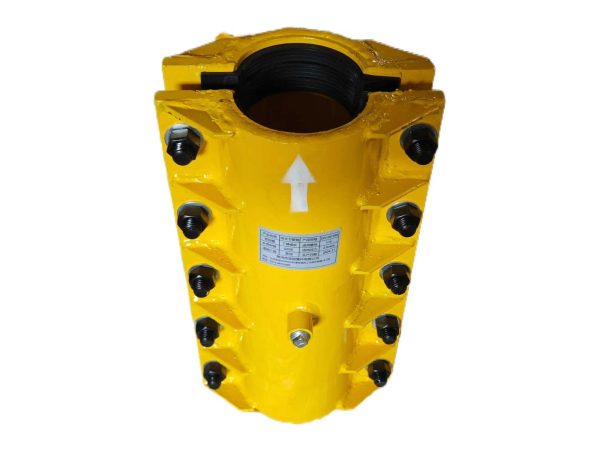
NBR-Sealed Repair Sleeve
NBR-sealed repair clamp for petroleum, lubricant and fuel lines — hydrocarbon service that swells and destroys EPDM…
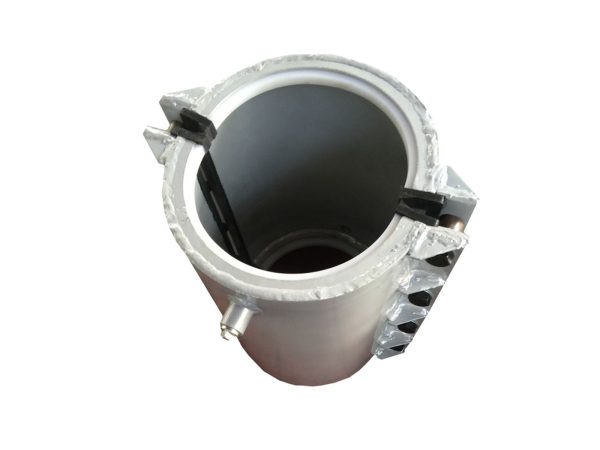
High-Temperature Repair Sleeve
The supplied silicone VMQ seal requires confirmation for the actual fluid, phase, temperature, pressure and thermal…