
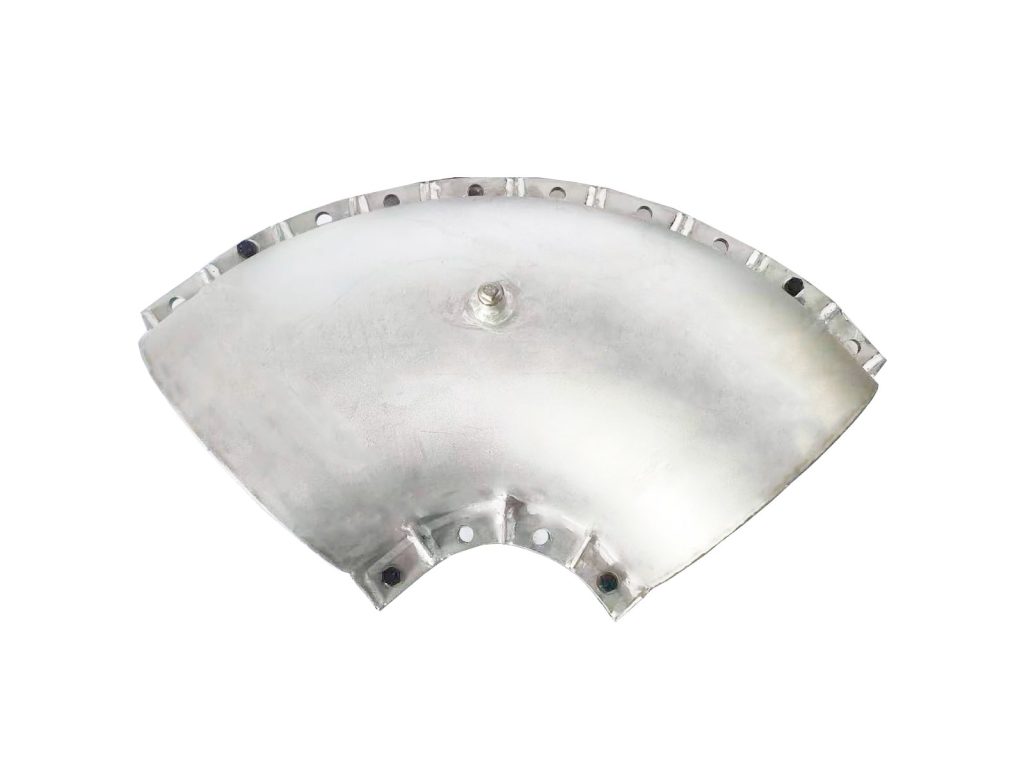
Stainless Steel Repair Sleeve for Elbow Fittings
A stainless elbow split sleeve is formed to the bend and made in the alloy the pipe is made of, which matters more at a bend than anywhere else on a stainless line. Bends are where wall thickness…
Also known as: Stainless Steel Split Repair Elbow, Stainless Steel Elbow Repair Clamp
BS-RCEL-SSUsually replies within 24 hours sales@baoshuopipe.com
Technical Specifications
| Part Number | BS-RCEL-SS |
|---|---|
| Size Range | DN15–DN4000 · Stainless Steel DN15–DN4000 · Custom sizes available beyond the above range |
| Body Material | SS304 / SS316L / Duplex 2205 |
| Seal Material | EPDM / NBR / FKM |
| Sealing Pressure | ≥1.6MPa (232 PSI) |
| Bolt Specification | M16×80, Grade 8.8 High-Strength Bolts |
| Coating | None (Stainless Steel Body) |
| Length Range | 200–600mm (7.9"–23.6") |
| Weight | 0.9–33.4 kg (approx) |
| Applicable Pipe Types | Steel, Stainless Steel, Ductile Iron, PVC |
| Working Conditions | Standard Pressure, Corrosion Resistant |
Custom Orders Available
This product can be customized to your specifications. Contact us with your requirements.
Request Custom QuoteCheck the fit before ordering.
- Measure the actual pipe
- Nominal DN alone does not define the outside diameter. Confirm the pipe material, measured OD and condition.
- Confirm the geometry
- Provide dimensions of the connection or damaged area. Product shape, sealing length and end connections must match the job.
- Match the seal to the service
- Confirm medium, temperature and pressure together. A material name alone is not a service approval.
- Plan a safe installation
- Pipe integrity, isolation and installation procedure require a site-specific assessment. Suitability for live service must be confirmed.
Read the full technical guide7 chapters · complete product description
Product Overview
A stainless elbow split sleeve is formed to the bend and made in the alloy the pipe is made of, which matters more at a bend than anywhere else on a stainless line. Bends are where wall thickness is lowest after forming and where chlorides collect in a crevice, so the part has to sit flat against the curve and not become the anode.
Where it is used
- 45° and 90° bends on stainless and hygienic pipework
- Riser offsets and direction changes in coastal or washdown areas
- Bends where a crevice between shell and pipe would corrode
- Bends repaired between planned outages
Choosing the right build
Send us the outside diameter, the angle of the bend and the length required; the shell is formed per bend. For a defect on the straight leg beside the bend, use the stainless straight sleeve; the range is set out on the stainless steel series page.
How a pre-formed elbow shell carries load around the curve
A straight sleeve seals on two flat contact bands and takes the whole bolt load along those bands. A bend has no straight band to sit on, so the shell has to be formed to the curve before it can hold anything. That pre-forming is what makes the part work: the stainless elbow split sleeve is pressed to the bend radius, which means the bolt load is carried as hoop tension distributed along the arc instead of being concentrated at two straight ends.
The gasket follows the same curve. It is bonded or located into the formed shell so it compresses against the bend at every point of the arc, not only where the shell happens to touch. At the extrados — the outer radius — the pipe surface is in tension and a straight sleeve would leave its widest unsupported span there. A formed shell removes that span, and the leak path at the outside of the bend is closed first.
The bolts sit on the flanks of the bend, on the two straight legs beside the curve, so the arc between them is bridged rather than clamped in the middle.
Installation
- Expose the whole bend, both tangents and enough straight pipe either side to land the shell. A bend that is half buried cannot be fitted properly.
- Measure the outside diameter on both legs. If the two differ, note which leg is which — the shell is formed to the bend, not to an average.
- Clean the bend back to bare metal. On stainless use a stainless wire brush or a dedicated stainless tool; a brush that has been on carbon steel leaves free iron, and the repair becomes the corrosion site.
- Inspect the bend for creases, wrinkles and buckled wall. Formed elbows are thinner on the extrados after bending, so record the lowest wall reading you find and where it sits.
- Dry-fit the shell without the gasket and check contact along the whole arc. High spots and rocking mean the bend is out of round and the shell will not seat evenly.
- Fit with the gasket and centre the shell on the defect, not on the middle of the bend. Mark the position on the pipe before you close it, so it does not walk as you tighten.
- Tighten in stages: bring all bolts up snug first, then work up to the working figure in two passes, alternating across the shell. Watch the gap between the two shell halves — it should close evenly along the bend. A gap that closes at one end and stays open at the other means the shell is misaligned or the bend is oval.
- Bring the line up to pressure with the bend exposed and check the extrados and both flanks. Backfill only after the joint is dry, and support the pipe under the bend so the sleeve does not carry pipe weight.
The commonest mistake is starting with one bolt taken to full torque. That rolls the shell onto one flank, pinches the gasket at the extrados and leaves a leak that no further tightening will close.
What we need to quote the bend
The shell is formed from the bend, so four figures decide the part:
- Outside diameter of each leg — both, separately
- Bend angle (45°, 90° or another angle)
- Centreline radius, or simply whether the fitting is short radius or long radius
- Distance from the bend tangent to the defect, so the shell covers the right arc length
Then the service data: medium, normal and maximum temperature, line pressure, and whether the pipe is insulated. Insulation matters because it sets how much room there is around the bend and whether the sleeve has to be built to sit under lagging.
If you also have the original fitting drawing or the bend angle measured on site, send it. The shell is formed per bend and is not a stock shape, so a dimensional sketch returned to you for confirmation before forming is the surest way to avoid a wrong part. Where the defect is on the straight leg beside the bend rather than in the curve, the stainless straight pipe repair clamp is the right part and is easier to fit.
Where an elbow sleeve is the wrong part
This is a formed part for a sound bend. It has limits worth knowing before you order.
- A creased or wrinkled bend. If the bend was fabricated badly or was buckled in service, the surface is no longer a smooth arc. A formed shell cannot compress a gasket evenly across a crease, and the leak will reappear along the fold. Replace the bend.
- Thin-wall stainless and vacuum service. An external sleeve closes a hole; it does not restore wall thickness and it does not add collapse resistance. Under vacuum, or on a line where the wall is already below what the design allows, the bolt load can oval the pipe. Replace the section.
- A defect at a branch on the bend. A welded branch or a boss near the curve needs a shell formed around the projection. That is a junction part, not an elbow part.
- A moving or unsupported bend. If the bend takes thermal movement or carries pipe weight, a rigid sleeve will be worked until the gasket frets. A straight expansion coupling or a properly supported repair is the right answer.
- Grooved or shouldered ends. A rolled groove changes the diameter locally. The shell will bridge the groove and leak on it; use a coupling designed for the joint.
Where the line is stainless but the medium is not corrosive, the coated carbon steel equivalent on the carbon steel split repair elbow page covers the same geometry.
Material choice for bends
The shell is supplied in SS304, SS316L or Duplex 2205, covered by ASTM A240 / GB/T 3280. The choice follows the pipe, not the pressure: a sleeve in a different alloy from the pipe becomes the anode in any crevice where moisture sits, and a bend is exactly where moisture sits.
- SS304 for hygienic and general process duty where chlorides are low.
- SS316L where chlorides are present, on coastal or washdown installations, or where the pipe is already 316L.
- Duplex 2205 where chloride stress corrosion cracking is the concern, typically warmer chloride-bearing lines, and where a higher strength shell is wanted.
The gasket is EPDM to BS EN 681-1 / GB/T 21873, NBR to BS EN 681-2 / GB/T 21873, or FKM to ASTM D2000 / ISO 1629. Match it to the medium before the geometry: EPDM is the default for potable and waste water but is attacked by mineral oil, NBR suits hydrocarbons but not ketones or ozone, and FKM covers higher temperatures and a wide chemical range at a higher material classification. Compounds are compared side by side in EPDM, NBR, FKM and silicone compared.
Fasteners are SS304 to ASTM A193 / GB/T 3098.6. Because the shell and bolts share an alloy family with the pipe, the installed assembly introduces no new dissimilar metal at the bend. The shell carries the design working pressure of 1.6 MPa with a size range of DN15–DN4000; for the full range see the stainless steel series.
Documents
Material standards ASTM A240 · GB/T 3280 · BS EN 681-1 · GB/T 21873 · BS EN 681-2 · ASTM D2000 · ISO 1629 · ISO 898-1 · GB/T 3098.1
Warning: Undefined array key "rcel-ss" in /www/wwwroot/baoshuopipe.com/wp-content/themes/astra-child/inc/helpers.php on line 1806
Also available in carbon steel: Repair Sleeve for Elbow Fittings
Related Products
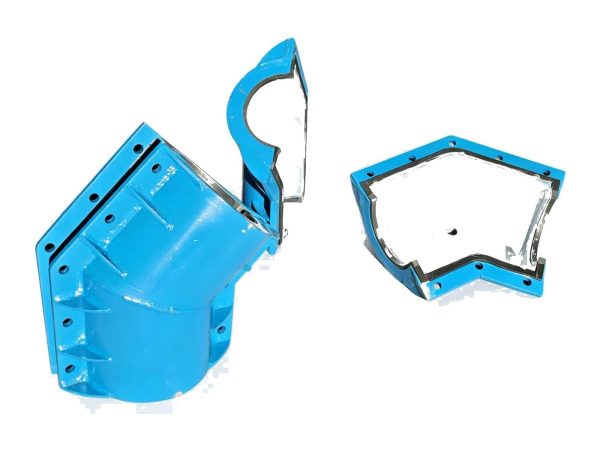
Corrosion-Resistant Repair Sleeve
The interior fluoroplastic barrier protects its covered shell surfaces, while FKM provides the seal; confirm both for…
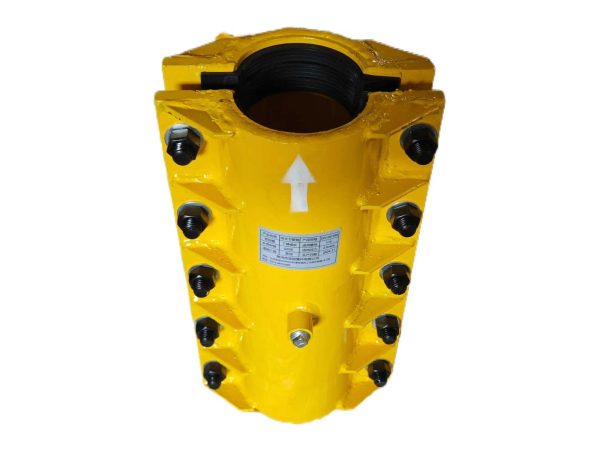
NBR-Sealed Repair Sleeve
NBR-sealed repair clamp for petroleum, lubricant and fuel lines — hydrocarbon service that swells and destroys EPDM…
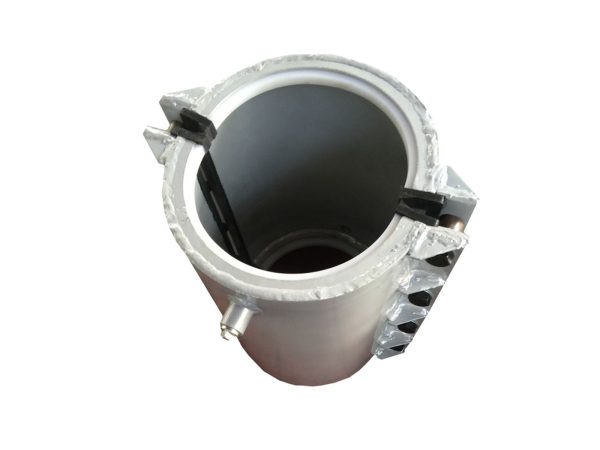
High-Temperature Repair Sleeve
The supplied silicone VMQ seal requires confirmation for the actual fluid, phase, temperature, pressure and thermal…