
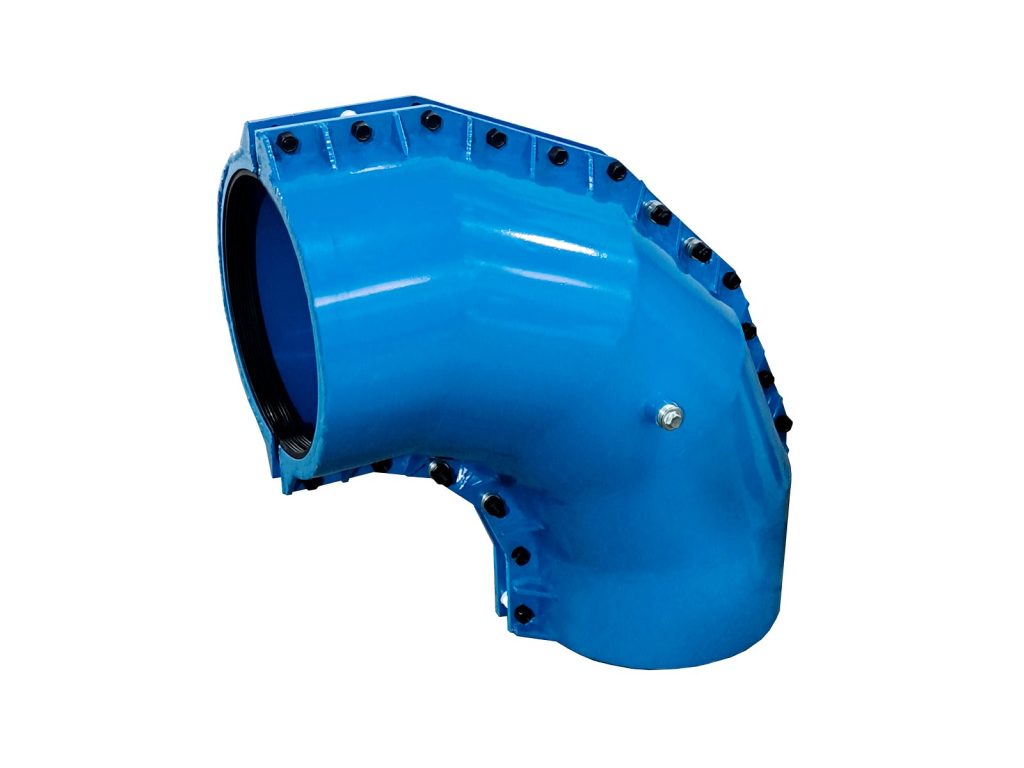
Repair Sleeve for Elbow Fittings
An elbow repair clamp is a split repair sleeve with a pre-formed bend in it. A straight shell cannot lie flat on a curve: it touches the outer radius and bridges the inner one, leaving the gasket unloaded…
Also known as: Split Repair Elbow, Elbow Repair Clamp
BS-RCELUsually replies within 24 hours sales@baoshuopipe.com
Technical Specifications
| Part Number | BS-RCEL |
|---|---|
| Size Range | DN15–DN4000 · Plastic φ20–φ355 · Custom sizes available beyond the above range |
| Body Material | Q235 Carbon Steel / SS304 / SS316L / Duplex 2205 |
| Seal Material | EPDM |
| Sealing Pressure | ≥1.6MPa (232 PSI) |
| Bolt Specification | M16×80, Grade 8.8 High-Strength Bolts |
| Coating | Epoxy Powder |
| Length Range | 150–500mm (5.9"–19.7") |
| Weight | 0.9–33.4 kg (approx) |
| Applicable Pipe Types | Steel, Ductile Iron |
| Working Conditions | Standard Pressure |
Custom Orders Available
This product can be customized to your specifications. Contact us with your requirements.
Request Custom QuoteCheck the fit before ordering.
- Measure the actual pipe
- Nominal DN alone does not define the outside diameter. Confirm the pipe material, measured OD and condition.
- Confirm the geometry
- Provide dimensions of the connection or damaged area. Product shape, sealing length and end connections must match the job.
- Match the seal to the service
- Confirm medium, temperature and pressure together. A material name alone is not a service approval.
- Plan a safe installation
- Pipe integrity, isolation and installation procedure require a site-specific assessment. Suitability for live service must be confirmed.
Read the full technical guide7 chapters · complete product description
Product Overview
An elbow repair clamp is a split repair sleeve with a pre-formed bend in it. A straight shell cannot lie flat on a curve: it touches the outer radius and bridges the inner one, leaving the gasket unloaded where the leak is. The elbow shell follows the bend, so the seal is loaded evenly around the inside and the outside of the curve.
Where it is used
- 45° and 90° bends on steel, iron and plastic pipe
- Leaks on the outer radius, where the wall is thinnest after forming
- Buried bends, riser offsets and plant changes of direction
- Pulled bends that no longer match the drawing
Choosing this clamp
Tell us the pipe outside diameter, the angle of the bend and the length to be covered — the shell is formed to that angle, so it is made per bend. For a defect on either straight leg the straight sleeve is the right part, and where three legs meet it is the tee sleeve.
Why the formed shell behaves differently from a flexible coupling
A flexible coupling absorbs movement by letting its elastomer deform. A split repair elbow does the opposite: the shell is already the shape of the bend, so the gasket is compressed evenly along the whole curve instead of being stretched across the outside radius. That is the point of forming it, and it is also what limits it — the shell only fits the bend it was formed to.
On a bend, the wall thickness is not uniform. Forming pulls material on the outer radius and thickens it on the inner. The outer radius is therefore the thinnest wall and the first place a leak appears, which is exactly the surface a straight sleeve bridges rather than touches.
There is a second effect worth knowing before ordering. The gasket inside the shell is longer on the outer radius than on the inner, so bolt load does not divide equally between the two sides of the bend. The shell geometry and the bolt positions are set to even that out; a shell formed to the wrong angle cannot compensate for it afterwards.
Installation
- Establish the true geometry of the bend as built, not as drawn. Pulled bends and site-made bends often differ from the isometric, and a formed shell fits the bend in front of you.
- Mark the plane of the bend on the pipe and record the angle. A formed elbow shell is not rotationally symmetrical: fitted out of plane it will not seat, and forcing the bolts will distort it.
- Clean the bend back to sound pipe, including the inner radius where access is worst. The outer radius usually gets cleaned properly because it is where the leak is visible.
- Dry-fit the shell to confirm the angle matches and that both straight ends of the shell land on sound pipe beyond the bend tangent points.
- Seat the gasket, keeping it even around both radii. On the inner radius the gasket has spare material to fold into; check it has not rucked.
- Close the shell and tighten in a cross pattern in two or three passes, watching the two split lines on the outside of the bend. They should close together, not one before the other.
- Test, then bed the pipe under the bend. A bend is where a line changes direction, so it is where thrust loads arrive; the sleeve should not be the component carrying them.
What we need to quote
The pipe outside diameter and the bend angle are the two numbers that define the part. After those, the centreline radius or the distance from the bend tangent to tangent, the length of straight pipe at each end that must be covered, and whether the bend is 45°, 90° or a site-made angle.
Also send the pipe material — formed fittings exist in steel, ductile iron and several plastics, and each takes clamping load differently — the medium and its temperature, and whether the bend is buried, in a chamber or inside plant. It is worth photographing the bend with a tape across it, because angle and radius are the two measurements that most often disagree with the drawing, and the shell is made once.
Limits and what to use instead
A formed elbow shell is made for one angle and one outside diameter. It cannot be re-used on a different bend, and it should not be forced onto a bend of a slightly different angle: the gasket will be loaded on one radius and unloaded on the other, which produces a seal that holds at test pressure and weeps under thermal cycling.
It is also the wrong part where the bend has deformed or ovalised. Forming a bend can flatten the section, and a flattened bend leaves the gasket bridging a flat. Where the leak is on the straight leg either side of a bend, the Straight Pipe Repair Clamp is the correct part and considerably cheaper. Where the geometry is a branch off the bend, or a junction rather than a change of direction, the part is a Split Repair Tee. Where an existing flanged connection at the bend is weeping, the Flange Wrap Repair Clamp covers the joint without touching the pipe. Where the line has to absorb movement rather than be sealed, a formed repair shell is the wrong class of product altogether and an expansion joint is the right one.
Materials and standards
Elbow shells are made in Q235 carbon steel to GB/T 700, or SS304, SS316L or Duplex 2205 to ASTM A240 / GB/T 3280. Forming is done cold on the smaller sizes and the material has to tolerate that without cracking, which is one reason duplex and high-strength stainless grades are quoted rather than assumed. Carbon steel remains the default for buried water mains, with stainless chosen for chemical service, coastal ground and lines where iron pick-up in the water is a problem.
Gaskets are EPDM to BS EN 681-1 / GB/T 21873 for water and most municipal service, NBR to BS EN 681-2 / GB/T 21873 for oily media, and FKM or silicone to ASTM D2000 / ISO 1629 where temperature or chemical attack rules the first two out. The gasket matters more on an elbow than on a straight sleeve because it has to form around two radii at once, and a hard compound will bridge rather than follow. Bolts are Grade 8.8 to ISO 898-1 / GB/T 3098.1 or SS304 to ASTM A193 / GB/T 3098.6. Coatings are epoxy to AWWA C210 / GB/T 18593, or zinc plating to ASTM B633 / GB/T 9799.
Documents
In the field
Photographs from completed installations of this product.
Material standards GB/T 700 · ASTM A240 · GB/T 3280 · BS EN 681-1 · GB/T 21873 · AWWA C210 · GB/T 18593 · ISO 898-1 · GB/T 3098.1
Related Products
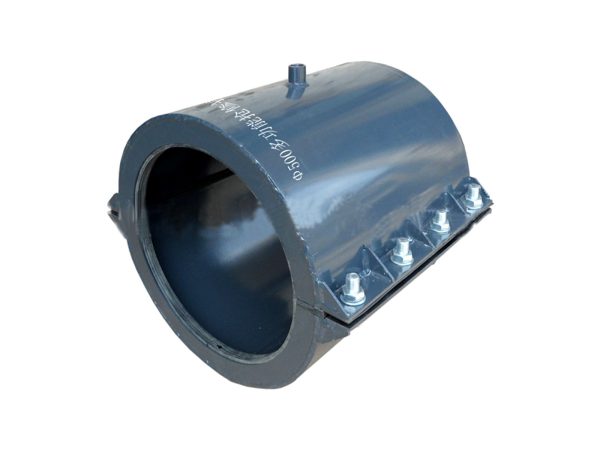
Mechanical Joint Split Repair Sleeve
Select a socket-joint repair sleeve from the actual joint profile, measured pipe and socket diameters, sealing…
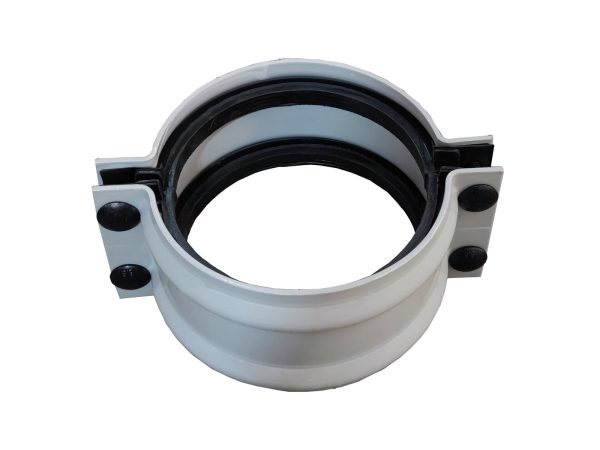
Weld Seam Repair Sleeve
Narrow-profile repair clamp for leaking weld seams on steel pipes. Targets the weld line directly with focused sealing…
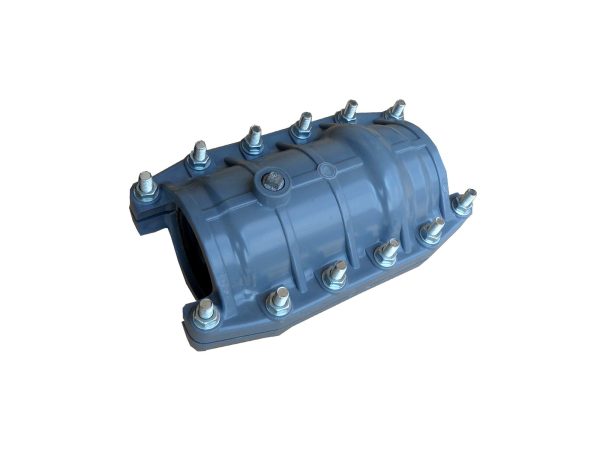
Split Repair Sleeve for PVC-M Pipe
Repair clamp specifically designed for PVC-M pipes. The PVC-M shell and supplied gasket must be checked against actual…