
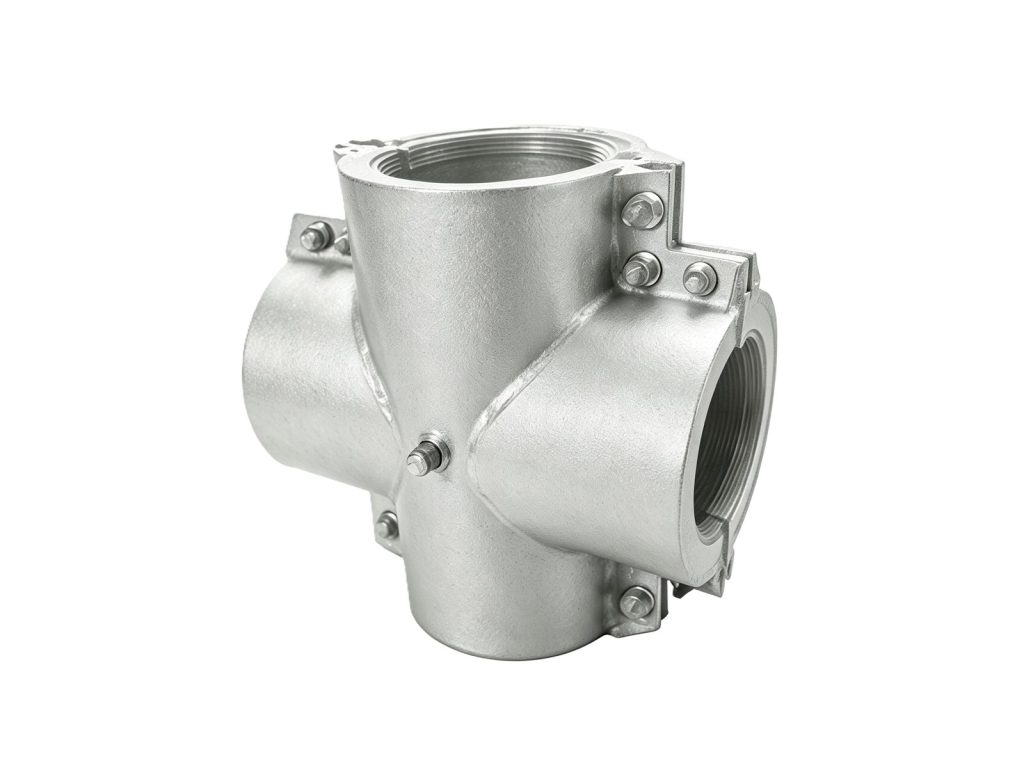
Stainless Steel Repair Sleeve for Cross Fittings
A formed stainless sleeve covers an existing cross fitting; send all four leg diameters, spans and angles for a confirmed fit.
Also known as: Stainless Steel Split Repair Cross, Stainless Steel Cross Repair Clamp
BS-RCCR-SSUsually replies within 24 hours sales@baoshuopipe.com
Technical Specifications
| Part Number | BS-RCCR-SS |
|---|---|
| Size Range | DN15–DN4000 · Stainless Steel DN15–DN4000 · Custom sizes available beyond the above range |
| Body Material | SS304 / SS316L / Duplex 2205 |
| Seal Material | EPDM / NBR / FKM |
| Sealing Pressure | ≥1.6MPa (232 PSI) |
| Bolt Specification | M16×80, Grade 8.8 High-Strength Bolts |
| Coating | None (Stainless Steel Body) |
| Length Range | 200–600mm (7.9"–23.6") |
| Applicable Pipe Types | Steel, Stainless Steel, Ductile Iron, PVC |
| Working Conditions | Standard Pressure, Corrosion Resistant |
Custom Orders Available
This product can be customized to your specifications. Contact us with your requirements.
Request Custom QuoteCheck the fit before ordering.
- Measure the actual pipe
- Nominal DN alone does not define the outside diameter. Confirm the pipe material, measured OD and condition.
- Confirm the geometry
- Provide dimensions of the connection or damaged area. Product shape, sealing length and end connections must match the job.
- Match the seal to the service
- Confirm medium, temperature and pressure together. A material name alone is not a service approval.
- Plan a safe installation
- Pipe integrity, isolation and installation procedure require a site-specific assessment. Suitability for live service must be confirmed.
Read the full technical guide7 chapters · complete product description
Product Overview
The stainless cross split sleeve seals a four-way junction in one bolt-up, with every leg inside the gasket and no coated surface anywhere in the assembly. At a cross the four connections are usually welded close together; if one leaks, the others are already suspect and the metal around them has been heated more than once. Covering the whole junction in one stainless shell deals with all four at the same time.
Where it is used
- Four-way junctions on stainless process and hygienic lines
- Manifolds and distribution points in chemical and food plants
- Junctions that cannot be cut out without a purge and a shutdown
- Corrosive duty where a coated shell would be the weak point
Choosing the right build
We need the diameter of every leg and the distance across the junction — the shell is formed around the projections. Three legs take the stainless tee sleeve; material options are compared on the stainless steel series page.
Sealing a junction with four projections
A cross is the hardest shape in this range to seal. A tee has one projection to wrap a gasket around; a cross has four, and the gasket has to form a closed loop that goes over each one in turn and still meet itself. The shell is pressed so that the four legs sit at the corners of a single conforming surface, and the gasket is cut as one continuous ring with no joint anywhere in it. A gasket assembled from two halves puts a butt joint on one of the four legs, and every leg is equally likely to be the one that weeps.
The bolt load has to close the shell in two perpendicular directions at once. That is why a cross shell is built with the bolts arranged in opposing pairs rather than run along one axis: tightening one pair alone pulls the shell off the legs at right angles to it. The correct sequence alternates between the two axes so the shell closes onto the junction evenly, without walking towards one pair of legs.
The stiffening effect is also different here. Four branch connections close together mean the junction area has been welded several times and the metal around it has been through more than one heat cycle.
Installation
- Establish the geometry before anything else. Check whether the four legs are actually at right angles and roughly in one plane. A cross that looks square on a drawing is often a few degrees out on site, and the shell is formed to the real angle.
- Measure every leg outside diameter and the distance across the junction in both directions. Mark which leg is which on a sketch — the four are frequently not the same size.
- Clean all four legs and the whole junction back to bare metal, including each weld fillet. Any grit or old coating trapped under a collar holds the gasket off and creates a leak path.
- Dry-fit the shell with no gasket. All four collars and the connecting surface must touch. Rocking on any leg means that leg is out of plane and the shell will not seal there.
- Fit with the gasket and centre all four collars at the same time, then mark every leg so the shell cannot shift as it closes.
- Tighten in alternating pairs across the two axes, in two passes. Do not close one axis fully before starting the other.
- Go round a third time on all bolts, because closing the second axis loosens the first. This pass is not optional on a cross.
- Pressure-test with the junction exposed, and watch all four collars and the inside corners where the collars meet.
The mistake that causes most failures is treating a cross like a tee and tightening the pair of bolts that is easiest to reach to full figure first. The shell takes a set across that axis, and the other two legs never compress their gaskets properly, no matter how much you tighten afterwards.
What we need to quote a four-way junction
The shell is formed around the projections, so every leg has to be described:
- Outside diameter of all four legs, listed separately against a marked sketch
- Distance across the junction in both directions, so the shell can be formed to the right span
- Branch projection on each leg, measured from the outside of the junction body
- Whether the legs run in one plane, and whether they are truly at right angles
Then the service: medium, normal and maximum temperature, line pressure, and whether the legs are insulated. Lagging on one leg and not another is common on a manifold and changes the room the collars have.
A sketch with the legs numbered and the measurements written against each number is the single most useful thing you can send, because a cross is formed to order and cannot be corrected on site. Where the junction has only three legs, the part is the stainless split repair tee, which takes the same information on three legs instead of four.
Where a cross sleeve is the wrong part
A cross shell covers a junction that is sound apart from the leak. It fails where the junction has distorted, and a four-way junction distorts more readily than any other shape.
- Legs not in one plane. If one leg has been pulled out of plane, the shell touches on one diagonal and stands off on the other. Two separate tees will not fix it either, because neither closes the corner between them.
- A crack travelling along a weld. With four legs welded close together, a crack at one junction has often started at another. A sleeve hides that. If the junction is cracked rather than pitted, cut it out.
- A wide spread of leg diameters. Four legs of very different sizes leave the shell thin in the transition areas between collars, and the gasket has to change section repeatedly. Ask before ordering; two separate repairs can be the better answer.
- An unsupported vertical cross. A large cross shell is a heavy part on an unsupported junction. If the junction carries the weight of the legs, the shell will be worked until the gasket loses compression. Support the pipework first.
- A junction that must stay accessible. If any leg has to be opened, rodded or have a fitting removed, the collar over it takes that access away. A repair clamp with threaded outlet keeps an outlet usable.
Alloy and gasket selection at a cross
The shell is supplied in SS304, SS316L or Duplex 2205 to ASTM A240 / GB/T 3280. A four-way junction is the worst crevice geometry in the range: four collars, four inside corners, and a body that has been welded repeatedly. Medium collects in those corners and stays there. Specifying the shell in the pipe alloy keeps the whole crevice at one potential.
- SS304 where the pipe is 304 and chlorides are low.
- SS316L for chloride-bearing streams, coastal plants and washdown areas, and wherever the manifold is already 316L.
- Duplex 2205 where chloride stress corrosion cracking is the risk; a heavily welded junction holds residual stress, and residual stress plus chlorides plus warmth is the combination that cracks stainless.
The gasket is a single continuous loop in EPDM to BS EN 681-1 / GB/T 21873, NBR to BS EN 681-2 / GB/T 21873, or FKM to ASTM D2000 / ISO 1629. EPDM is the default for potable and waste water but not for mineral oil; NBR suits hydrocarbon service but not ketones or ozone; FKM covers higher temperature and a broader chemical range. Compounds are compared in EPDM, NBR, FKM and silicone compared.
Fasteners are SS304 to ASTM A193 / GB/T 3098.6. Design working pressure is 1.6 MPa, the size range is DN15–DN4000, and grades are set out on the stainless steel series page. AWWA C230 covers full-encirclement repair and service connection clamps and is named as the industry reference for this family.
Documents
Material standards ASTM A240 · GB/T 3280 · BS EN 681-1 · GB/T 21873 · BS EN 681-2 · ASTM D2000 · ISO 1629 · ISO 898-1 · GB/T 3098.1
Warning: Undefined array key "rccr-ss" in /www/wwwroot/baoshuopipe.com/wp-content/themes/astra-child/inc/helpers.php on line 1806
Also available in carbon steel: Repair Sleeve for Cross Fittings
Related Products
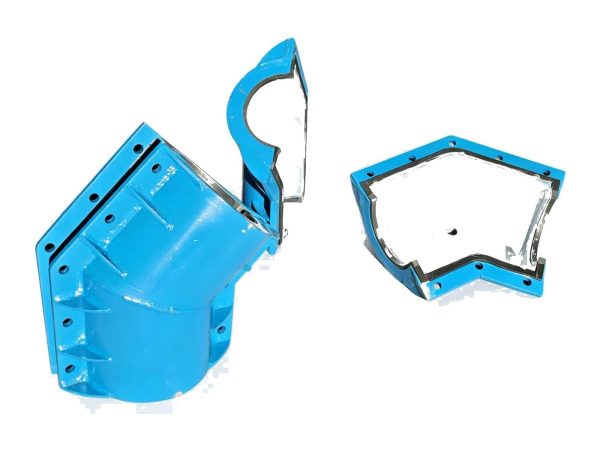
Corrosion-Resistant Repair Sleeve
The interior fluoroplastic barrier protects its covered shell surfaces, while FKM provides the seal; confirm both for…
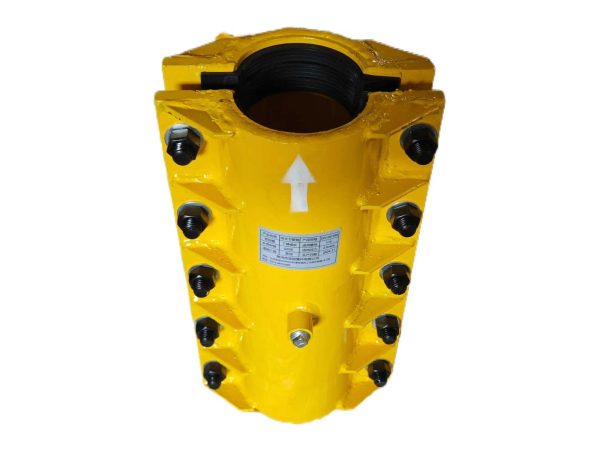
NBR-Sealed Repair Sleeve
NBR-sealed repair clamp for petroleum, lubricant and fuel lines — hydrocarbon service that swells and destroys EPDM…
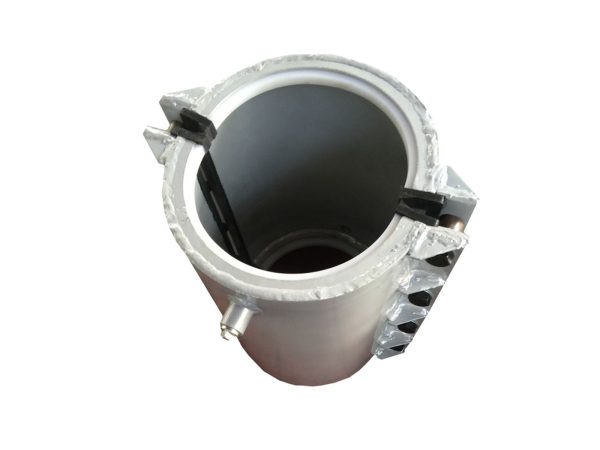
High-Temperature Repair Sleeve
The supplied silicone VMQ seal requires confirmation for the actual fluid, phase, temperature, pressure and thermal…