
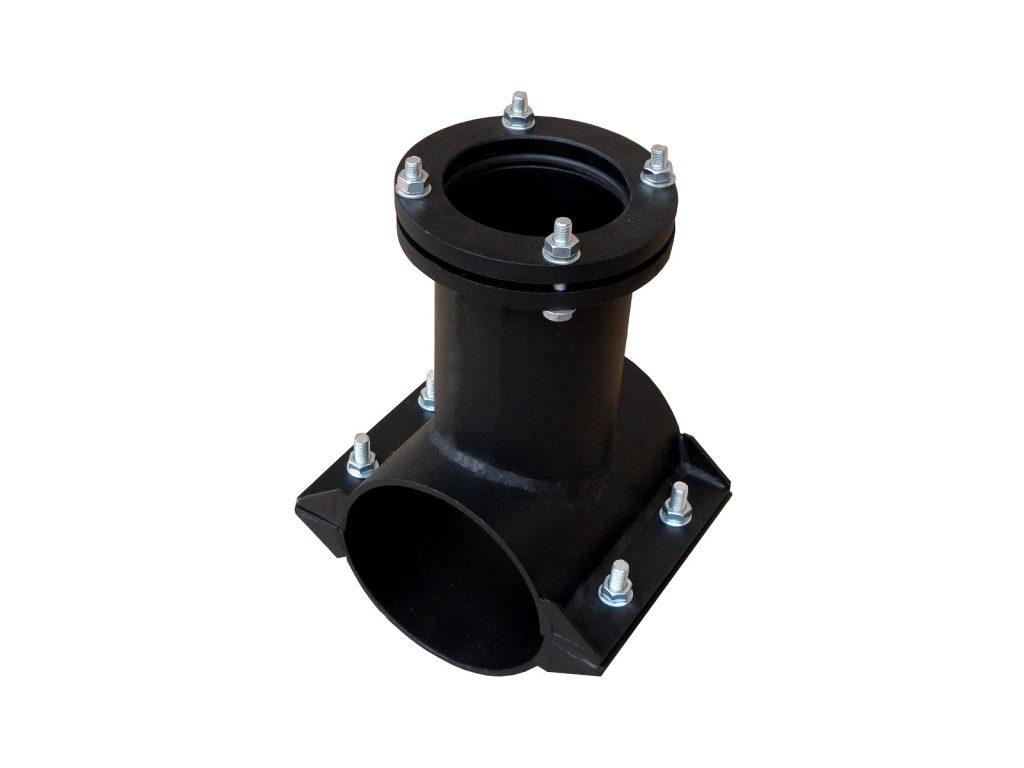
Saddle Outlet with Quick-Connect Branch
A quick-joint tapping saddle adds a branch through a push-fit coupling rather than a thread or a flange. Nothing has to be machined or tightened onto the outlet: the branch pipe is pushed in and held by the…
Also known as: Quick-Joint Saddle Outlet, Quick-Connect Branch Saddle
BS-SLQTUsually replies within 24 hours sales@baoshuopipe.com
Technical Specifications
| Part Number | BS-SLQT |
|---|---|
| Size Range | DN15–DN4000 · Plastic φ50–φ315 / Steel DN50–DN315 · Custom sizes available beyond the above range |
| Body Material | Q235 Carbon Steel / SS304 / SS316L / Duplex 2205 |
| Seal Material | EPDM |
| Sealing Pressure | ≥1.0MPa (145 PSI) |
| Bolt Specification | M16×80, Grade 8.8 High-Strength Bolts |
| Coating | Epoxy Powder |
| Applicable Pipe Types | UPVC, PVC-M, HDPE, PE Composite |
| Working Conditions | Standard Pressure |
Custom Orders Available
This product can be customized to your specifications. Contact us with your requirements.
Request Custom QuoteCheck the fit before ordering.
- Measure the actual pipe
- Nominal DN alone does not define the outside diameter. Confirm the pipe material, measured OD and condition.
- Confirm the geometry
- Provide dimensions of the connection or damaged area. Product shape, sealing length and end connections must match the job.
- Match the seal to the service
- Confirm medium, temperature and pressure together. A material name alone is not a service approval.
- Plan a safe installation
- Pipe integrity, isolation and installation procedure require a site-specific assessment. Suitability for live service must be confirmed.
Read the full technical guide7 chapters · complete product description
Product Overview
A quick-joint tapping saddle adds a branch through a push-fit coupling rather than a thread or a flange. Nothing has to be machined or tightened onto the outlet: the branch pipe is pushed in and held by the coupling. That suits take-offs needed immediately — site water, washdown, a temporary supply to a works area, or an emergency branch to be rationalised later.
Where it fits
- Construction-site water supply and washdown points
- Temporary or emergency branch connections
- Plastic distribution lines where a fused branch would be slow
- Points that will be re-routed once the works are finished
Choosing the right outlet
We need the main outside diameter, the branch pipe size and the branch material, since the coupling grips the pipe it was made for. For a branch that stays and ends in a thread, the threaded outlet saddle is the permanent counterpart; for a branch that ends at equipment, see the flanged outlet saddle.
Why the outlet is a push-fit coupling
A saddle with a threaded outlet has to be held while the branch is screwed in, and that wrench load lands on a formed sheet shell. A saddle with a flanged outlet has to be pulled up against a gasket, and that load lands on the same shell. A push-fit outlet applies neither. The branch pipe is pushed home and held by the coupling, so the only load the shell ever sees is the bolt tension that seals it against the main.
That is the design reason this version exists, and it brings two more things with it. The coupling grips the branch pipe on its outside diameter, so the branch does not have to be cut to an exact length or faced square — the joint tolerates a small amount of angular mismatch between the branch and the main, which matters when the take-off is being made from an excavation rather than a drawing. And the outlet can be capped and left. The saddle then behaves as a branch-ready connection until the day the branch is needed.
The seal at the main is unchanged: a compressed elastomer band held by the shell. The coupling is a second, independent seal, and a weep after commissioning is nearly always at the coupling, not at the main.
Installation
- Measure both the main outside diameter and the branch pipe outside diameter. The coupling is built for a specific pipe, so the branch measurement matters as much as the main.
- Cut the branch pipe square and chamfer the end. Burrs are the single most common cause of a weeping push-fit joint, because they cut the sealing ring on insertion.
- Mark the insertion depth on the branch pipe with a paint line. Without a mark there is no way to tell whether the pipe is fully home.
- Clean and dry the gasket land on the main and check for ovality. On a plastic main, check for deflection from ground load.
- Fit the shell and tension the bolts in a cross pattern in two or three passes. Over-tightening ovalises a plastic main and the gasket loses contact on the flat.
- Pressure-test the shell with the outlet capped before drilling. This separates a main seal problem from a coupling problem while the line is still intact.
- Drill through the outlet, keeping the cutter clear of the coupling bore, and retain the coupon.
- Push the branch pipe home to the mark, then pull back gently to confirm the grip has engaged. Support the branch so it does not hang on the outlet.
What we need to quote
Start with the main outside diameter, then the branch pipe outside diameter and its wall class or pressure rating. The coupling grips a specific outside diameter, so a branch in a thinner wall of the same nominal size will not necessarily be held to the same standard.
Then the working pressure, the surge or vacuum condition if the line has one, the medium and its temperature range, and whether the installation is buried or exposed. Buried work is the normal case for this fitting, and it needs the coating choice settled at order rather than on site.
Two more answers shape the recommendation. Is the take-off permanent or will it be rationalised later — a coupling that will be opened and closed year after year is a different proposition from one installed once? And how will the branch be restrained against pull-out on a line that cycles in pressure?
The size table on this page gives the built range. Outside it, the fitting is quoted as drawn.
Where a push-fit saddle does not belong
The coupling seals on the branch pipe surface, and it is not a restraint against branch thrust on its own. Where the branch is large relative to the main, the thrust rocks the saddle on the main and the main seal starts to weep at the edge of the gasket land. If the branch is large and permanent, specify the Flanged Saddle Outlet Tee and support the branch properly.
It is also the wrong choice where the branch pipe end is out of round, crushed, or has been gripped before. A ring cannot seal against a dent, and it cannot grip a pipe that has already been squeezed.
Where the take-off point is already leaking, this saddle is the wrong part: it adds a branch and does not seal a defect. The push-fit outlet then has to be carried on a repair body instead, which is the Repair Clamp with Quick-Release Outlet.
Finally, a plastic main that has deflected out of round under ground load will not take this fitting — the band cannot pull the gasket down onto a flat. Re-round or replace the section first; where the pipe is already damaged there, the repair part is the PVC-M Straight Repair Clamp. A branch on a permanently plastic-only line is also worth reconsidering: a fused or welded branch has no elastomer seal to age.
Materials and standards
The shell is Q235 carbon steel to GB/T 700 with an epoxy coating to AWWA C210 / GB/T 18593, or SS304, SS316L or Duplex 2205 to ASTM A240 / GB/T 3280 where the fitting will sit in aggressive ground or on a line where a corrosion product is not acceptable. On a plastic main the shell never contacts the pipe — the gasket does — so the shell material is chosen for the soil and the water, not for the pipe it clamps.
The gasket is EPDM to BS EN 681-1 / GB/T 21873, which is the right default for potable water and for contact with PE and PVC surfaces because it seals at low compression without biting the pipe. Where the line carries oil or fuel, the compound becomes NBR to BS EN 681-2 / GB/T 21873. Higher-temperature and chemical duty moves to FKM or silicone to ASTM D2000 / ISO 1629.
Bolts are Grade 8.8 to ISO 898-1 / GB/T 3098.1, or SS304 to ASTM A193 / GB/T 3098.6. The class standard to name on a specification is AWWA C230, full-encirclement repair and service connection clamps.
Material standards GB/T 700 · ASTM A240 · GB/T 3280 · BS EN 681-1 · GB/T 21873 · AWWA C210 · GB/T 18593 · ISO 898-1 · GB/T 3098.1
Related Products
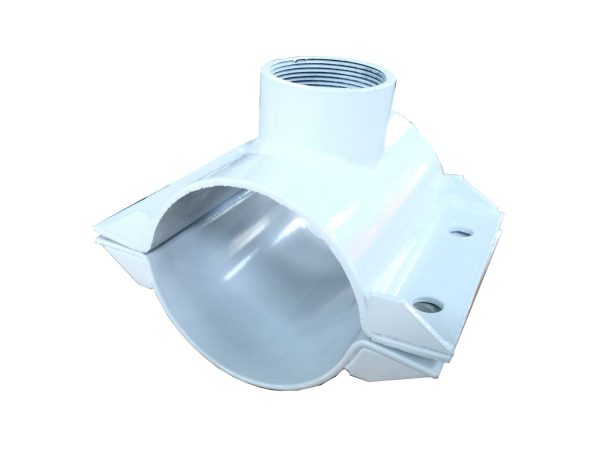
Threaded Saddle Outlet
Saddle-type tapping tee with threaded (BSP/NPT) branch outlet. For adding branch connections to existing pipelines…
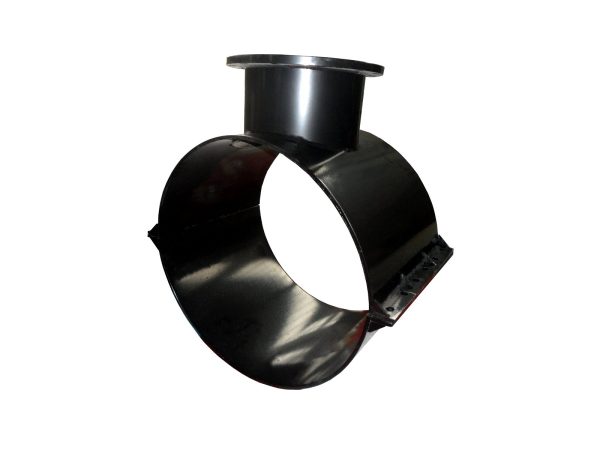
Flanged Saddle Outlet
Saddle-type tapping tee with flanged branch connection. For high-flow branch takeoffs on main pipelines — suitable for…
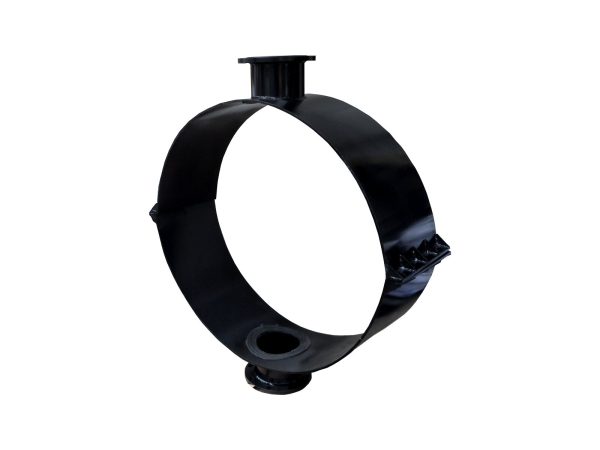
Saddle Outlet for Cross Connections
Four-way saddle clamp for creating cross-intersections on existing pipelines. Two opposing branch outlets with…