
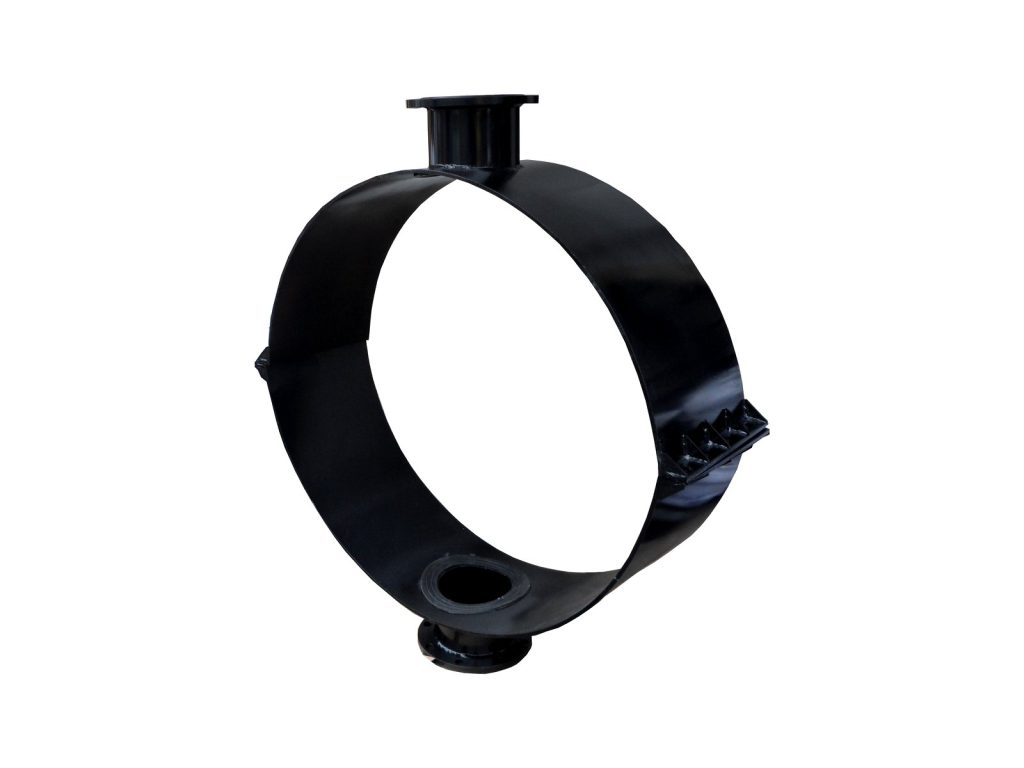
Saddle Outlet for Cross Connections
A tapping saddle cross puts two branches on one main at the same point, each on its own side and each sealed independently. It is used where a network splits at one location rather than two: one fitting…
Also known as: Saddle Outlet Cross, Double Branch Saddle
BS-SLSCUsually replies within 24 hours sales@baoshuopipe.com
Technical Specifications
| Part Number | BS-SLSC |
|---|---|
| Size Range | DN15–DN4000 · Ductile Iron DN100–DN500 / Steel DN100–DN500 · Custom sizes available beyond the above range |
| Body Material | Q235 Carbon Steel / SS304 / SS316L / Duplex 2205 |
| Seal Material | EPDM |
| Sealing Pressure | ≥1.0MPa (145 PSI) |
| Bolt Specification | M16×80, Grade 8.8 High-Strength Bolts |
| Coating | Epoxy Powder |
| Applicable Pipe Types | UPVC, HDPE, Steel, Ductile Iron |
| Working Conditions | Standard Pressure |
Custom Orders Available
This product can be customized to your specifications. Contact us with your requirements.
Request Custom QuoteCheck the fit before ordering.
- Measure the actual pipe
- Nominal DN alone does not define the outside diameter. Confirm the pipe material, measured OD and condition.
- Confirm the geometry
- Provide dimensions of the connection or damaged area. Product shape, sealing length and end connections must match the job.
- Match the seal to the service
- Confirm medium, temperature and pressure together. A material name alone is not a service approval.
- Plan a safe installation
- Pipe integrity, isolation and installation procedure require a site-specific assessment. Suitability for live service must be confirmed.
Read the full technical guide7 chapters · complete product description
Product Overview
A tapping saddle cross puts two branches on one main at the same point, each on its own side and each sealed independently. It is used where a network splits at one location rather than two: one fitting instead of two saddles a pipe-length apart, which also keeps the take-offs in line. Each branch has its own outlet.
Where it is used
- Distribution networks splitting at one point
- Two service connections taken from the same location
- Branch pairs that have to stay in line with each other
- Mains where two separate saddles would sit too close together
Choosing this clamp
Give us the main outside diameter, both branch sizes and their end connections — the two outlets are made to suit what is being connected, and they need not be the same. Where a branch is also a repair point, start from the branch cross; for a single take-off, see the flanged outlet saddle.
Two branches from one band
Two separate saddles a pipe length apart each carry their own bolt load, their own gasket band and their own excavation. A saddle outlet cross puts both outlets on one band, so both holes are drilled through one fitting and the spacing between them is fixed at build rather than decided on site.
The mechanical consequence is the ligament — the strip of shell between the two outlet bores. That strip is the part of the band carrying the hoop tension from one side of the fitting to the other, and once two holes are cut through it there is less metal doing that work. The band is therefore made heavier between the outlets than it would be for a single saddle. This is why the centre-to-centre distance along the main is a build input and not a site decision: an outlet spacing chosen to suit a drawing leaves either enough ligament or it does not.
The two thrusts behave differently depending on the outlet arrangement. Where the outlets are directly opposed along one axis, their thrusts largely cancel at the fitting and the net load into the main is small. Where they leave at an angle, the shell carries the vector sum and needs more bolt load to hold the seal.
Installation
- Measure the main outside diameter, then record the position of both branches as they exist on site — by clock position, not by drawing. A branch that has to land at a fixed downstream point will not move to suit the fitting.
- Confirm the outlet spacing along the main before anything is drilled. Once the band is made, the spacing cannot be adjusted.
- Locate the main’s longitudinal weld seam. It has to sit under a gasket land, not in the ligament between the outlets where the shell is about to be weakened.
- Dry-fit both halves without the gasket to prove the bolt holes align and both outlets clock correctly.
- Seat the gasket as one continuous band, fit the lower half, then the upper half. Bring every bolt up finger-tight first.
- Torque in a cross pattern in two or three passes, working outward from the ligament. Tightening around one outlet first closes that face and springs the other open.
- Pressure-test the main seal before drilling either hole.
- Drill the first hole and retain the coupon, then the second. Connect both branches and support them independently — never use the two outlets to pull two misaligned lines together, which loads the ligament in bending.
What we need to quote
The main outside diameter and material come first, then the two branch sizes. They need not match, so state both, along with the end connection each one needs and the size of the branch pipe that will be connected.
Then the geometry: the angle or clock position of each outlet relative to the other, and the centre-to-centre distance required along the main. If the outlets are opposed, say so explicitly — a straight-through arrangement is a different shell from an angled pair.
Then the service data: working pressure and test pressure, medium and temperature, whether the main stays in service during installation and how the coupons will be retained. Finally the restraint and support arrangement at both branches, and the pit dimensions, because two outlets need more spanner room than one.
The built range is in the table on this page. Sizes and spacings outside it are made to the dimensions you send.
Limits of a two-outlet saddle
A saddle outlet cross adds branches. It does not seal the main, and it does not seal a junction. If the main is weeping between the two outlet positions, drilling into it makes the leak worse and the fitting cannot help. That combination — a junction that is leaking and also has to supply two directions — is the Repair Branch Cross, a split shell with outlets that seals and branches in one bolt-up.
The second limit is the ligament. Two branch holes close together on a small main leave a narrow strip of shell doing the work, and that is where the band bellies. If the branches must be close, the spacing is a design input so the band can be built heavier there. If they can be separated, two single saddles may be the better commercial answer.
Third, this fitting suits new take-offs. Where a single branch is all that is needed, the Flanged Saddle Outlet Tee or the Threaded Saddle Outlet Tee is lighter and cheaper. Where two branches need independent movement, no rigid saddle will do.
Materials and standards
The shell is Q235 carbon steel to GB/T 700 with epoxy coating to AWWA C210 / GB/T 18593 for buried work, or SS304, SS316L or Duplex 2205 to ASTM A240 / GB/T 3280 where the ground, the atmosphere or the water calls for it. Duplex 2205 is worth naming on a cross specifically: with two holes cut in the band, the ligament is the thinnest section in the fitting, and a higher-strength material lets that section do more work without thickening the whole shell.
The gasket is a continuous band, EPDM to BS EN 681-1 / GB/T 21873 for water service and NBR to BS EN 681-2 / GB/T 21873 where the main carries oil or fuel. Because the band has to pass around two openings, it is longer than a single-saddle gasket, and the grade has to resist taking a permanent set along that length. FKM or silicone to ASTM D2000 / ISO 1629 covers higher temperatures.
Bolts are Grade 8.8 to ISO 898-1 / GB/T 3098.1, or SS304 to ASTM A193 / GB/T 3098.6. The relevant class standard is AWWA C223 for fabricated steel and stainless steel tapping sleeves.
Material standards GB/T 700 · ASTM A240 · GB/T 3280 · BS EN 681-1 · GB/T 21873 · AWWA C210 · GB/T 18593 · ISO 898-1 · GB/T 3098.1
Related Products
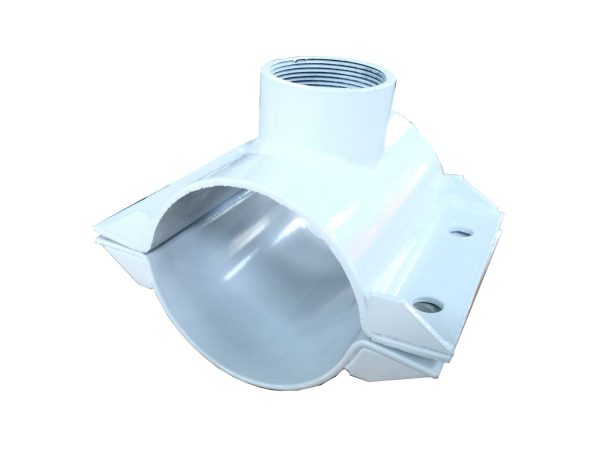
Threaded Saddle Outlet
Saddle-type tapping tee with threaded (BSP/NPT) branch outlet. For adding branch connections to existing pipelines…
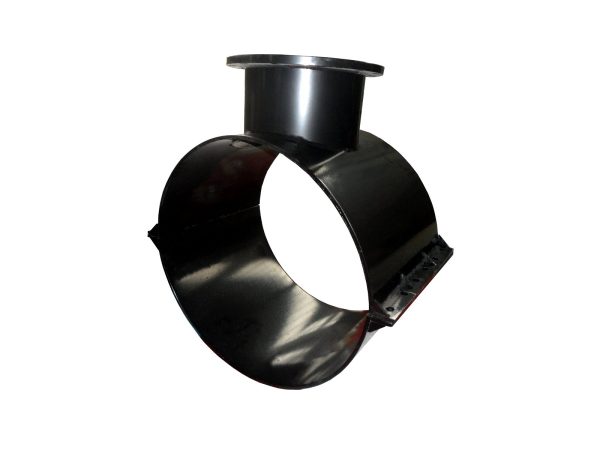
Flanged Saddle Outlet
Saddle-type tapping tee with flanged branch connection. For high-flow branch takeoffs on main pipelines — suitable for…
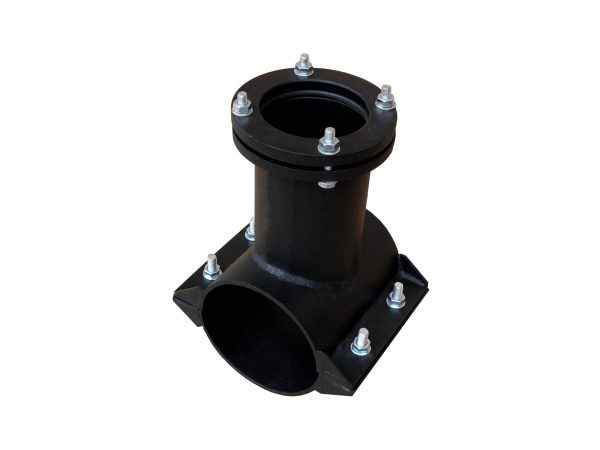
Saddle Outlet with Quick-Connect Branch
Saddle outlet tee with quick-connect coupling on the branch. Tool-free installation for temporary or emergency branch…