
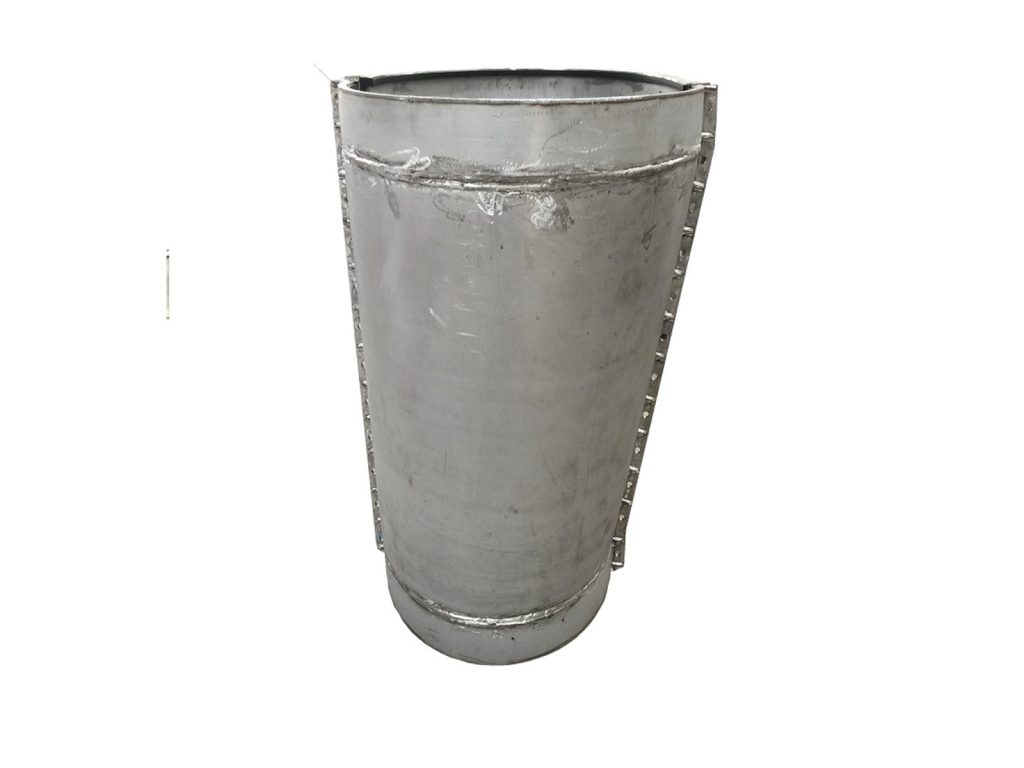
Stainless Steel Repair Sleeve for Reducer Fittings
A stainless reducing split sleeve seals two diameters at once, and on a hygienic line the wetted path stays stainless while it does. The stepped shell closes on each diameter separately, so neither face is bridged, and there…
Also known as: Stainless Steel Reducing Repair Clamp
BS-RCRD-SSUsually replies within 24 hours sales@baoshuopipe.com
Technical Specifications
| Part Number | BS-RCRD-SS |
|---|---|
| Size Range | DN15–DN4000 · Stainless Steel DN15–DN4000 · Custom sizes available beyond the above range |
| Body Material | SS304 / SS316L / Duplex 2205 |
| Seal Material | EPDM / NBR / FKM |
| Sealing Pressure | ≥1.6MPa (232 PSI) |
| Bolt Specification | M16×80, Grade 8.8 High-Strength Bolts |
| Coating | None (Stainless Steel Body) |
| Length Range | 200–600mm (7.9"–23.6") |
| Applicable Pipe Types | Steel, Stainless Steel, Ductile Iron, PVC |
| Working Conditions | Standard Pressure, Corrosion Resistant |
Custom Orders Available
This product can be customized to your specifications. Contact us with your requirements.
Request Custom QuoteCheck the fit before ordering.
- Measure the actual pipe
- Nominal DN alone does not define the outside diameter. Confirm the pipe material, measured OD and condition.
- Confirm the geometry
- Provide dimensions of the connection or damaged area. Product shape, sealing length and end connections must match the job.
- Match the seal to the service
- Confirm medium, temperature and pressure together. A material name alone is not a service approval.
- Plan a safe installation
- Pipe integrity, isolation and installation procedure require a site-specific assessment. Suitability for live service must be confirmed.
Read the full technical guide7 chapters · complete product description
Product Overview
A stainless reducing split sleeve seals two diameters at once, and on a hygienic line the wetted path stays stainless while it does. The stepped shell closes on each diameter separately, so neither face is bridged, and there is no coating to chip at the step where the two diameters meet.
Where it is used
- Concentric and eccentric reducers on stainless process pipe
- Pump suction and discharge spools with stepped diameters
- Hygienic lines where a coating inside the shell is not acceptable
- Transitions that cannot be cut out for a welded replacement
Choosing the right build
Tell us the two outside diameters, how long the transition is, and which diameter sits on which side — the shell is asymmetric and is built in the direction you give. Where the reducer ends at a flange, the part you want is the stainless flange wrap; grades are compared on the stainless steel series page.
Two sealing diameters in one shell
A reducer has two different circumferences a short distance apart, and the transition between them is the leak point. The stainless reducing repair clamp handles this with a stepped shell rather than a tapered one: the bore is machined in two diameters with a shoulder between them, so each end compresses its own gasket band against its own pipe diameter. Sealing in two independent rings is stronger than trying to seal across the step, because the gasket is never asked to bridge a change in radius.
Between the two bands the internal pressure acts on the annular face of the shoulder. That face is the reason the shell is stepped rather than formed as a cone — a cone would let the gasket creep down the slope as the bolts load, whereas a shoulder gives the gasket a positive stop and the shell a face to react against.
On an eccentric reducer the large end and the small end do not share a centreline. The shell follows the offset so both bands stay concentric with their own pipe.
Installation
- Confirm which diameter is on which side before you touch the line. On a concentric reducer the two ends are mirror images and the part can be reversed; on an eccentric reducer it cannot, and a reversed part will not seal.
- On an eccentric reducer, check the orientation of the flat. The flat side is normally set to the top on gas and vapour lines so condensate can run, and to the bottom on liquid lines so the line drains. Record what you have, because the shell has to follow it.
- Clean both pipe diameters and the transition, including the weld cap where the reducer was joined in. A weld cap sitting inside the gasket band is a leak path along the weld.
- Dry-fit the shell without the gasket. Each band must touch its own diameter over the full circumference with no rock. If one band touches and the other stands off, the two pipes are not concentric or the transition is longer than quoted.
- Fit with the gasket and set the shoulder over the middle of the transition, then mark both pipe ends.
- Tighten the bolts at the large end first, in two alternating passes, then the small end. The large end carries more of the pressure load, and closing it first stops the shell being dragged along the pipe.
- Re-check the large end after the small end is closed, then pressure-test and look at both bands, the shoulder and the weld cap.
Two mistakes show up repeatedly. Tightening the small end first rolls the shell towards the large end and opens the large band. Leaving the gasket overhanging the shoulder rather than seated in its band means the closing force is spent folding the overhang instead of compressing the seal.
What we need to quote a reducing repair
The shell is asymmetric, so the order of the diameters is part of the specification:
- Both outside diameters, and which one sits on which side
- Length of the transition, or the overall length of the reducer fitting
- Concentric or eccentric, and on an eccentric reducer the clock position of the flat
- Whether the reducer is welded or threaded into the line, and the position of the nearest weld or fitting each side
Then the service: medium, normal and maximum temperature, line pressure, and flow direction if the line runs one way only. Flow direction matters on eccentric reducers because the flat is usually set for drainage or venting, and the shell is formed to match.
A reducer with a long transition, or one where the two diameters are close together, may not take two separate sealing bands and is worth flagging when you enquire. Where the transition ends at a bolted joint rather than a pipe, the part you want is the stainless flange wrap repair clamp, which spans the joint instead. Where the step is on a carbon steel line, the coated equivalent is on the reducing repair clamp page.
Where a stepped shell will not work
A stepped shell seals a transition on a sound reducer. It does not seal a transition that has moved or thinned.
- Transition longer than the shell. A long gradual cone has no single shoulder to react against, and two bands far apart act as two separate sleeves with an unsupported span between them. Split it into two repairs or replace the fitting.
- Diameters too close to give two bands. Below a certain ratio, cutting two sealing bands leaves too little shell between them to hold the shoulder. Ask before ordering; a straight sleeve may be the better answer.
- Erosion at the step. Reducers erode at the transition where flow accelerates and separates. If the metal is thinned there rather than cracked, a sleeve covers the thin area without restoring it. Replace the fitting.
- A reducer at a pump suction with vibration. Vibration frets a rigid shell against the pipe and the gasket loses compression. Deal with the vibration or use a flexible joint instead.
- A transition that leaks because the joint has cracked, not the pipe. Where the reducer has cracked at the weld, the crack can run under the shell. Cut out and reweld.
Where the real problem is that two pipes of different material have been joined, a mechanical joint or an adapter made for that transition is the correct part, not a repair sleeve.
Alloy and gasket selection on a transition
The shell is supplied in SS304, SS316L or Duplex 2205 to ASTM A240 / GB/T 3280. On a reducer the two bands land on the same body of metal, so both must be in the same alloy as the fitting. Mixing an SS304 shell onto a 316L reducer puts the shell and the reducer at different potentials in the same crevice, and the shell — thinner and more highly stressed — is generally the one that suffers.
- SS304 for 304 pipework with low chlorides.
- SS316L where chlorides are present, on coastal and washdown installations, and wherever the reducer itself is 316L.
- Duplex 2205 where chloride stress corrosion cracking is the concern or a stronger shell is wanted at a step where the bolt load is unevenly shared.
Two gasket bands mean two seals and twice the chance of a wrong compound if the two ends see different conditions. The gasket is EPDM to BS EN 681-1 / GB/T 21873, NBR to BS EN 681-2 / GB/T 21873, or FKM to ASTM D2000 / ISO 1629. EPDM is the default for potable and waste water but is attacked by mineral oil; NBR suits hydrocarbons but not ketones or ozone; FKM covers higher temperature and a wider chemical range. Both bands are supplied in the same compound unless a different pairing is asked for, and the differences are compared in EPDM, NBR, FKM and silicone compared.
Fasteners are SS304 to ASTM A193 / GB/T 3098.6. Design working pressure is 1.6 MPa across a size range of DN15–DN4000, and the grades are set out on the stainless steel series page.
Documents
Material standards ASTM A240 · GB/T 3280 · BS EN 681-1 · GB/T 21873 · BS EN 681-2 · ASTM D2000 · ISO 1629 · ISO 898-1 · GB/T 3098.1
Warning: Undefined array key "rcrd-ss" in /www/wwwroot/baoshuopipe.com/wp-content/themes/astra-child/inc/helpers.php on line 1806
Also available in carbon steel: Repair Sleeve for Reducer Fittings
Related Products
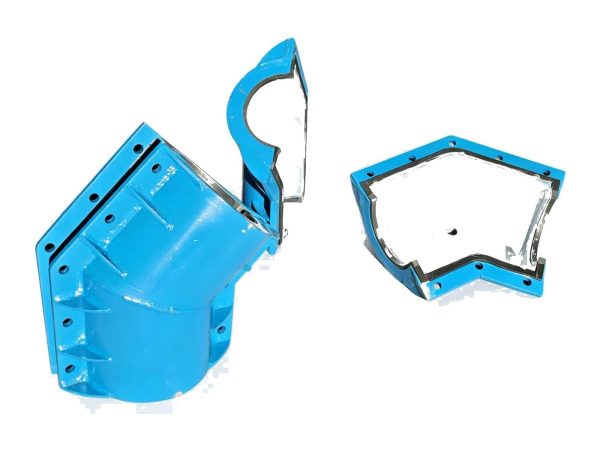
Corrosion-Resistant Repair Sleeve
The interior fluoroplastic barrier protects its covered shell surfaces, while FKM provides the seal; confirm both for…
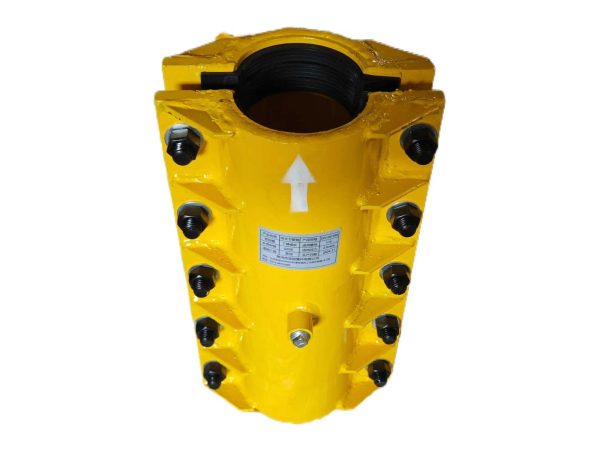
NBR-Sealed Repair Sleeve
NBR-sealed repair clamp for petroleum, lubricant and fuel lines — hydrocarbon service that swells and destroys EPDM…
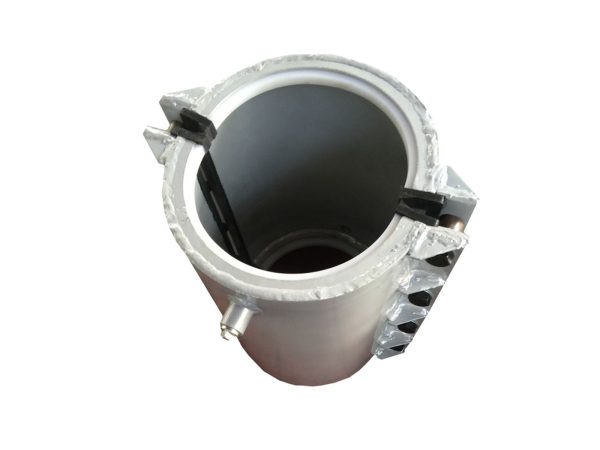
High-Temperature Repair Sleeve
The supplied silicone VMQ seal requires confirmation for the actual fluid, phase, temperature, pressure and thermal…