
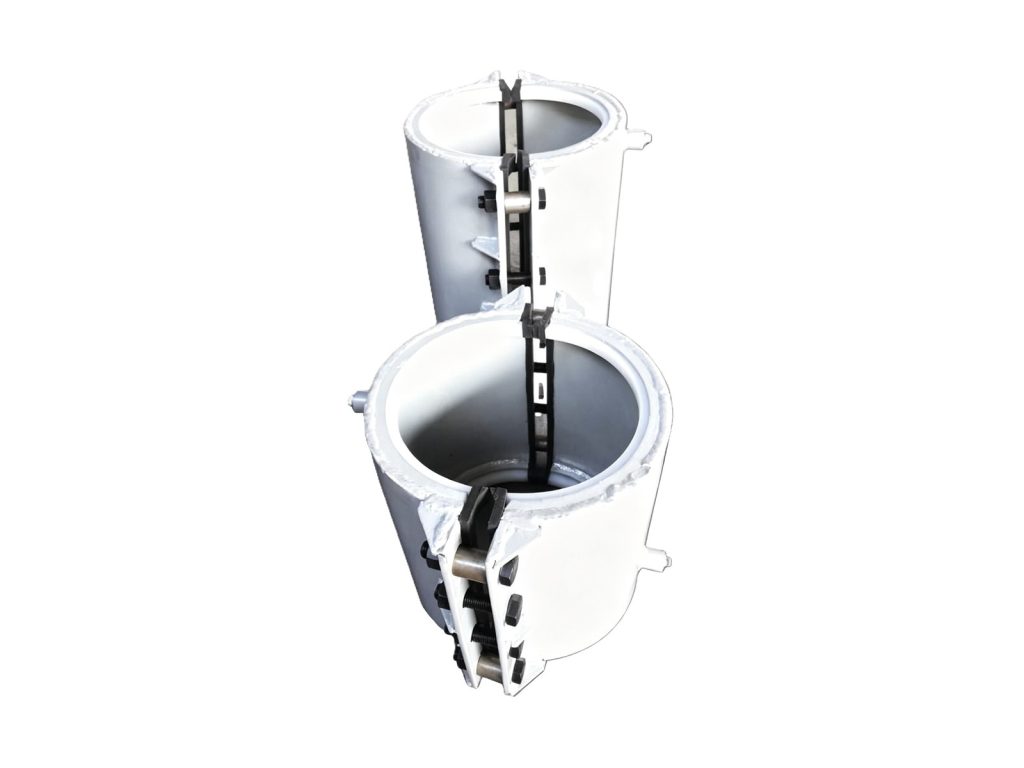
Ultra-Low-Temperature Repair Sleeve
At low temperature the failure mode of a split sleeve changes: an elastomer that is flexible at ambient becomes glassy and brittle, and a gasket that sealed during a pressure test can crack when the line is cooled…
Also known as: Low Temperature Repair Clamp, PTFE Sealed Repair Sleeve
Usually replies within 24 hours sales@baoshuopipe.com
Technical Specifications
| Size Range | DN15–DN4000 · Ductile Iron DN15–DN4000 / Steel DN15–DN4000 / Stainless Steel DN15–DN4000 · Custom sizes available beyond the above range |
|---|---|
| Body Material | Carbon Steel Q235 / SS304 / SS316L / Duplex 2205 |
| Seal Material | PTFE |
| Sealing Pressure | ≥1.6MPa (232 PSI) |
| Bolt Specification | M16×80, Grade 8.8 High-Strength Bolts |
| Coating | Epoxy Powder (or Stainless Steel on request) |
| Length Range | 200–600mm (7.9"–23.6") |
| Applicable Pipe Types | Steel, Stainless Steel, Ductile Iron, PVC |
| Working Conditions | Ultra-Low Temperature |
Custom Orders Available
This product can be customized to your specifications. Contact us with your requirements.
Request Custom QuoteCheck the fit before ordering.
- Measure the actual pipe
- Nominal DN alone does not define the outside diameter. Confirm the pipe material, measured OD and condition.
- Confirm the geometry
- Provide dimensions of the connection or damaged area. Product shape, sealing length and end connections must match the job.
- Match the seal to the service
- Confirm medium, temperature and pressure together. A material name alone is not a service approval.
- Plan a safe installation
- Pipe integrity, isolation and installation procedure require a site-specific assessment. Suitability for live service must be confirmed.
Read the full technical guide7 chapters · complete product description
Product Overview
At low temperature the failure mode of a split sleeve changes: an elastomer that is flexible at ambient becomes glassy and brittle, and a gasket that sealed during a pressure test can crack when the line is cooled and re-warmed. Confirm the supplied seal construction and complete assembly for the actual minimum temperature, fluid phase, pressure and contraction cycles using configuration-specific evidence.
Where it is used
- Proposed cold-service conditions require confirmation of the supplied assembly before approval.
- Cold-recovery and low-temperature process lines
- Lines that cycle between ambient and very low temperature
- Insulated pipe where the repair stays under the lagging
Choosing the right build
Give us the outside diameter, the lowest temperature reached and the number of cycles the line sees — cycling determines the seal as much as the minimum does. Compounds are compared in EPDM, NBR, FKM and silicone compared; the stainless version is the stainless ultra-low temperature sleeve.
What changes when the line goes cold
Cold does not degrade a sealing material the way heat does. It stiffens it. Every elastomer has a temperature below which it stops behaving like rubber and starts behaving like a rigid plastic, and below that point it will not deform to follow the pipe surface and will not recover when the load comes off. A gasket that sealed perfectly at ambient becomes a hard ring with no elasticity left in it, and the leak appears at the frost line rather than at the defect.
The second effect is differential contraction. The pipe contracts as it cools, and the shell contracts with it, but not to the same degree. Compression on the gasket changes as the line comes down to temperature, and the gasket has to keep sealing across that change while it is becoming less able to deform.
The third effect only appears later. If the line is cooled and rewarmed, the gasket is squeezed in one state and released in another. It takes a set in whichever state it spent longest in, and on the next cycle it no longer fills the gap it was compressed into. That is why a low-temperature repair can hold through a commissioning test and then fail on the second or third cycle.
Installation
- Get the real minimum, not the design minimum. Ask what the line actually reaches during a cooldown, a defrost, a depressurisation or a trip, because those excursions are usually lower than normal operation and they are what the seal has to survive.
- Establish whether the line cycles, and roughly how often. A seal that only ever sits cold is a different problem from one taken between ambient and cryogenic repeatedly.
- Check whether the line is pigged, purged, steamed or defrosted with anything warm, and at what temperature. A routine warm purge can take the seal above the range it was chosen for.
- Remove the insulation generously rather than trimming it back to the last possible edge. Frost travel along the pipe under lagging often means the wet or damaged area is longer than the visible leak.
- Look at where the ice or frost forms before you clean anything. The frost pattern shows the leak path, and on an insulated line it shows how far water has travelled along the pipe.
- Clean back to bare metal and check for wall loss. Cryogenic and refrigeration lines suffer from water ingress at damaged cladding, and the corrosion is frequently worse than the original defect.
- Fit and tighten at ambient, in two alternating passes, to the figure for the working condition rather than adding extra load to allow for contraction. Over-compressing a low-temperature seal is what extrudes it.
- Cool down slowly with the repair exposed and inspect at temperature, then inspect again after the first full warm-up. The warm-up inspection is the one that reveals whether the gasket took a set.
The frequent mistake is to over-tighten against the expected contraction. It feels like insurance and it is not: the material most at risk here has the least ability to recover from being crushed, so extra load makes the second cycle worse rather than better.
What we need to quote a cold duty
The lowest temperature is one number; the cycling is the other, and both are needed:
- Minimum temperature actually reached, and whether it is continuous or an excursion
- Maximum temperature the line also sees, including defrost and purge, and how often it goes between the two
- The medium, whether it is liquid or gas at the repair point, and whether the line can be isolated and warmed for the repair
- Outside diameter, line pressure, and whether the line is insulated, in a cold box, or buried
Then the practical question that decides whether a sleeve can be fitted at all: how much straight pipe is exposed and how much room there is around it. A cold line in a cold box or a dense rack often has very little access, and that is decided long before the seal is chosen.
If the medium is one of the refrigerants or cryogenic fluids that also causes rapid decompression problems, or if the line is a liquefied gas service with its own code requirements, say so. That is a case where the honest answer may be that the section should be replaced rather than sleeved, and we will say so.
Where each seal reaches its cold limit
Low-temperature behaviour is the one place where the usual ranking of sealing materials reverses, so it is worth setting out where each one stands.
- Nitrile (NBR) is the first to go. Its low-temperature flexibility depends on how it is formulated and it stiffens earlier than the others. It has no place on a genuinely cold line, whatever its oil resistance is worth elsewhere.
- FKM is an excellent high-temperature seal and a poor low-temperature one. Standard FKM grades stiffen at temperatures well above those a refrigeration or cryogenic line reaches, which is the specific trap here: a buyer who knows FKM as the premium compound picks it for the wrong reason and gets a seal that is rigid at the working condition. FKM’s other weaknesses are hot water and steam, hot strong alkalis, and ketones, esters and low-molecular-weight organic acids.
- Silicone (VMQ) is the best of the elastomers in the cold, staying flexible where FKM and NBR have already hardened, and it cycles well. Its weakness is mechanical: silicone has the lowest tear strength of the common sealing materials, and it swells in oils, fuels and many solvents. It is a cold-water and cold-air seal, not a cold-hydrocarbon one.
- EPDM keeps useful flexibility at low temperature, handles water, glycol mixtures and many polar media, and is tough. It is attacked by mineral oil and many non-polar solvents, so it is the wrong choice where the cold line also carries hydrocarbon.
- PTFE is not an elastomer at all, and that is the point of using it here. PTFE compatibility and low-temperature performance require confirmation for the actual grade, fluid phase, pressure and complete seal construction. What it lacks is elastic memory: it does not spring back. Confirm the PTFE element’s actual sealing, barrier or anti-extrusion role, its support and the assembly’s load-retention arrangement from the supplied seal drawing.
Acceptance of this sleeve for cold duty requires evidence that the supplied seal, shell and fasteners maintain the required sealing load through the specified temperature and contraction cycles. If your line also runs hot, or carries hydrocarbon as well as cold, say so — neither is a given. See EPDM, NBR, FKM and silicone compared.
Materials and standards
The shell is supplied in carbon steel Q235 to GB/T 700, or in SS304, SS316L or Duplex 2205 to ASTM A240 / GB/T 3280. Cold service puts the choice in a specific light: a cold shell sits below the dew point for most of its life, so it is wet, and the crevice between shell and pipe stays wet and stagnant. That is what makes the alloy decision matter on a line whose medium is completely benign.
- Q235 with epoxy to AWWA C210 / GB/T 18593 for indoor refrigeration plant with no chloride exposure.
- SS304 for general cold duty with low chlorides.
- SS316L where chlorides are present, which on a cold line means any site where de-icing salts, coastal air or chloride-bearing process water reaches the pipe.
- Duplex 2205 where a stronger shell is wanted and the assembly has to resist a wet crevice over a long service life.
The supplied seal field lists PTFE, which is a fluoroplastic; any FKM alternative and its material classification require a separate evaluation rather than being treated as the same sealing construction. Fasteners are grade 8.8 to ISO 898-1 / GB/T 3098.1, or SS304 to ASTM A193 / GB/T 3098.6. On a cycling cold line the fasteners hold the compression while the pipe contracts and expands, and a fastener that relaxes under that cycling takes the seal with it. The design working pressure is 1.6 MPa and the size range is DN15–DN4000.
Documents
Material standards GB/T 700 · ASTM A240 · GB/T 3280 · AWWA C210 · GB/T 18593 · ISO 898-1 · GB/T 3098.1
Also available in stainless steel: Stainless Steel Ultra-Low-Temperature Repair Sleeve
Related Products
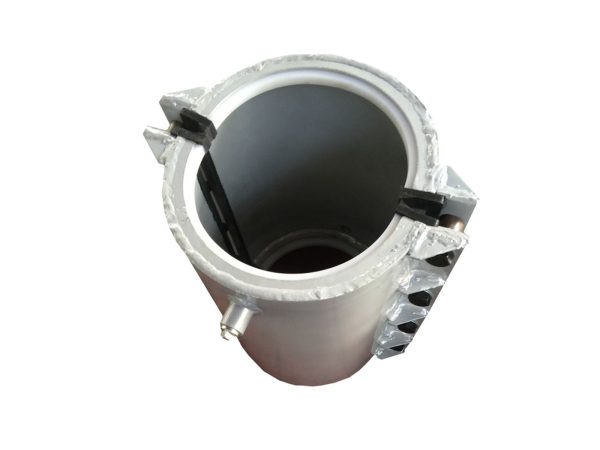
High-Temperature Repair Sleeve
The supplied silicone VMQ seal requires confirmation for the actual fluid, phase, temperature, pressure and thermal…
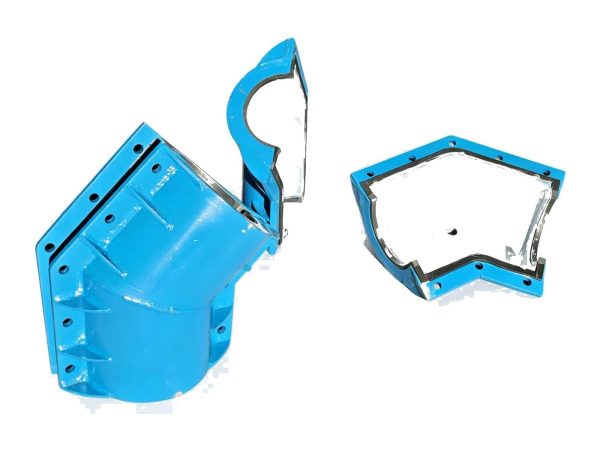
Corrosion-Resistant Repair Sleeve
The interior fluoroplastic barrier protects its covered shell surfaces, while FKM provides the seal; confirm both for…
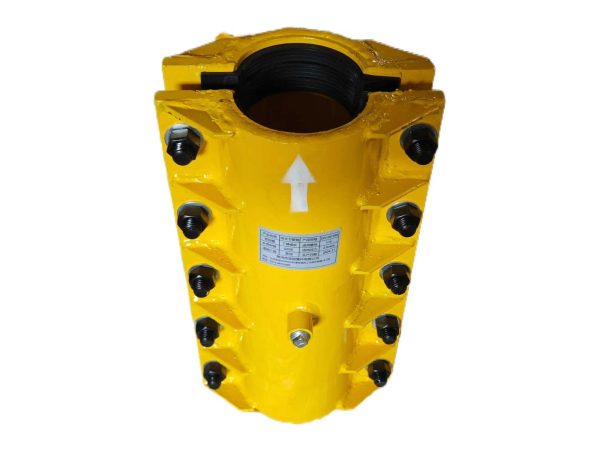
NBR-Sealed Repair Sleeve
NBR-sealed repair clamp for petroleum, lubricant and fuel lines — hydrocarbon service that swells and destroys EPDM…