
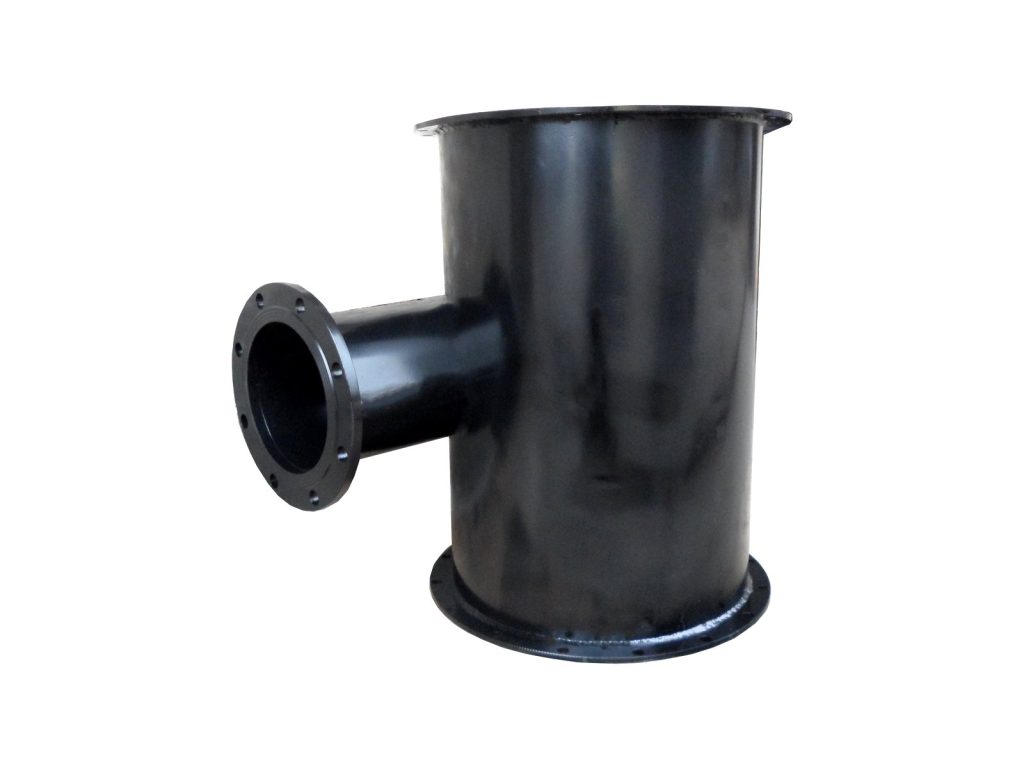
Tee with Three Sockets
A triple socket tee makes a branch on plain-end pipe through three push-fit sockets: two in line for the run, one for the branch. There is nothing to fuse and nothing to thread, so the branch is assembled…
Also known as: Triple Socket Tee, Three-Socket Tee
BS-SJDTUsually replies within 24 hours sales@baoshuopipe.com
Technical Specifications
| Part Number | BS-SJDT |
|---|---|
| Size Range | φ63–φ800 · Custom sizes available beyond the above range |
| Body Material | Q235 Carbon Steel / SS304 / SS316L / Duplex 2205 |
| Seal Material | EPDM |
| Sealing Pressure | ≥1.6MPa (232 PSI) |
| Bolt Specification | M16×80, Grade 8.8 High-Strength Bolts |
| Coating | Epoxy Powder |
| Applicable Pipe Types | UPVC, PVC-M |
| Working Conditions | Standard Pressure |
Custom Orders Available
This product can be customized to your specifications. Contact us with your requirements.
Request Custom QuoteCheck the fit before ordering.
- Measure the actual pipe
- Nominal DN alone does not define the outside diameter. Confirm the pipe material, measured OD and condition.
- Confirm the geometry
- Provide dimensions of the connection or damaged area. Product shape, sealing length and end connections must match the job.
- Match the seal to the service
- Confirm medium, temperature and pressure together. A material name alone is not a service approval.
- Plan a safe installation
- Pipe integrity, isolation and installation procedure require a site-specific assessment. Suitability for live service must be confirmed.
Read the full technical guide7 chapters · complete product description
Product Overview
A triple socket tee makes a branch on plain-end pipe through three push-fit sockets: two in line for the run, one for the branch. There is nothing to fuse and nothing to thread, so the branch is assembled by pushing three pipe ends home — a coupling in the plainest sense. That makes it the practical fitting at distribution junctions, and where the pipe is already laid.
Where it is installed
- Branch connections on plain-end plastic distribution pipe
- Junctions assembled in the trench rather than in a shop
- Tie-ins where the pipe is already in place
- Positions that may need to be opened again for access
Choosing the right size
We need the outside diameters of the run and the branch, the pipe material and the line pressure — the sockets are sized to the pipes, so all three diameters have to be stated. Four lines meeting instead of three take the quad socket cross; assembly: installation manual.
Three seals at once, and a branch that pushes sideways
A triple socket tee makes three simultaneous ring seals, and the third one changes the mechanics of the fitting. On the run, the two opposing thrusts mostly cancel against each other. The branch does not cancel anything: its pressure thrust acts at right angles to the run and has to be carried entirely by anchorage behind the branch. That is the load case people miss, because the run pipe looks substantial while the branch looks like an afterthought.
The fitting also grips none of the three pipes. Its position is set by the pipe layout, so the run has to be cut to the tee’s face-to-face length plus both insertion depths, and the branch has to land exactly where the branch socket sits. There is no sliding it along the run afterwards, and there is no rotation to correct a branch that points the wrong way.
Assembly order matters more here than on any other fitting in the family. Pushing the branch pipe home tends to rotate the tee in the trench, which disturbs the two run joints that were already made. The usual sequence is run first, with the tee supported, branch last.
Installation
- Cut the run pipe to the tee’s face-to-face length plus the two marked insertion depths. Cutting it short and using the sockets to bridge the gap consumes the movement the joints need.
- Support both run ends at the same level and on the same line before the tee is presented. A tee that has to hold alignment will leak at one socket.
- Chamfer and deburr all three pipe ends and mark the insertion depth on each.
- Check all three rings are seated and undamaged, and lubricate them and the pipe ends with the specified lubricant.
- Assemble the run first, with the tee carried on a sling so its weight is not hanging on the rings, then confirm both insertion depths.
- Insert the branch pipe, keeping it square to the branch socket, and re-check the two run depths afterwards.
- Support the branch pipe independently so its weight and any valve on it are not carried by the branch socket.
- Anchor or thrust-block behind the branch before pressure is applied, then test before backfill.
What to send with an enquiry
- Run outside diameter and branch outside diameter. They do not have to match, but both must be stated because the sockets are sized individually.
- Pipe material and wall class for all three connections.
- The branch angle, whether 90 degrees or oblique. An oblique branch produces a smaller resultant but in a less convenient direction, so it has to be known before the part is made.
- Working pressure and surge pressure, which size the anchorage behind the branch.
- Medium and temperature, which choose the ring compound.
- Whether the branch will carry a valve or a meter. A valve is a concentrated weight and a second thrust case in the same place.
- Depth of cover, ground conditions and the restraint plan for the branch.
If the branch is expected to settle differently from the run, say so. That is a design input, not an installation detail.
Failure modes, and where a tee is the wrong part
Branch thrust blow-off is the classic failure, and it happens because the branch anchorage was copied from the run detail. The second is the tee rotating in the trench before backfill, usually because the branch pipe was left unsupported and the tee took its weight. The third is the fitting acting as a rigid node: where the branch settles more than the run, the movement concentrates at the socket and cracks appear in the run pipe just outside it. With three rings there are also three separate chances of rolling one during assembly, and the rolled one is often the one nobody re-checked.
Do not use this tee where the run cannot be cut or where the branch is being added to a line already in service. For a live branch, a saddle outlet or a repair branch clamp is the right family: the repair clamp with threaded outlet for a small screwed branch, the flanged saddle outlet tee for a flanged one, or the repair clamp with quick-release outlet where the branch has to be connected fast.
Four lines meeting at one point take the quad socket cross.
Materials and the standards behind them
The body is Q235 carbon steel to GB/T 700 with an epoxy coating to AWWA C210 / GB/T 18593, or SS304, SS316L or Duplex 2205 to ASTM A240 / GB/T 3280.
On a fabricated tee the branch socket is a welded joint, and in aggressive ground the weld is a corrosion path. That is one reason a fully coated carbon steel body is specified with edge coverage on the weld and on every socket lip, and one reason to move to a stainless body where the ground is wet, saline or contaminated. Use SS316L where chlorides are present and Duplex 2205 where the fitting also carries mechanical load, which is normal at a branch under a road.
The rings are EPDM to BS EN 681-1 / GB/T 21873 for potable water, or NBR to BS EN 681-2 where the medium carries oil or fuel. The double socket and socket tee family follows DIN 28650. Fitting is covered in the socket joint fittings installation manual, and the quoting fields are on the triple socket tee datasheet.
Documents
Material standards GB/T 700 · ASTM A240 · GB/T 3280 · BS EN 681-1 · GB/T 21873 · AWWA C210 · GB/T 18593 · ISO 898-1 · GB/T 3098.1
Related Products
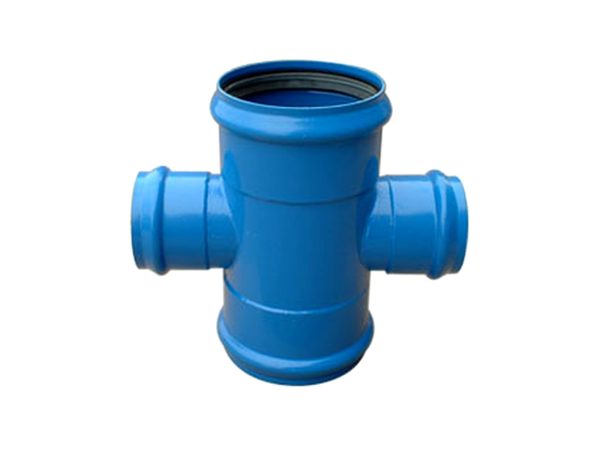
Cross with Four Sockets
Socket-type cross fitting for four-way intersections on plain-end pipes. Four push-fit sockets — used in complex piping…
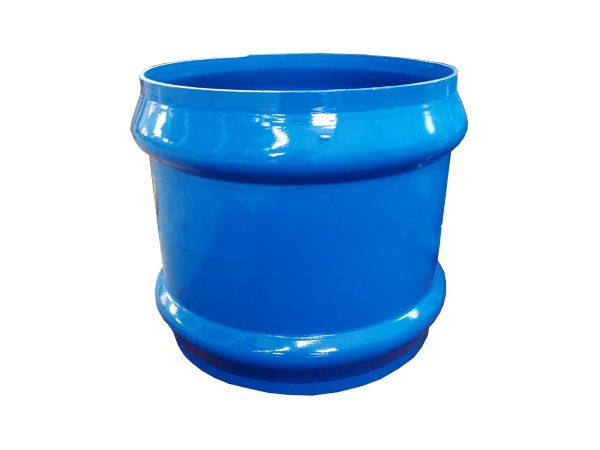
Double-Socket Pipe Coupling
Straight socket coupling for joining two plain-end pipes of the same diameter. Bell-and-spigot style with rubber ring…
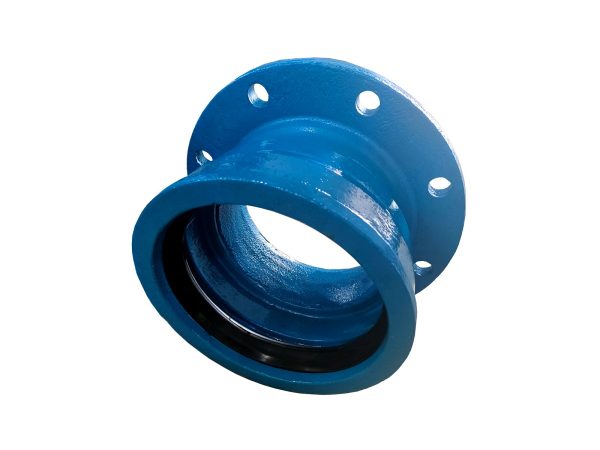
Socket-to-Flange Adapter
Confirm the product and pipe-end mating geometry, receiving end and insertion depth against the supplied interface…