
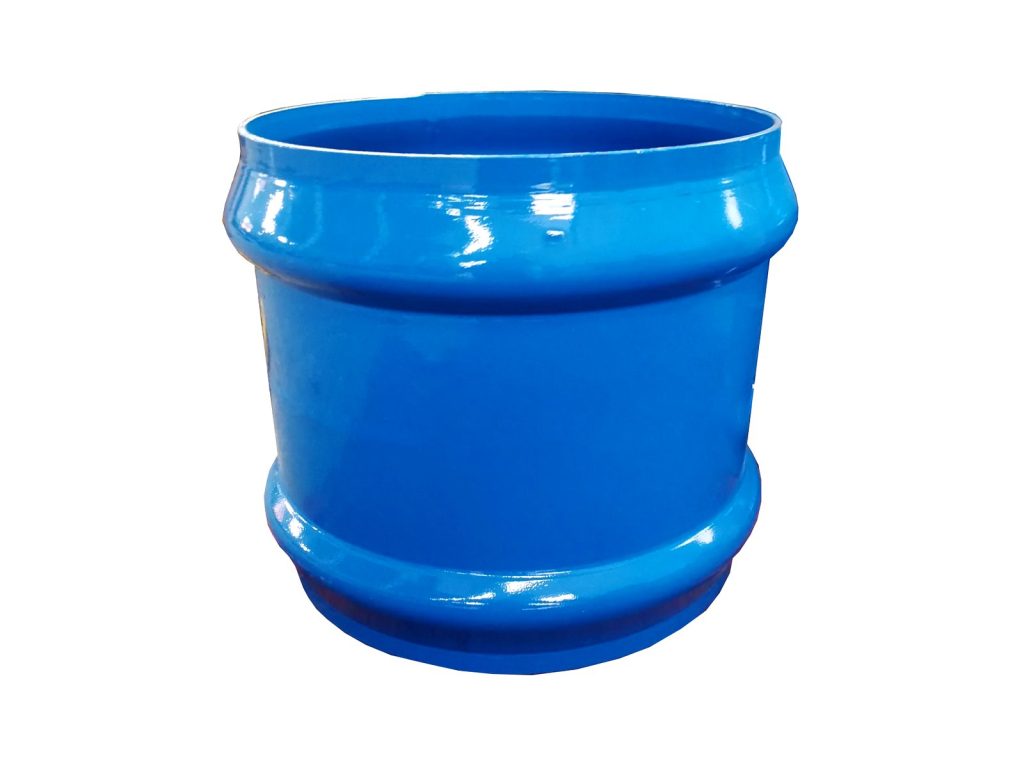
Double-Socket Pipe Coupling
Two socket ends and rubber ring seals join plain pipe ends; confirm actual OD, insertion depth and the required thrust restraint.
Also known as: Double Socket Coupling, Double-Socket Joint Coupling
BS-SJDSUsually replies within 24 hours sales@baoshuopipe.com
Technical Specifications
| Part Number | BS-SJDS |
|---|---|
| Size Range | φ63–φ800 · Custom sizes available beyond the above range |
| Body Material | Q235 Carbon Steel / SS304 / SS316L / Duplex 2205 |
| Seal Material | EPDM |
| Sealing Pressure | ≥1.6MPa (232 PSI) |
| Bolt Specification | M16×80, Grade 8.8 High-Strength Bolts |
| Coating | Epoxy Powder |
| Applicable Pipe Types | UPVC, PVC-M |
| Working Conditions | Standard Pressure |
Custom Orders Available
This product can be customized to your specifications. Contact us with your requirements.
Request Custom QuoteCheck the fit before ordering.
- Measure the actual pipe
- Nominal DN alone does not define the outside diameter. Confirm the pipe material, measured OD and condition.
- Confirm the geometry
- Provide dimensions of the connection or damaged area. Product shape, sealing length and end connections must match the job.
- Match the seal to the service
- Confirm medium, temperature and pressure together. A material name alone is not a service approval.
- Plan a safe installation
- Pipe integrity, isolation and installation procedure require a site-specific assessment. Suitability for live service must be confirmed.
Read the full technical guide7 chapters · complete product description
Product Overview
A double socket coupling joins two plain pipe ends without welding and without threading. Both ends of the fitting are sockets: the pipe ends push in and a rubber ring in each socket is compressed against the pipe as the joint is assembled. On plastic pipe this replaces a fusion joint needing a machine and a dry trench, and it can be taken apart again.
Where it is installed
- Joining plain-end plastic pipe without fusion or threading
- Tie-ins and last connections in a trench
- Positions that may have to be opened again for access
- Repairs where a short length of pipe has been cut out and replaced
Choosing the right size
Send us the pipe outside diameter and material, the line pressure and the medium — the socket and the ring are sized to the pipe, so the actual outside diameter matters more than the nominal size. Fitting: socket joint fittings installation manual; for a change of direction, see the double socket elbow.
A ring seal, not a clamp
It is worth stating plainly, because our repair clamps and our socket fittings work on opposite principles. A bolted split sleeve grips the pipe wall: the fasteners pull the shell down, the gasket is compressed against the pipe, and the friction that results is what stops the sleeve walking along the line. A double socket coupling grips nothing. The rubber ring sits in a groove in the socket, the pipe end passes through it, and the ring is compressed radially between the groove and the pipe outside diameter. Sealing force comes from the ring’s own elastic recovery, and it stays fairly constant because the ring is confined on three sides.
The useful consequence is that a push-fit joint tolerates angular deflection and small ground movement, and it can be taken apart again. The consequence to design for is the other half of the same fact: nothing restrains the pipe ends. Pressure thrust has to be taken by thrust blocks, anchors or a restrained joint. A coupling is not a restraint, and the thrust grows with the square of the bore, so what is adequate on a service connection is nowhere near enough on a trunk main. This build is published at 1.6 MPa, and on an unrestrained line that figure is what sizes the blocks.
Installation
- Cut the pipe square. A bevelled or ragged cut holds the ring on one side only, and that is where it will leak.
- Chamfer and deburr the pipe end. A sharp edge shaves the ring as it passes through the groove.
- Mark the insertion depth on the pipe with a wrap of tape, using the depth marked on the socket.
- Check the ring is not twisted, nicked or hardened, and seat it fully and evenly in its groove.
- Lubricate the ring and the pipe end with the lubricant supplied for the joint. Do not use oil, grease or solvent-cement primer; EPDM swells in hydrocarbon and the joint will weep weeks later.
- Push the pipe home with a lever or a bar. Do not drag it in with a winch or a come-along, because a stretched insertion rolls the ring out of the groove.
- Check the gap between the pipe end and the socket shoulder all the way round. An uneven gap means the pipe is not square in the socket.
- Restrain the joint before pressure testing, and test before backfill.
The three mistakes that account for most call-backs: inserting dry, reusing a ring that has already been rolled once, and pulling back a pipe that went in too far without re-checking the ring.
What to send with an enquiry
- The pipe outside diameter, measured rather than taken from the nominal size. The socket and the ring are sized to the actual outside diameter, and two pipes of the same nominal bore can differ enough to matter.
- Pipe material and wall class. UPVC and PVC-M do not share the same outside diameter at the same nominal bore.
- Working pressure and the surge pressure the line sees.
- The medium and its temperature, because the ring compound follows the medium.
- Whether the joint has to be restrained, and if so how.
- Depth of cover and ground conditions, and whether the joint may have to be reopened later.
The socket range published for this coupling runs from φ63 up to φ800, with both ends made to suit the pipe. Pipe that is oval, badly cut or corroded needs a different family; see the selection note below.
Failure modes, and where this coupling is the wrong part
Three failures account for most of them. The ring rolls out of its groove during insertion and leaves a path straight past the seal, usually because the pipe was pushed in dry or the end was never chamfered. The joint blows apart because it was never restrained; a push-fit coupling takes no end load of its own. And the socket is asked to act as a hinge where the ground moves, so the ring stays in contact on the compression side and lifts on the tension side, and the leak appears at the bottom of a settled trench.
Do not use it where the pipe outside diameter varies along the joint, on oval or corroded pipe, or on a line that must resist its own thrust without anchors. Those positions need a bolted sleeve that grips the pipe and seals over a wider band: the straight pipe repair clamp, or the mechanical joint split repair sleeve where the defect is at a socket rather than in the barrel. For a change of direction, the double socket elbow uses the same joint with the bend built in.
Materials and the standards behind them
The body is Q235 carbon steel to GB/T 700 with an epoxy coating to AWWA C210 / GB/T 18593, or SS304, SS316L or Duplex 2205 to ASTM A240 / GB/T 3280. Epoxy over carbon steel is the normal buried choice for water and is what most municipal specifications expect.
Stainless is specified where the ground is aggressive, where the line carries chlorides, or where the joint sits in a chamber that floods. A coating is a barrier with edges, and a socket has an edge at both ends, which is exactly where a barrier fails first. Duplex 2205 suits coastal and high-chloride ground where the fitting also carries mechanical load.
The ring decides whether the joint seals, so it is chosen from the medium rather than from the fitting: EPDM to BS EN 681-1 / GB/T 21873 for potable water and general service, NBR to BS EN 681-2 where the medium carries oil or fuel. The double socket family follows DIN 28650. Assembly is covered in the socket joint fittings installation manual, and the fields we quote from are on the double socket coupling datasheet.
Documents
Material standards GB/T 700 · ASTM A240 · GB/T 3280 · BS EN 681-1 · GB/T 21873 · AWWA C210 · GB/T 18593 · ISO 898-1 · GB/T 3098.1
Related Products
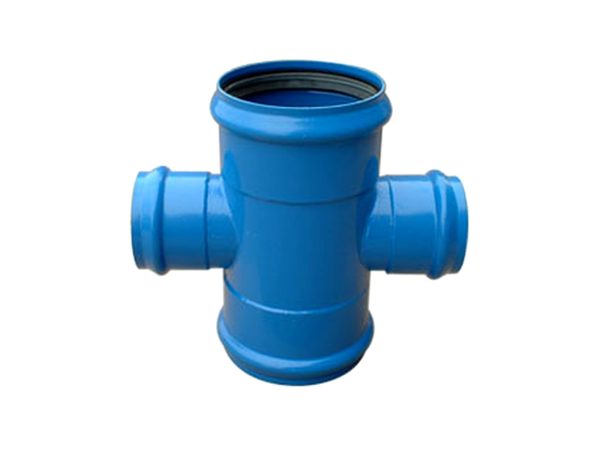
Cross with Four Sockets
Socket-type cross fitting for four-way intersections on plain-end pipes. Four push-fit sockets — used in complex piping…
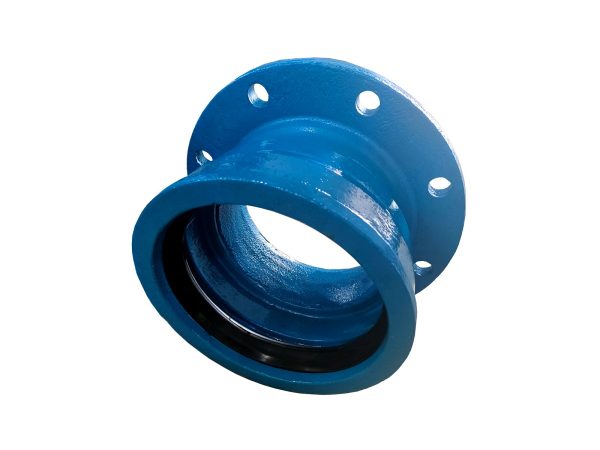
Socket-to-Flange Adapter
Confirm the product and pipe-end mating geometry, receiving end and insertion depth against the supplied interface…
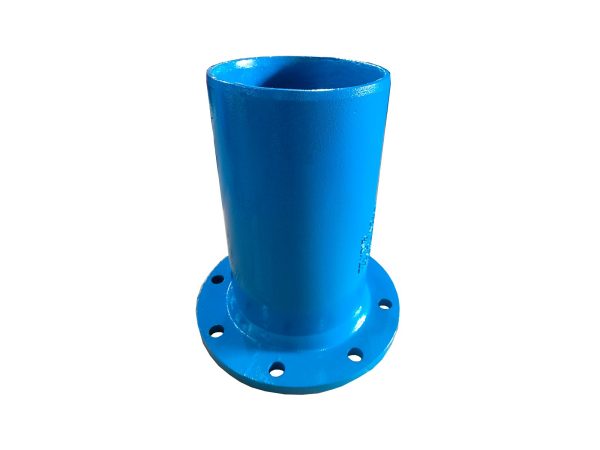
Spigot-to-Flange Adapter
Confirm the product and pipe-end mating geometry, receiving end and insertion depth against the supplied interface…