
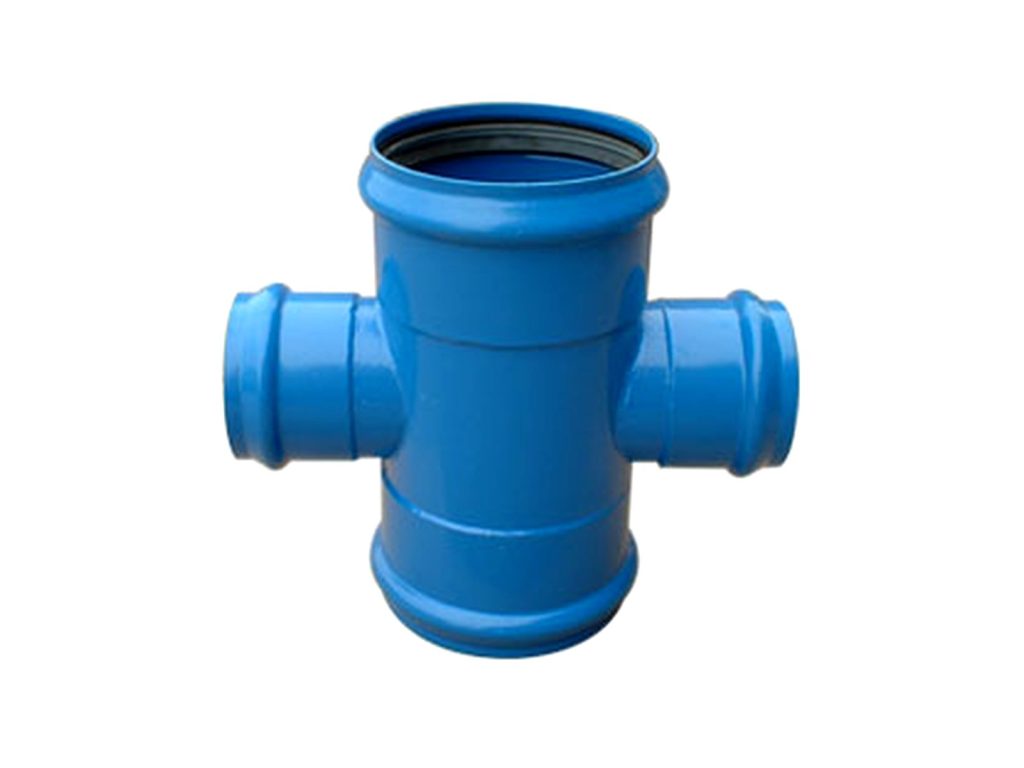
Cross with Four Sockets
A quad socket cross is the four-way version of the push-fit junction: four sockets meeting at one point, each taking a plain pipe end with its own rubber ring. It is used where several lines meet in a…
Also known as: Four-Way Socket Cross, Quad Socket Cross
BS-SJDQUsually replies within 24 hours sales@baoshuopipe.com
Technical Specifications
| Part Number | BS-SJDQ |
|---|---|
| Size Range | φ63–φ800 · Custom sizes available beyond the above range |
| Body Material | Q235 Carbon Steel / SS304 / SS316L / Duplex 2205 |
| Seal Material | EPDM |
| Sealing Pressure | ≥1.6MPa (232 PSI) |
| Bolt Specification | M16×80, Grade 8.8 High-Strength Bolts |
| Coating | Epoxy Powder |
| Applicable Pipe Types | UPVC, PVC-M |
| Working Conditions | Standard Pressure |
Custom Orders Available
This product can be customized to your specifications. Contact us with your requirements.
Request Custom QuoteCheck the fit before ordering.
- Measure the actual pipe
- Nominal DN alone does not define the outside diameter. Confirm the pipe material, measured OD and condition.
- Confirm the geometry
- Provide dimensions of the connection or damaged area. Product shape, sealing length and end connections must match the job.
- Match the seal to the service
- Confirm medium, temperature and pressure together. A material name alone is not a service approval.
- Plan a safe installation
- Pipe integrity, isolation and installation procedure require a site-specific assessment. Suitability for live service must be confirmed.
Read the full technical guide7 chapters · complete product description
Product Overview
A quad socket cross is the four-way version of the push-fit junction: four sockets meeting at one point, each taking a plain pipe end with its own rubber ring. It is used where several lines meet in a small space — manifold positions, plant rooms and compact distribution chambers — because it replaces a fabricated cross and several separate joints with one fitting.
Where it is installed
- Manifold and chamber positions where four lines meet
- Compact plant rooms and distribution nodes
- Plain-end plastic pipework with limited fabrication access
- Positions that may have to be re-opened for maintenance
Choosing the right size
Tell us the outside diameter of each leg, the pipe material and the line pressure; the four sockets are sized individually, so mixed diameters have to be stated up front. Three connections instead of four take the triple socket tee; the fitting sequence is in the installation manual.
The only node in the family where thrust can cancel
A four-way push-fit node is geometrically special. If all four legs are the same diameter, opposite each other and in the same plane, the four pressure thrusts balance and the fitting needs very little anchorage. Nothing else in the socket family behaves that way.
Break the symmetry and the advantage disappears. A smaller branch, an angled leg, or a leg that rises out of the plane leaves a residual thrust pointing in a direction that is not obvious on a drawing. That is the hardest load case in this family to anchor, because there is no single leg to put a block behind. The residual has to be worked out from the layout, not copied from the tee detail.
The second characteristic is assembly. Four pipe ends are offered to one fitting, and each insertion disturbs the three already made. The node normally hangs on a sling while the legs are brought in one at a time, and the geometry has to be proved before the first ring is compressed.
Installation
- Dry-fit the four pipe ends without the rings first and prove the geometry: spacing, level, angle and plane. Correcting it later means undoing four joints.
- Support the cross on a sling or a cradle so its own weight is never carried by a ring.
- Cut, chamfer and deburr all four pipe ends and mark the insertion depth on each.
- Fit the rings, lubricate them and the pipe ends with the specified lubricant.
- Assemble in the order that leaves the least movement for last, which is normally the shortest leg first so the remaining ends can still be levered square.
- Re-check all four insertion depths after the final leg is home. The last insertion is the one that pulls an earlier pipe back out.
- Anchor where the arrangement is asymmetric, working from the layout rather than from a standard detail.
- Backfill in layers and compact evenly on all sides. Compacting one side only rotates the node before the pipe has any support around it.
- Test before backfill, and again after the first pressure cycle if the line is a critical one.
What to send with an enquiry
- The outside diameter of each leg, stated individually. Mixed diameters and unequal legs are normal on a manifold node, and the branch walls may differ too.
- The exact arrangement: which leg is which, the angle of each leg, and the plane the branches lie in.
- Pipe material for each leg.
- Working pressure and surge pressure.
- Medium and temperature, which choose the ring compound.
- Whether the node is symmetric. If it is not, the residual thrust and the restraint plan belong in the enquiry.
- Access, cover depth and whether the node can be reached again for inspection.
A four-way is built to the arrangement, so a dimensioned sketch or a marked-up layout drawing is the fastest route to a quotation. A written description of four legs is workable but slower, and misreads are common.
Failure modes, and where a cross is the wrong part
The residual thrust of an asymmetric node is the failure that catches people out, because the fitting looks fully restrained by four pipes and is not. The next is one rolled ring, usually on the last leg, found only when the line is pressured. The third is node rotation from one-sided compaction: the cross turns before the pipe has any support around it, and three or four sockets end up loaded on one side.
There is also a service case this fitting cannot cover. A push-fit node has no travel, so if the four legs move thermally in different directions, the movement arrives at a point with nowhere to go. That duty belongs to a fitting designed for it, the cross expansion joint, which gives each leg its own sliding section. Using a socket cross in that position transfers the movement into the pipe just outside the sockets.
For three connections rather than four, use the triple socket tee. Where the problem is a cracked or leaking existing node rather than a new connection, the split repair cross wraps it without disturbing the pipework.
Materials and the standards behind them
The body is Q235 carbon steel to GB/T 700 with an epoxy coating to AWWA C210 / GB/T 18593, or SS304, SS316L or Duplex 2205 to ASTM A240 / GB/T 3280.
Coating integrity matters more on a four-way than anywhere else in the family, because there are four socket lips and four crevices in one small fitting, and a manifold node usually sits in a chamber that floods or in ground that stays wet. Epoxy is the standard buried specification, with edge coverage checked on every socket lip and on any weld in the body. Where the node is in saline or contaminated ground, or in a chamber with a high water table, specify a stainless body and remove the coating question altogether. SS316L is the general choice; Duplex 2205 suits high-chloride ground where the node also carries mechanical load.
The rings are EPDM to BS EN 681-1 / GB/T 21873 for potable water, or NBR to BS EN 681-2 where the medium carries oil. This family follows DIN 28650. Fitting is covered in the socket joint fittings installation manual, and the quoting fields are on the quad socket cross datasheet.
Documents
Material standards GB/T 700 · ASTM A240 · GB/T 3280 · BS EN 681-1 · GB/T 21873 · AWWA C210 · GB/T 18593 · ISO 898-1 · GB/T 3098.1
Related Products
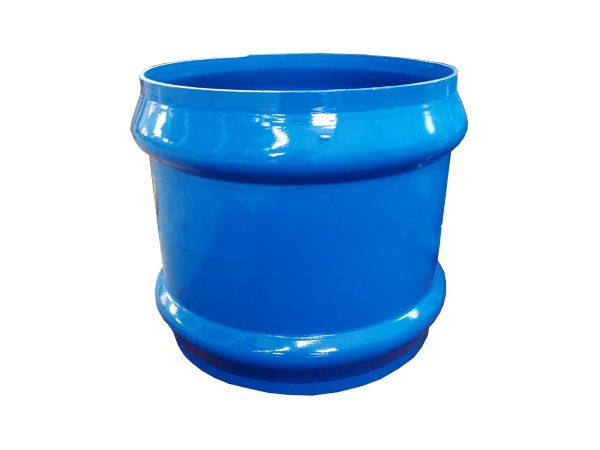
Double-Socket Pipe Coupling
Straight socket coupling for joining two plain-end pipes of the same diameter. Bell-and-spigot style with rubber ring…
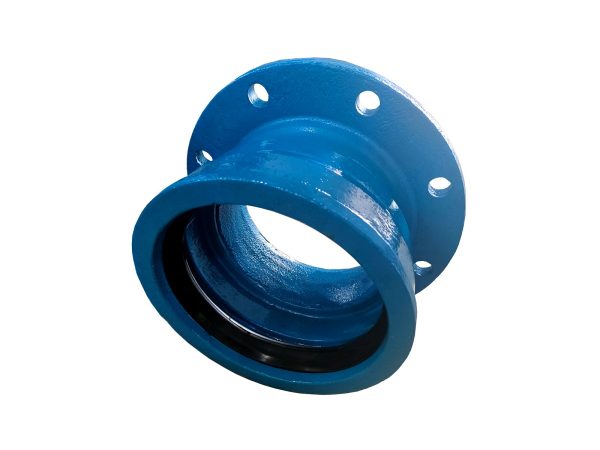
Socket-to-Flange Adapter
Confirm the product and pipe-end mating geometry, receiving end and insertion depth against the supplied interface…
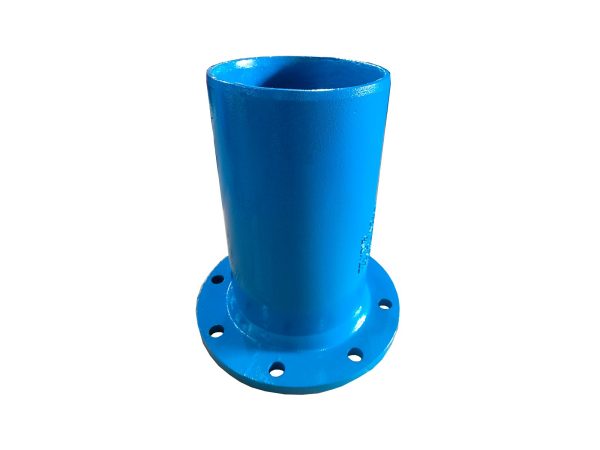
Spigot-to-Flange Adapter
Confirm the product and pipe-end mating geometry, receiving end and insertion depth against the supplied interface…