
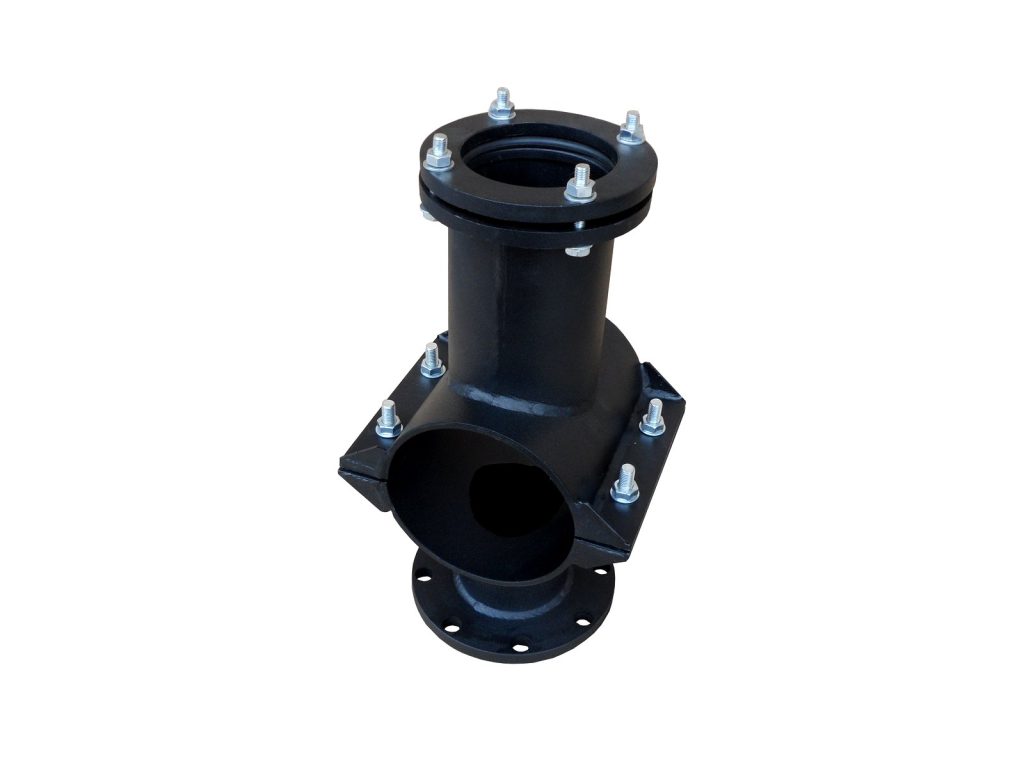
Cross Expansion Joint
A cross expansion joint gives each leg of a four-way junction its own movement. Crossings concentrate stress: four connections meet at one point, each expanding at its own rate, and a rigid junction resolves that difference by loading…
Also known as: Custom Cross Expansion Joint
BS-EJEXUsually replies within 24 hours sales@baoshuopipe.com
Technical Specifications
| Part Number | BS-EJEX |
|---|---|
| Size Range | DN15–DN4000 · Custom sizes available beyond the above range |
| Body Material | Q235 Carbon Steel / SS304 / SS316L / Duplex 2205 |
| Seal Material | EPDM |
| Sealing Pressure | ≥1.6MPa (232 PSI) |
| Bolt Specification | M16×80, Grade 8.8 High-Strength Bolts |
| Coating | Epoxy Powder |
| Applicable Pipe Types | Steel, Ductile Iron, Cast Iron |
| Working Conditions | Standard Pressure |
Custom Orders Available
This product can be customized to your specifications. Contact us with your requirements.
Request Custom QuoteCheck the fit before ordering.
- Measure the actual pipe
- Nominal DN alone does not define the outside diameter. Confirm the pipe material, measured OD and condition.
- Confirm the geometry
- Provide dimensions of the connection or damaged area. Product shape, sealing length and end connections must match the job.
- Match the seal to the service
- Confirm medium, temperature and pressure together. A material name alone is not a service approval.
- Plan a safe installation
- Pipe integrity, isolation and installation procedure require a site-specific assessment. Suitability for live service must be confirmed.
Read the full technical guide7 chapters · complete product description
Product Overview
A cross expansion joint gives each leg of a four-way junction its own movement. Crossings concentrate stress: four connections meet at one point, each expanding at its own rate, and a rigid junction resolves that difference by loading the welds and the branch collars. Measure each leg OD separately and confirm moving ports, directions and travel in the order drawing.
Where it is installed
- Four-way junctions on lines with large temperature swings
- Complex networks where several directions meet at one point
- Crossings that show cracking or distortion at the collars
- Retrofit positions where the junction cannot be re-anchored
Choosing the right size
We need the diameter of every leg, the movement expected on each and the medium with its temperature; the joint is built around the projection of all four connections. For three ports see the tee expansion joint; fitting: expansion joints installation manual.
How a sliding joint seals, and what it does not do
A cross expansion joint is not a push-fit fitting. There is no rubber ring compressed by a pipe end pushed into a socket. Confirm the sealing structure and any telescopic movement for the specified ports in the supplied configuration drawing. That single difference sets every limit of the part.
Axial movement is absorbed. Angular deflection is not, and neither is torsion. A sliding joint is a telescopic element, not a flexible one, so it cannot be used to correct an alignment the pipework got wrong, and it cannot absorb settlement. Where a leg has to tolerate angular movement, the joint belongs to a different family.
A crossing adds a thrust problem. Internal pressure pushes every leg outward, and those forces only cancel if the legs are equal, opposite and symmetric. Where a branch is smaller, or a leg leaves at an angle, a residual force remains. It has to be carried by anchors, guides or a tied joint, never by the soil. That is why the order of work on site is anchors first, joint second.
Installation
- Build the anchors and pipe guides first and let the concrete reach its working strength. A sliding joint set between two unanchored pipe ends simply travels until it separates.
- Set any confirmed moving sections to the installation positions specified by the order drawing for the installation temperature. A joint set hard against one end of its stroke on a cold morning has nothing left when the line heats up.
- Bring each pipe end to the joint. Never use the travel to close a short pipe length or to pull two ends together; that consumes the movement the joint was ordered for.
- Align every leg to its pipe axis and check it before tightening anything. A joint forced into a misaligned line loads the packing on one side and will weep there.
- Check the packing and follower on all four legs. Packing that is dry, pinched or rolled during assembly leaks at the first pressure test.
- Tighten the followers evenly and in stages. Do not use a follower to pull a flange gap closed.
- Keep backfill and bedding clear of the sliding section so the trench does not lock the travel.
- Pressure test before backfill, then re-check the followers after the first thermal cycle.
What to send with an enquiry
- The outside diameter of all four legs. They do not have to match, but each one has to be stated.
- The layout: which leg runs where, the angle between legs, and whether the cross is symmetric in plan and in profile.
- The medium, and the lowest and highest temperature the line actually reaches, not only the design point.
- The movement expected on each leg, and whether it is a start-up movement or a daily cycle.
- The anchor and guide arrangement: where the anchors are, what they are fixed to, and whether any leg is tied.
- Whether the joint is buried, in a chamber or above ground, since that decides coating or alloy.
Say so if one leg will move more than the others. An asymmetric cross is built around the largest movement, and the anchors have to be sized for the residual thrust rather than for the ideal case. Production covers DN15 to DN4000, and sizes outside that are made to order.
Failure modes, and where a cross joint is the wrong part
The failures on this fitting are rarely failures of the metal. A joint installed at the end of its travel either bottoms out or pulls apart at the first cold night. Packing run dry, or tightened on one side, weeps from commissioning. A crossing built with no anchor lets the residual thrust of an asymmetric layout walk the whole assembly along the trench.
Two duties are the wrong fit. Where a leg has to absorb angular deflection or ground settlement, a telescopic element cannot help at all; that service belongs to a flexible coupling or a push-fit socket fitting. Where the line offers no room for anchors and guides, the movement has to be taken out somewhere else in the system.
For three legs use the tee expansion joint. For a straight run use the straight expansion coupling, and for one change of direction the elbow expansion joint. Where the problem is a cracked or leaking cross rather than movement, a sleeve is the cheaper answer: the split repair cross.
Materials and the standards behind them
The body is made in Q235 carbon steel to GB/T 700, or in SS304, SS316L or Duplex 2205 to ASTM A240 / GB/T 3280. Carbon steel with an epoxy coating to AWWA C210 / GB/T 18593 is the normal choice for a chamber or a dry crossing.
Specify stainless where the joint is buried in aggressive ground, where the line carries chlorides, or where the coating cannot be inspected after backfill. The sliding surface is the one place a coating breach matters most, because the movement keeps reopening it. Duplex 2205 suits the same duties where high chloride and mechanical load come together.
Packing is EPDM to BS EN 681-1 / GB/T 21873 for water service, and NBR to BS EN 681-2 where the medium carries oil. The carbon steel build uses grade 8.8 fasteners to ISO 898-1 / GB/T 3098.1; a stainless build is specified with SS304 bolts to ASTM A193 / GB/T 3098.6. Movement, anchoring and medium decide the build, not size alone. The assembly sequence is in the expansion joints installation manual, and the cross expansion joint datasheet lists the fields we quote from.
Documents
Material standards GB/T 700 · ASTM A240 · GB/T 3280 · BS EN 681-1 · GB/T 21873 · AWWA C210 · GB/T 18593 · ISO 898-1 · GB/T 3098.1
Related Products
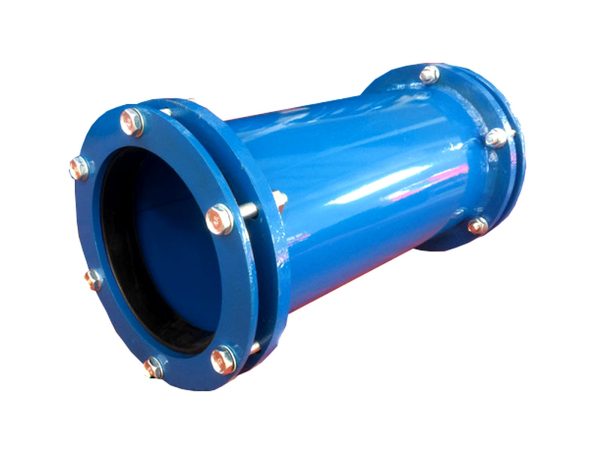
Telescopic Expansion Coupling
Axial expansion coupling for straight pipe sections. Compensates for thermal expansion and contraction — ideal for long…
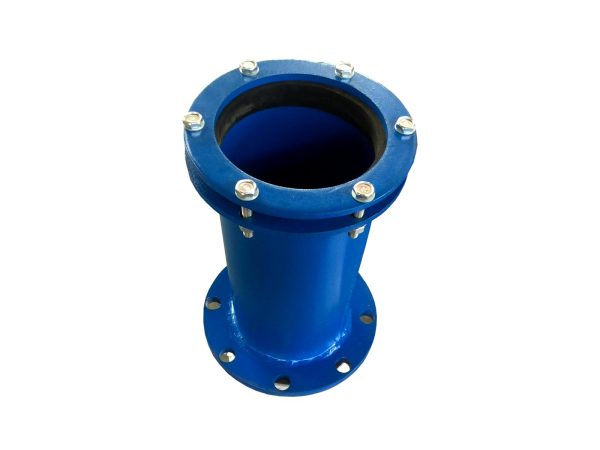
Flanged Expansion Adapter
Single-flange expansion joint for connecting plain-end pipe to flanged valve or fitting. Axial travel with full-face…
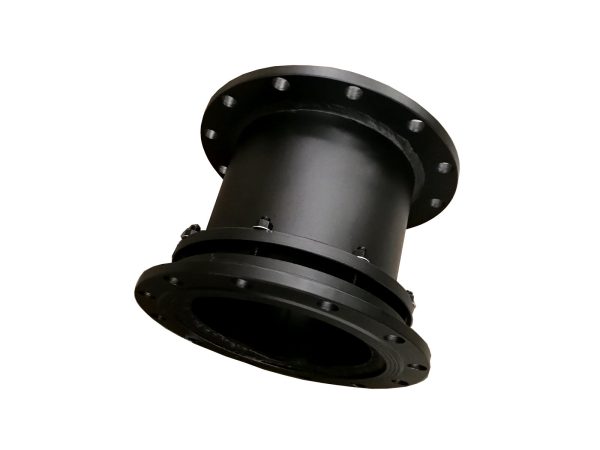
Double-Flange Expansion Joint
Double-flanged expansion joint for installation between two flanged connections. Absorbs axial movement and reduces…