
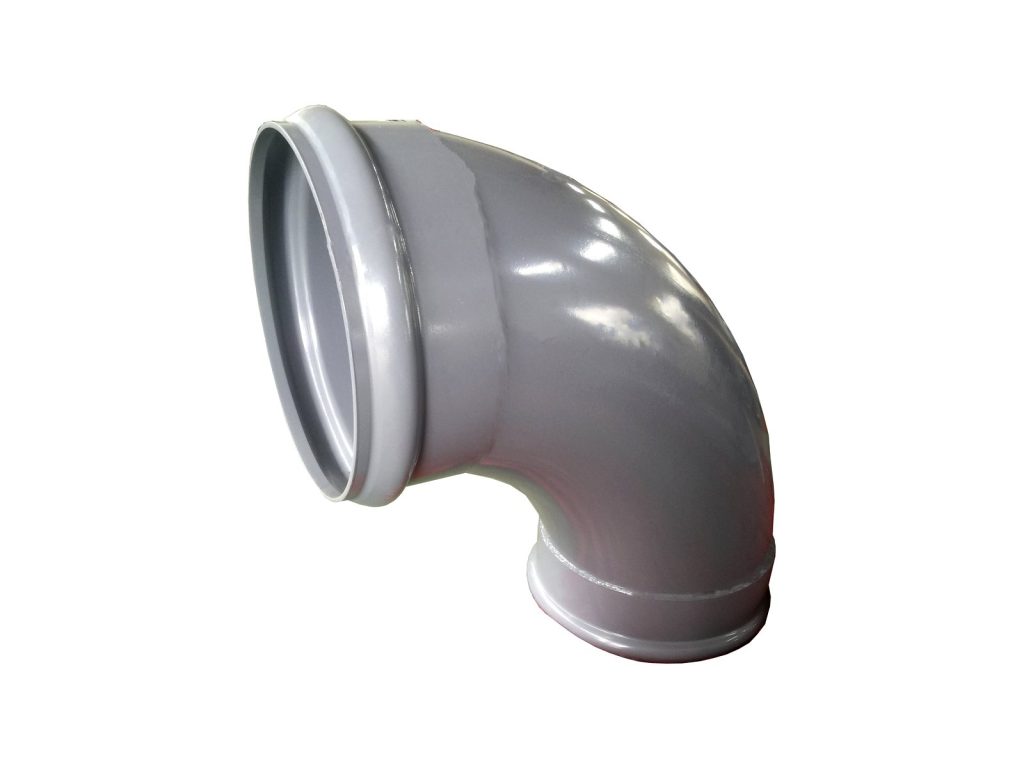
Double-Socket Elbow
A double socket elbow changes direction on plain-end pipe with the same push-fit joint the straight coupling uses. Each socket takes a pipe end with its own rubber ring, so the bend is assembled by pushing the two…
Also known as: Double Socket Bend, Double Socket Elbow
BS-SJDEUsually replies within 24 hours sales@baoshuopipe.com
Technical Specifications
| Part Number | BS-SJDE |
|---|---|
| Size Range | φ63–φ800 · Custom sizes available beyond the above range |
| Body Material | Q235 Carbon Steel / SS304 / SS316L / Duplex 2205 |
| Seal Material | EPDM |
| Sealing Pressure | ≥1.6MPa (232 PSI) |
| Bolt Specification | M16×80, Grade 8.8 High-Strength Bolts |
| Coating | Epoxy Powder |
| Applicable Pipe Types | UPVC, PVC-M |
| Working Conditions | Standard Pressure |
Custom Orders Available
This product can be customized to your specifications. Contact us with your requirements.
Request Custom QuoteCheck the fit before ordering.
- Measure the actual pipe
- Nominal DN alone does not define the outside diameter. Confirm the pipe material, measured OD and condition.
- Confirm the geometry
- Provide dimensions of the connection or damaged area. Product shape, sealing length and end connections must match the job.
- Match the seal to the service
- Confirm medium, temperature and pressure together. A material name alone is not a service approval.
- Plan a safe installation
- Pipe integrity, isolation and installation procedure require a site-specific assessment. Suitability for live service must be confirmed.
Read the full technical guide7 chapters · complete product description
Product Overview
A double socket elbow changes direction on plain-end pipe with the same push-fit joint the straight coupling uses. Each socket takes a pipe end with its own rubber ring, so the bend is assembled by pushing the two pipes home rather than by fusing a bend into the line. The fittings are made in a range of angles, so a change of direction is built from stock.
Where it is installed
- Direction changes on plain-end plastic pipe
- Trench work where a fused bend would need a machine on site
- Positions that may have to be re-opened later
- Damaged bends replaced in a confined trench
Choosing the right size
Tell us the pipe outside diameter and material, the angle you need and the line pressure — the angle is part of the fitting, so it is chosen rather than adjusted. A straight joint in the same system takes the double socket coupling; assembly: installation manual.
A push-fit bend hands you a thrust problem
Two sockets and a bend in the body do three things at once. The direction change happens inside the fitting, so no pipe has to be bent and no fusion machine is needed in the trench. Both connections keep the ring-seal behaviour of the straight coupling, so the bend tolerates the same small angular deflection. And the fitting puts a thrust resultant into the line that a straight coupling never has to deal with.
At a change of direction the internal pressure acts on an area that is no longer balanced, and the resultant pushes the bend off the line along the bisector of the angle. The bigger the turn, the bigger the resultant: a 90 degree bend loads its anchorage roughly twice as hard as each of two 45 degree bends covering the same overall change. That is the main reason to prefer two shallow bends over one sharp one where the trench allows it, and it is the reason a bend is anchored on both legs rather than on the one that looks weaker.
The second thing to know is that the angle is built into the body. A push-fit bend is made at one fixed angle, and the deflection trick sometimes used on site — leaving the spigot short of the socket to gain a degree or two — is not a substitute for ordering the right fitting. It trades a known thrust direction for an unknown one, and it leaves the rubber ring compressed unevenly around its circumference.
Installation
- Confirm the angle against the trench before ordering. Angles are made to a range, and a bend that is close but wrong uses up the deflection allowance of both sockets and leaves nothing for the line to move with.
- Set both legs to the right level and direction and block or bed them before assembly, so the fitting does not have to hold the alignment on its own.
- Cut, chamfer and deburr both pipe ends, then mark the insertion depth on each.
- Check both rings are seated and undamaged, and lubricate them and the pipe ends with the specified lubricant.
- Insert both ends with a lever, keeping the two sockets in the same plane. A bend installed with a twist compresses each ring unevenly and will weep on one side.
- Confirm both insertion depths after the second end is in, because pushing one home tends to pull the other back.
- Cast or compact the thrust restraint against undisturbed ground, never against loose backfill, and do it before the line is pressured.
- Test before backfill, and leave the joint accessible if it is a maintenance point.
What to send with an enquiry
- Pipe outside diameter and material for both legs. Both are made to the pipe, so both have to be stated.
- The angle required, and whether the change is in plan or in profile. A profile change is anchored differently from a plan change and it is often the one that gets missed.
- Working pressure and surge pressure, since both feed the thrust resultant.
- Medium and temperature, which choose the ring compound.
- The restraint arrangement: what the thrust blocks bear on, and whether the joints are to be tied instead.
- Depth of cover and whether the bend sits under traffic.
- Whether both legs are the same diameter, and whether the bend is a reducer as well as a change of direction.
Tell us if the angle is not yet fixed. If it is still moving, a fitting with a set angle is the wrong purchase and the layout should be settled first.
Failure modes, and where a bend is the wrong part
The dominant failure is blow-off at the bend because the anchorage was sized for the straight run rather than for the resultant. The second is a bend installed twisted, so one side of each ring is compressed and the other is not, and the weep starts early. It has a small deflection allowance, and spending it on installation work leaves none for service movement.
Where the angle is unknown or likely to change, a fitting with a fixed angle is the wrong purchase; a double socket coupling plus the pipe’s own allowable deflection may be enough, and where more movement is expected the elbow expansion joint is the part designed for it. Where the problem is a cracked or leaking bend rather than a change of direction, the split repair elbow wraps the existing fitting instead.
Materials and the standards behind them
The body is Q235 carbon steel to GB/T 700 with an epoxy coating to AWWA C210 / GB/T 18593, or SS304, SS316L or Duplex 2205 to ASTM A240 / GB/T 3280.
A bend carries bending load as well as pressure, so the shell wall matters more here than on a straight fitting. Do not downgrade the material or the wall to save on a bend; it is the one fitting in the family that is loaded in two ways at once. Carbon steel with epoxy is the standard buried choice for water mains. Specify stainless where the ground is aggressive, where chlorides are present, or where the joint sits in a chamber that floods, and Duplex 2205 where high chloride and mechanical load come together, which is the usual combination under a road crossing.
The rings are EPDM to BS EN 681-1 / GB/T 21873 for potable water and general service, or NBR to BS EN 681-2 where the medium carries oil. Installation is described in the socket joint fittings installation manual, and the quoting fields are on the double socket elbow datasheet.
Documents
Material standards GB/T 700 · ASTM A240 · GB/T 3280 · BS EN 681-1 · GB/T 21873 · AWWA C210 · GB/T 18593 · ISO 898-1 · GB/T 3098.1
Related Products
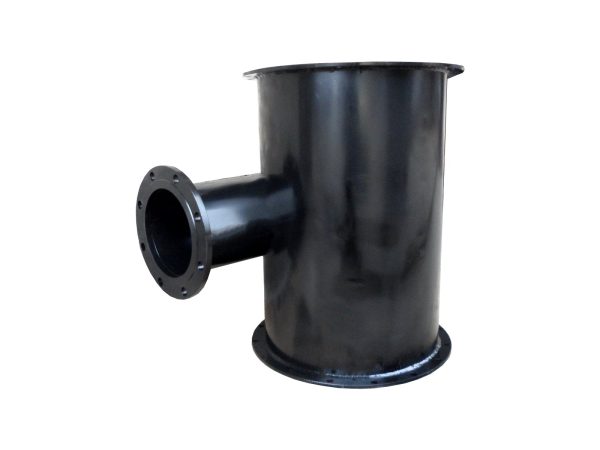
Tee with Three Sockets
Socket-type tee fitting for branch connections on plain-end pipes. Three push-fit sockets with rubber ring seals —…
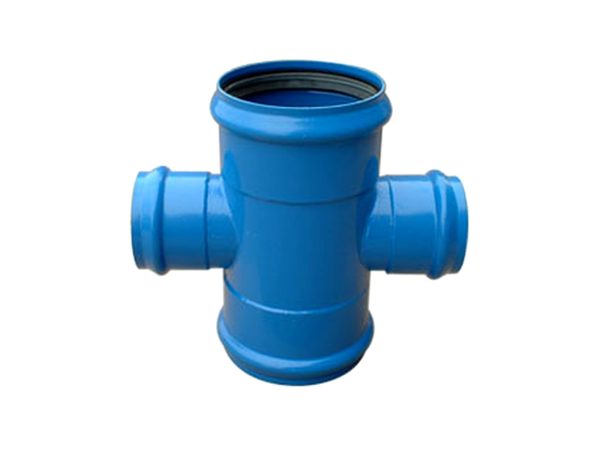
Cross with Four Sockets
Socket-type cross fitting for four-way intersections on plain-end pipes. Four push-fit sockets — used in complex piping…
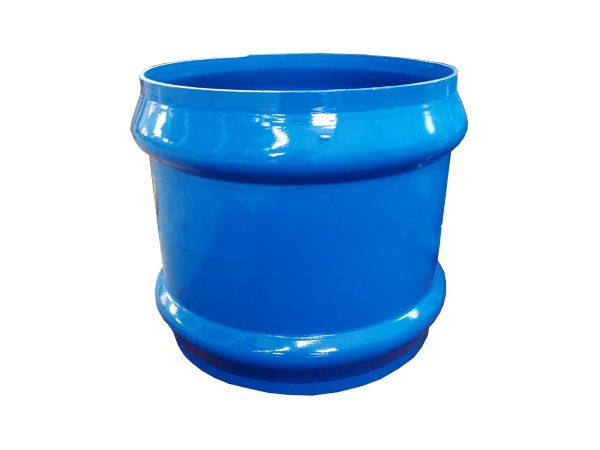
Double-Socket Pipe Coupling
Straight socket coupling for joining two plain-end pipes of the same diameter. Bell-and-spigot style with rubber ring…